Event submissions
Published

This submission belongs to the session S4. Composite and Bonded Structures of the event 1st Corrosion and Materials Degradation Web Conference
Published date
06 May, 2021
Citation
Andrey Krauklis, Predicting environmental ageing of composites: modular approach & multiscale modelling, in Proceedings of 1st Corrosion and Materials Degradation Web Conference, 17 May–19 May 2021, MDPI: Basel, Switzerland, doi: 10.3390/CMDWC2021-09890
Share
Email
Facebook
Twitter
LinkedIn
Predicting environmental ageing of composites: modular approach & multiscale modelling

Andrey Krauklis 1
1. Institute for Mechanics of Materials, University of Latvia
Abstract
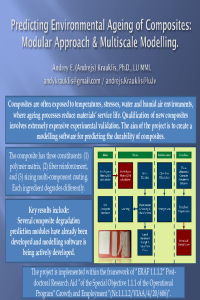
Fibre-reinforced composite materials are used in structural applications in marine, offshore and oil & gas industries due to their light weight and excellent mechanical properties. However, an exposure of such materials to water leads to environmental ageing, weakening the composite over time. A typical design lifetime of offshore composite structures, being in direct contact with water and humid air, spans 25 years or more. Thus, prediction and modelling of the environmental ageing phenomena becomes highly important, especially for predicting the long-term environmental durability. In this work, a systematic and modular approach for quantitatively modelling such phenomena is provided. The modular methodology presented in this work can and should be further expanded – it is multiscale and scalable. In the state-of-the-art, the degradation framework is not complete, yet it is a systematic step towards the multiscale modelling paradigm for composite materials. The topic of environmental durability of composite materials is being actively developed and is expected to continue growing also in the future.
There are 3 constituents in a composite: matrix, fibres and an interphase. Each constituent degrades differently and may also affect the degradation behaviour of each other. Therefore, a modular multiscale approach is preferred. The modules are based on the physics, chemistry of individual constituents’ interaction with the environment, including diffusion, molecular mechanisms and kinetics of environmental ageing.
The methodology is seen as a useful approach for both industry and academia, including such use cases as accelerated testing, prediction of lifetime of composite materials and structures, as well as improving understanding of the environmental ageing effects and the time-dependent properties of composites due to environmental ageing.
Keywords
Composite materials
environmental ageing
multiscale modelling
accelerated ageing
lifetime prediction
Manuscript
sciforum-042887.pdf
Poster
Krauklis-CMDWC1-Poster.pdf
Corrosion of steel in porous media–role of the interfacial zone
The development, validity and applicability of integrated computational corrosion