Event submissions
Published
 10.3390/IECAG2021-09902 (registering DOI)
 This submission belongs to the session S8. Posters of the event The 1st International Electronic Conference on Agronomy
Published date
06 May, 2021
Citation
Justas Mingaila, Simona Paulikienė, Quality assessment of birch sap under ozone treatment, in Proceedings of The 1st International Electronic Conference on Agronomy, 3 May–17 May 2021, MDPI: Basel, Switzerland, doi: 10.3390/IECAG2021-09902
Share
Email
Facebook
Twitter
LinkedIn
Quality assessment of birch sap under ozone treatment
'%3e%3cpath%20d='M12.6647%2010.9104C12.4176%2010.325%2012.0589%209.7933%2011.6088%209.34485C11.16%208.89511%2010.6283%208.53653%2010.0432%208.28891C10.038%208.28629%2010.0327%208.28498%2010.0275%208.28236C10.8437%207.69282%2011.3743%206.73252%2011.3743%205.64907C11.3743%203.85423%209.92005%202.40002%208.12522%202.40002C6.33038%202.40002%204.87618%203.85423%204.87618%205.64907C4.87618%206.73252%205.40677%207.69282%206.22296%208.28367C6.21772%208.28629%206.21248%208.2876%206.20724%208.29022C5.62031%208.53783%205.09365%208.89287%204.64167%209.34616C4.19192%209.79496%203.83334%2010.3266%203.58573%2010.9117C3.34247%2011.4846%203.21128%2012.0987%203.19925%2012.721C3.1989%2012.735%203.20135%2012.7489%203.20646%2012.7619C3.21157%2012.7749%203.21924%2012.7868%203.22901%2012.7968C3.23877%2012.8068%203.25045%2012.8148%203.26334%2012.8202C3.27623%2012.8256%203.29007%2012.8284%203.30406%2012.8284H4.09012C4.14776%2012.8284%204.19362%2012.7825%204.19493%2012.7262C4.22113%2011.7148%204.62726%2010.7676%205.34519%2010.0497C6.08802%209.30686%207.07452%208.89811%208.12522%208.89811C9.17592%208.89811%2010.1624%209.30686%2010.9052%2010.0497C11.6232%2010.7676%2012.0293%2011.7148%2012.0555%2012.7262C12.0568%2012.7839%2012.1027%2012.8284%2012.1603%2012.8284H12.9464C12.9604%2012.8284%2012.9742%2012.8256%2012.9871%2012.8202C13%2012.8148%2013.0117%2012.8068%2013.0214%2012.7968C13.0312%2012.7868%2013.0389%2012.7749%2013.044%2012.7619C13.0491%2012.7489%2013.0515%2012.735%2013.0512%2012.721C13.0381%2012.0947%2012.9084%2011.4856%2012.6647%2010.9104ZM8.12522%207.90243C7.52388%207.90243%206.95792%207.66793%206.53214%207.24215C6.10636%206.81636%205.87185%206.2504%205.87185%205.64907C5.87185%205.04773%206.10636%204.48177%206.53214%204.05599C6.95792%203.63021%207.52388%203.3957%208.12522%203.3957C8.72655%203.3957%209.29252%203.63021%209.7183%204.05599C10.1441%204.48177%2010.3786%205.04773%2010.3786%205.64907C10.3786%206.2504%2010.1441%206.81636%209.7183%207.24215C9.29252%207.66793%208.72655%207.90243%208.12522%207.90243Z'%20fill='%235D1EE1'/%3e%3c/g%3e%3c/svg%3e)
Justas Mingaila 1
Simona Paulikienė 2
1. Faculty of Engineering, Agriculture Academy, Vytautas Magnus University, Studentu Str. 15, 53362 Akademija, Kaunas District, Lithuania
2. Vytautas Magnus University
Abstract
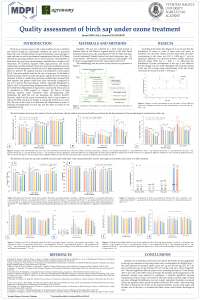
Research have shown that ozone is a potentially viable tool in many areas of the food industry. It is a strong disinfectant. However, it has been observed that relatively little information has been provided on the potential of ozone to reduce the number of microorganisms in the birch sap. Thus, the research investigated the effectiveness of ozone in the reduction of microorganisms in the sap of Silver birch (Betula pendula Roth) and at the same time the influence of ozone on the quality parameters of the sap. For this purpose, fresh sap was ozonated at different intervals: 5min (O3 – 0.087±0.009 mg L–1), 10min, 15min, 20min, 25min and 30min (O3 – 0.99±0.09 mg L–1). In parallel, the effect of ozone on birch sap parameters was studied immediately after ozonation and during storage after 7 days (2ºC temperature) and after 5 days (20ºC temperature). In all cases, the parameters of fresh birch sap (control) are compared with the parameters of ozonated sap. The total number of bacteria, the number of lactic acid bacteria, and the number of yeasts and molds were chosen for the determination of the microbiological contamination of the sap. The influence of ozone on sap color, titratable and active pH acidity, Brix value, monosaccharides, sucrose, total sugars and ascorbic acid content was also evaluated. The results of the microbiological analysis showed that the microbial reduction of the sap after ozone exposure ranged from 2.46 to 6.48 log. The most effective effect of ozone was by ozonating the sap for 25 and 30 min. Ozone affected the sap color purity and tone values, although visually this difference was not visible. The results of other sap quality parameters show that ozonation had no statistically significant effect.
Keywords
birch sap
ozone
treatment
microbiological contamination
quality
Manuscript
sciforum-043392.pdf
Poster
Poster_MDPI_Agronomy.pdf
Effects of plantation establishment on yields and morphological traits of Sida hermaphrodita and Silphium perfoliatum for sustainable biomass production
Biotreatment impact on dynamics of manure composition and the reduction of ammonia emission from agriculture