Event submissions
Published
 10.3390/IECAG2021-09903 (registering DOI)
 This submission belongs to the session S8. Posters of the event The 1st International Electronic Conference on Agronomy
Published date
06 May, 2021
Citation
Vilma Naujokienė, Rolandas Bleizgys, Mantas Rubežius, Biotreatment impact on dynamics of manure composition and the reduction of ammonia emission from agriculture, in Proceedings of The 1st International Electronic Conference on Agronomy, 3 May–17 May 2021, MDPI: Basel, Switzerland, doi: 10.3390/IECAG2021-09903
Share
Email
Facebook
Twitter
LinkedIn
Biotreatment impact on dynamics of manure composition and the reduction of ammonia emission from agriculture

Vilma Naujokienė 1
'%3e%3cpath%20d='M12.6647%2010.9104C12.4176%2010.325%2012.0589%209.7933%2011.6088%209.34485C11.16%208.89511%2010.6283%208.53653%2010.0432%208.28891C10.038%208.28629%2010.0327%208.28498%2010.0275%208.28236C10.8437%207.69282%2011.3743%206.73252%2011.3743%205.64907C11.3743%203.85423%209.92005%202.40002%208.12522%202.40002C6.33038%202.40002%204.87618%203.85423%204.87618%205.64907C4.87618%206.73252%205.40677%207.69282%206.22296%208.28367C6.21772%208.28629%206.21248%208.2876%206.20724%208.29022C5.62031%208.53783%205.09365%208.89287%204.64167%209.34616C4.19192%209.79496%203.83334%2010.3266%203.58573%2010.9117C3.34247%2011.4846%203.21128%2012.0987%203.19925%2012.721C3.1989%2012.735%203.20135%2012.7489%203.20646%2012.7619C3.21157%2012.7749%203.21924%2012.7868%203.22901%2012.7968C3.23877%2012.8068%203.25045%2012.8148%203.26334%2012.8202C3.27623%2012.8256%203.29007%2012.8284%203.30406%2012.8284H4.09012C4.14776%2012.8284%204.19362%2012.7825%204.19493%2012.7262C4.22113%2011.7148%204.62726%2010.7676%205.34519%2010.0497C6.08802%209.30686%207.07452%208.89811%208.12522%208.89811C9.17592%208.89811%2010.1624%209.30686%2010.9052%2010.0497C11.6232%2010.7676%2012.0293%2011.7148%2012.0555%2012.7262C12.0568%2012.7839%2012.1027%2012.8284%2012.1603%2012.8284H12.9464C12.9604%2012.8284%2012.9742%2012.8256%2012.9871%2012.8202C13%2012.8148%2013.0117%2012.8068%2013.0214%2012.7968C13.0312%2012.7868%2013.0389%2012.7749%2013.044%2012.7619C13.0491%2012.7489%2013.0515%2012.735%2013.0512%2012.721C13.0381%2012.0947%2012.9084%2011.4856%2012.6647%2010.9104ZM8.12522%207.90243C7.52388%207.90243%206.95792%207.66793%206.53214%207.24215C6.10636%206.81636%205.87185%206.2504%205.87185%205.64907C5.87185%205.04773%206.10636%204.48177%206.53214%204.05599C6.95792%203.63021%207.52388%203.3957%208.12522%203.3957C8.72655%203.3957%209.29252%203.63021%209.7183%204.05599C10.1441%204.48177%2010.3786%205.04773%2010.3786%205.64907C10.3786%206.2504%2010.1441%206.81636%209.7183%207.24215C9.29252%207.66793%208.72655%207.90243%208.12522%207.90243Z'%20fill='%235D1EE1'/%3e%3c/g%3e%3c/svg%3e)
Rolandas Bleizgys 1
Mantas Rubežius 1
1. Vytautas Magnus university
Abstract
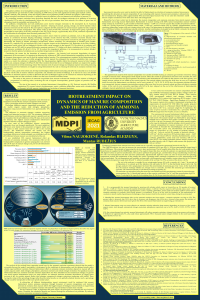
Increasing control of localized air pollution caused by ammonia is identified, including limiting the maximum emissions from animal sites, since approximately 35-40% of ammonia evaporates from barns, while in the case of cattle, ammonia emissions account for as much as 46-50% of the total emissions. By the main priority to save nitrogen losses, in view of the reason for the formation and propagation of ammonia gas — the bacterial and enzymatic degradation of organic components in excrement — it is important to determine the influence of 100% of the natural composition of biotreatments on the emission of ammonia from organic waste and to find the optimal method. For the evaluation of the efficacy of biodegradable compounds, experimental researches were carried out to determine the changes in agrochemical composition and NH3 gas emissions, depending on the storage duration and ventilation intensity. Experimental investigations were carried out on fresh organic livestock waste — a liquid manure with a biodegradable compound — and measurement of the gaseous propagation was obtained via a laser gas analyser using a spectroscopic method with dynamic chamber, specially reconstructed in a wind tunnel. Significant differences in the distribution of ammonia gas in the wind tunnel from the biodegradable compound and control dung periods were determined in the studies: one week and 4-5 weeks. The evaluation of the experimental results is generalized such that the impact of the manure on the biodegradable compound may reduce the ammonia emissions by an average of up to 32%. The maximum effect of the biodegradable compound on gaseous propagation was recorded on average for 28-35 days, and then the effect of biotreatment decreased and disappeared at, on average, 49-56 days. By the saving nitrogen loses priority, manure biotreatment will reduce ammonia emissions, nitrogen losses from manure and inorganic N fertilizers by approximately 5%, also could reduce approximately 5911.1 thousand tonnes nitrogen fertilizer in the world and reduce approximately 5.5 Eur / ha. The biodegradation impact assessment confirmed that increased evaporation of ammonia from manure affects the impact of biotreatment on suppressing gas evaporation.
Keywords
biotreatment
ammonia emissions reduction
manure composition dynamics
environment
management
Manuscript
sciforum-038310.pdf
Poster
Poster_MDPI1.pdf
Quality assessment of birch sap under ozone treatment
THE BIO-EFFECT ON COMPLEX OF DIFFERENT CHARACTERISTICS OF SOIL, TILLAGE AND YIELD IN CROP PRODUCTION