Event submissions
Published
 10.3390/IECAG2021-09906 (registering DOI)
 This submission belongs to the session S8. Posters of the event The 1st International Electronic Conference on Agronomy
Published date
06 May, 2021
Citation
Edward Muntean, Ionut Racz, The dynamics of assimilatory pigments in wheat, in Proceedings of The 1st International Electronic Conference on Agronomy, 3 May–17 May 2021, MDPI: Basel, Switzerland, doi: 10.3390/IECAG2021-09906
Share
Email
Facebook
Twitter
LinkedIn
The dynamics of assimilatory pigments in wheat

Edward Muntean 1,2
'%3e%3cpath%20d='M12.6647%2010.9104C12.4176%2010.325%2012.0589%209.7933%2011.6088%209.34485C11.16%208.89511%2010.6283%208.53653%2010.0432%208.28891C10.038%208.28629%2010.0327%208.28498%2010.0275%208.28236C10.8437%207.69282%2011.3743%206.73252%2011.3743%205.64907C11.3743%203.85423%209.92005%202.40002%208.12522%202.40002C6.33038%202.40002%204.87618%203.85423%204.87618%205.64907C4.87618%206.73252%205.40677%207.69282%206.22296%208.28367C6.21772%208.28629%206.21248%208.2876%206.20724%208.29022C5.62031%208.53783%205.09365%208.89287%204.64167%209.34616C4.19192%209.79496%203.83334%2010.3266%203.58573%2010.9117C3.34247%2011.4846%203.21128%2012.0987%203.19925%2012.721C3.1989%2012.735%203.20135%2012.7489%203.20646%2012.7619C3.21157%2012.7749%203.21924%2012.7868%203.22901%2012.7968C3.23877%2012.8068%203.25045%2012.8148%203.26334%2012.8202C3.27623%2012.8256%203.29007%2012.8284%203.30406%2012.8284H4.09012C4.14776%2012.8284%204.19362%2012.7825%204.19493%2012.7262C4.22113%2011.7148%204.62726%2010.7676%205.34519%2010.0497C6.08802%209.30686%207.07452%208.89811%208.12522%208.89811C9.17592%208.89811%2010.1624%209.30686%2010.9052%2010.0497C11.6232%2010.7676%2012.0293%2011.7148%2012.0555%2012.7262C12.0568%2012.7839%2012.1027%2012.8284%2012.1603%2012.8284H12.9464C12.9604%2012.8284%2012.9742%2012.8256%2012.9871%2012.8202C13%2012.8148%2013.0117%2012.8068%2013.0214%2012.7968C13.0312%2012.7868%2013.0389%2012.7749%2013.044%2012.7619C13.0491%2012.7489%2013.0515%2012.735%2013.0512%2012.721C13.0381%2012.0947%2012.9084%2011.4856%2012.6647%2010.9104ZM8.12522%207.90243C7.52388%207.90243%206.95792%207.66793%206.53214%207.24215C6.10636%206.81636%205.87185%206.2504%205.87185%205.64907C5.87185%205.04773%206.10636%204.48177%206.53214%204.05599C6.95792%203.63021%207.52388%203.3957%208.12522%203.3957C8.72655%203.3957%209.29252%203.63021%209.7183%204.05599C10.1441%204.48177%2010.3786%205.04773%2010.3786%205.64907C10.3786%206.2504%2010.1441%206.81636%209.7183%207.24215C9.29252%207.66793%208.72655%207.90243%208.12522%207.90243Z'%20fill='%235D1EE1'/%3e%3c/g%3e%3c/svg%3e)
Ionut Racz 1,2
1. University of Agricultural Sciences and Veterinary Medicine Cluj Napoca, Romania
2. Research & Development Station for Agriculture, Turda, Romania
Abstract
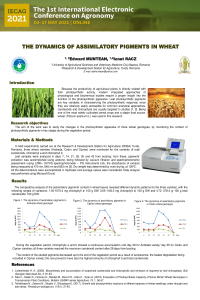
Because the productivity of agricultural plants is directly related with their photosynthetic activity, modern integrated approaches of physiological and biochemical studies require a proper insight into the function of the photosynthetic apparatus. Leaf photosynthetic pigments are key variables in characterizing the photosynthetic response. Being one of the most widely cultivated cereal crops and a staple food source, wheat (Triticum aestivum L.) was targeted in this research. The aim of the work was to study the changes in the photosynthetic apparatus of three wheat genotypes, by monitoring the content of photosynthetic pigments in key stages during the vegetation period. In field experiments carried out at the Research & Development Station for Agriculture Turda, Romania, three wheat varieties (Andrada, Codru and Ciprian) were monitored for the contents of total carotenoids, chlorophyll a and chlorophyll b. Leaf samples were analyzed in days 7, 14, 21, 28, 35 and 42 from booting; from these, pigments’ extraction was accomplished using acetone, being followed by vacuum filtration and spectrophotometric assessment (using aT80+ UV/VIS spectrophotometer – PG Instruments Ltd), the absorbance of extracts being measured at 470 nm, 646 nm and 663 nm. Dry weight was determined by oven drying, at 1050C. The comparative analysis of the assimilatory pigments’ content in wheat leaves revealed different dynamic patterns for the three varieties, with the following ranges of variations: 1.55-1670.4 mg chlorophyll a/ 100 g DW, 0.65-1103.2 mg chlorophyll b/ 100 g DW and 4.72 -278.4 g/ 100 g total carotenoids/ 100 g DW. During the vegetation period, chlorophylls a and b showed a continuous accumulation until day 28 for Andrada variety/ day 35 for Codru and Ciprian varieties; all three varieties reached the maximum carotenoid content after 28 days from booting. The content of the studied pigments decreased up to the end of the vegetation period as a result of senescence, the fastest degradation being recorded in Ciprian variety; this one proved to have also the highest amounts of chlorophyll b and total carotenoids.
Keywords
wheat
chlorophyll a
chlorophyll b
carotenoids
photosynthesis
spectrophotometry
Manuscript
sciforum-043422.pdf
Poster
Wheat Muntean poster.pdf
Evaluation of fruit quality, chromatic parameters and anthocyanins content under foliar application of magnesium and potassium on sweet cherry (Prunus avium L.) cv. Burlat
Isoflavones in Transylvanian soybeans genotypes