Event submissions
Published
 10.3390/IECAG2021-09908 (registering DOI)
 This submission belongs to the session S8. Posters of the event The 1st International Electronic Conference on Agronomy
Published date
06 May, 2021
Citation
Ivo Oliveira, Anne S. Meyer, Sílvia Afonso, Alice Vilela, Piebiep Goufo, Henrique Trindade, Berta Gonçalves, Bioactive compounds, antioxidant activities, fatty acids, and sensorial characteristics of almond (Prunus dulcis) after roasting and blanching, in Proceedings of The 1st International Electronic Conference on Agronomy, 3 May–17 May 2021, MDPI: Basel, Switzerland, doi: 10.3390/IECAG2021-09908
Share
Email
Facebook
Twitter
LinkedIn
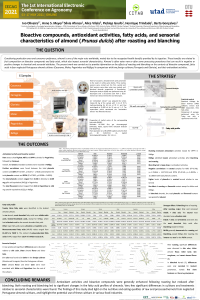
Bioactive compounds, antioxidant activities, fatty acids, and sensorial characteristics of almond (Prunus dulcis) after roasting and blanching
'%3e%3cpath%20d='M12.6647%2010.9104C12.4176%2010.325%2012.0589%209.7933%2011.6088%209.34485C11.16%208.89511%2010.6283%208.53653%2010.0432%208.28891C10.038%208.28629%2010.0327%208.28498%2010.0275%208.28236C10.8437%207.69282%2011.3743%206.73252%2011.3743%205.64907C11.3743%203.85423%209.92005%202.40002%208.12522%202.40002C6.33038%202.40002%204.87618%203.85423%204.87618%205.64907C4.87618%206.73252%205.40677%207.69282%206.22296%208.28367C6.21772%208.28629%206.21248%208.2876%206.20724%208.29022C5.62031%208.53783%205.09365%208.89287%204.64167%209.34616C4.19192%209.79496%203.83334%2010.3266%203.58573%2010.9117C3.34247%2011.4846%203.21128%2012.0987%203.19925%2012.721C3.1989%2012.735%203.20135%2012.7489%203.20646%2012.7619C3.21157%2012.7749%203.21924%2012.7868%203.22901%2012.7968C3.23877%2012.8068%203.25045%2012.8148%203.26334%2012.8202C3.27623%2012.8256%203.29007%2012.8284%203.30406%2012.8284H4.09012C4.14776%2012.8284%204.19362%2012.7825%204.19493%2012.7262C4.22113%2011.7148%204.62726%2010.7676%205.34519%2010.0497C6.08802%209.30686%207.07452%208.89811%208.12522%208.89811C9.17592%208.89811%2010.1624%209.30686%2010.9052%2010.0497C11.6232%2010.7676%2012.0293%2011.7148%2012.0555%2012.7262C12.0568%2012.7839%2012.1027%2012.8284%2012.1603%2012.8284H12.9464C12.9604%2012.8284%2012.9742%2012.8256%2012.9871%2012.8202C13%2012.8148%2013.0117%2012.8068%2013.0214%2012.7968C13.0312%2012.7868%2013.0389%2012.7749%2013.044%2012.7619C13.0491%2012.7489%2013.0515%2012.735%2013.0512%2012.721C13.0381%2012.0947%2012.9084%2011.4856%2012.6647%2010.9104ZM8.12522%207.90243C7.52388%207.90243%206.95792%207.66793%206.53214%207.24215C6.10636%206.81636%205.87185%206.2504%205.87185%205.64907C5.87185%205.04773%206.10636%204.48177%206.53214%204.05599C6.95792%203.63021%207.52388%203.3957%208.12522%203.3957C8.72655%203.3957%209.29252%203.63021%209.7183%204.05599C10.1441%204.48177%2010.3786%205.04773%2010.3786%205.64907C10.3786%206.2504%2010.1441%206.81636%209.7183%207.24215C9.29252%207.66793%208.72655%207.90243%208.12522%207.90243Z'%20fill='%235D1EE1'/%3e%3c/g%3e%3c/svg%3e)
Ivo Oliveira 1

Anne S. Meyer 2
Sílvia Afonso 3

Alice Vilela 4

Piebiep Goufo 3

Henrique Trindade 3

Berta Gonçalves 3
1. Centre for the Research and Technology of AgroEnvironmental and Biological Sciences - CITAB, Universidade de Tra´s-os-Montes e Alto Douro, UTAD,
2. Department of Biotechnology and Biomedicine, Technical University of Denmark, DTU Building 221,
DK-2800 Kgs, 2800 Lyngby, Denmark
3. Centre for the Research and Technology of Agro-Environmental and Biological Sciences—CITAB,
Universidade de Trás-os-Montes e Alto Douro (UTAD), Quinta de Prados, 5000-801 Vila Real, Portugal
4. Biology and Environment Department, CQ-VR, Chemistry Research Centre–Vila Real, Food and Wine
Sensory Lab, University of Trás-os-Montes and Alto Douro, 5001-801 Vila Real, Portugal
Abstract
Considering production area and consumer preference, almond is one of the major nuts worldwide, mainly due to the recognized health benefits provided by its consumption. These benefits are related to the fruit composition of bioactive compounds and fatty acids, which also impact the sensorial characteristics. Almond is often eaten raw or after undergoing some processing procedures that can result in negative or positive changes in chemical and sensorial attributes. The present work was carried out to provide information on the effects of roasting and blanching on the contents of bioactive compounds, fatty acids in four neglected Portuguese almond cultivars (Casanova, Molar, Pegarinhos and Refêgo) in comparison with two foreign cultivars (Ferragnès and Glorieta), and their antioxidant activities and sensorial characteristics. Overaal, results show that levels of bioactive compounds (total phenolics and total flavonoids) and antioxidant activities increased with roasting (except for Refêgo), and decreased with blanching. The fatty acid profiles of raw kernels of all cultivars were generally identical, although Refêgo exhibited a high content of α‐linolenic acid. Following roasting and blanching, the content of polyunsaturated fatty acids (e.g., γ-linolenic and α‐linolenic acid) increased while those of saturated fatty acids (e.g., palmitic acid), monounsaturated fatty acids (e.g., oleic and nervonic acids), and several health lipid indices (e.g., atherogenic and thrombogenic index) decreased. Roasting positively affected the perception of skin color and sweetness of Ferragnès and Glorieta, and skin roughness of Molar and Pegarinhos. Blanching led to positive changes in textural properties of Refêgo and Pegarinhos. This work offers novel data on the nutritive and eating qualities of neglected almond cultivars of interest to the scientific community, growers, and consumers. The finding reported here could be useful in the selection or rejection of fruits from a given cultivar to be used by the industry, and might motivate efforts for genotype conservation and fruit valorization.
Keywords
Prunus dulcis
processing
sensorial analysis
fatty acids
antioxidant
Manuscript
sciforum-043645.pdf
Poster
Poster IECAG.pdf
Isoflavones in Transylvanian soybeans genotypes
EFFECTS OF GLYPHOSATE APPLICATION ON SOIL CHEMISTRY TO CONTROL INVASIVE PLANTS IN A MEDITERRANEAN ECOSYSTEM