Event submissions
Published

This submission belongs to the session S8. Posters of the event The 1st International Electronic Conference on Agronomy
Published date
06 May, 2021
Citation
Tomasz Wójtowicz, Andrzej Zieliński, Variability of selected traits in meadow fescue (Festuca pratensis Huds.) plants with different susceptibility to seed shattering, in Proceedings of The 1st International Electronic Conference on Agronomy, 3 May–17 May 2021, MDPI: Basel, Switzerland, doi: 10.3390/IECAG2021-09910
Share
Email
Facebook
Twitter
LinkedIn
Variability of selected traits in meadow fescue (Festuca pratensis Huds.) plants with different susceptibility to seed shattering
'%3e%3cpath%20d='M12.6647%2010.9104C12.4176%2010.325%2012.0589%209.7933%2011.6088%209.34485C11.16%208.89511%2010.6283%208.53653%2010.0432%208.28891C10.038%208.28629%2010.0327%208.28498%2010.0275%208.28236C10.8437%207.69282%2011.3743%206.73252%2011.3743%205.64907C11.3743%203.85423%209.92005%202.40002%208.12522%202.40002C6.33038%202.40002%204.87618%203.85423%204.87618%205.64907C4.87618%206.73252%205.40677%207.69282%206.22296%208.28367C6.21772%208.28629%206.21248%208.2876%206.20724%208.29022C5.62031%208.53783%205.09365%208.89287%204.64167%209.34616C4.19192%209.79496%203.83334%2010.3266%203.58573%2010.9117C3.34247%2011.4846%203.21128%2012.0987%203.19925%2012.721C3.1989%2012.735%203.20135%2012.7489%203.20646%2012.7619C3.21157%2012.7749%203.21924%2012.7868%203.22901%2012.7968C3.23877%2012.8068%203.25045%2012.8148%203.26334%2012.8202C3.27623%2012.8256%203.29007%2012.8284%203.30406%2012.8284H4.09012C4.14776%2012.8284%204.19362%2012.7825%204.19493%2012.7262C4.22113%2011.7148%204.62726%2010.7676%205.34519%2010.0497C6.08802%209.30686%207.07452%208.89811%208.12522%208.89811C9.17592%208.89811%2010.1624%209.30686%2010.9052%2010.0497C11.6232%2010.7676%2012.0293%2011.7148%2012.0555%2012.7262C12.0568%2012.7839%2012.1027%2012.8284%2012.1603%2012.8284H12.9464C12.9604%2012.8284%2012.9742%2012.8256%2012.9871%2012.8202C13%2012.8148%2013.0117%2012.8068%2013.0214%2012.7968C13.0312%2012.7868%2013.0389%2012.7749%2013.044%2012.7619C13.0491%2012.7489%2013.0515%2012.735%2013.0512%2012.721C13.0381%2012.0947%2012.9084%2011.4856%2012.6647%2010.9104ZM8.12522%207.90243C7.52388%207.90243%206.95792%207.66793%206.53214%207.24215C6.10636%206.81636%205.87185%206.2504%205.87185%205.64907C5.87185%205.04773%206.10636%204.48177%206.53214%204.05599C6.95792%203.63021%207.52388%203.3957%208.12522%203.3957C8.72655%203.3957%209.29252%203.63021%209.7183%204.05599C10.1441%204.48177%2010.3786%205.04773%2010.3786%205.64907C10.3786%206.2504%2010.1441%206.81636%209.7183%207.24215C9.29252%207.66793%208.72655%207.90243%208.12522%207.90243Z'%20fill='%235D1EE1'/%3e%3c/g%3e%3c/svg%3e)
Tomasz Wójtowicz 1
Andrzej Zieliński 1
1. University of Agriculture in Krakow, Faculty of Agriculture and Economics, Department of Plant Breeding, Physiology and Seed Science
Abstract
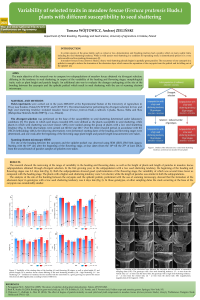
In meadow fescue (Festuca pratensis Huds.), a perennial fodder grass plant characterized by high quality and yield potential, seed shattering makes seed production difficult. The objective of the research was to compare two subpopulations, differing in a tendency to seed shattering, in respect of variability in the beginning of the heading and flowering stages, morphological traits (plant height and panicle length), and changes occurring at the site of the bonding between the caryopsis and the pedicel. The subpopulations were obtained by divergent selection carried out in the years 2008-2011 on four meadow fescue cultivars. The selected genotypes were cloned and tested in the years 2011-2017, and further selection was performed. Significant variability in years and subpopulations in respect of the tested traits was found. The subpopulation with a low tendency to seed shattering was characterized by a 2-3-day delay in the beginning of the heading and flowering stages. However, in both the subpopulations good flowering stage synchronization was found, its variability being several times smaller compared with the heading stage. Between the starting dates of these stages a significant correlation was found (r=0.828; p<0.01). The clones with a high tendency to seed shattering were approximately 7 cm shorter, while the length of panicles was similar in both the subpopulations. The analysis with the use of a scanning microscope showed that in genotypes with a low tendency to shattering the formation of the abscission layer was four days late, which may confirm the effectiveness of the carried out selection.
Keywords
abscission
Festuca pratensis
flowering
heading
morphological traits
seed shattering
Manuscript
sciforum-043824.pdf
Poster
poster_Wojtowicz.pdf
EFFECTS OF GLYPHOSATE APPLICATION ON SOIL CHEMISTRY TO CONTROL INVASIVE PLANTS IN A MEDITERRANEAN ECOSYSTEM
Mediterranean lupines as an alternative protein source to soybean