Event submissions
Published
 10.3390/ECA2021-09917 (registering DOI)
 This submission belongs to the session B. Antimicrobial Discovery, Development, Stewardship and Susceptibility Testing of the event The 1st International Electronic Conference on Antibiotics
Published date
06 May, 2021
Citation
Zannat Urbi, Nina Suhaity Azmi, Md. Sanower Hossain, Antimicrobial Role of Glycosaminoglycans: Beyond Bacterial Adhesion to Host Cell, in Proceedings of The 1st International Electronic Conference on Antibiotics, 8 May–17 May 2021, MDPI: Basel, Switzerland, doi: 10.3390/ECA2021-09917
Share
Email
Facebook
Twitter
LinkedIn
Antimicrobial Role of Glycosaminoglycans: Beyond Bacterial Adhesion to Host Cell
'%3e%3cpath%20d='M12.6647%2010.9104C12.4176%2010.325%2012.0589%209.7933%2011.6088%209.34485C11.16%208.89511%2010.6283%208.53653%2010.0432%208.28891C10.038%208.28629%2010.0327%208.28498%2010.0275%208.28236C10.8437%207.69282%2011.3743%206.73252%2011.3743%205.64907C11.3743%203.85423%209.92005%202.40002%208.12522%202.40002C6.33038%202.40002%204.87618%203.85423%204.87618%205.64907C4.87618%206.73252%205.40677%207.69282%206.22296%208.28367C6.21772%208.28629%206.21248%208.2876%206.20724%208.29022C5.62031%208.53783%205.09365%208.89287%204.64167%209.34616C4.19192%209.79496%203.83334%2010.3266%203.58573%2010.9117C3.34247%2011.4846%203.21128%2012.0987%203.19925%2012.721C3.1989%2012.735%203.20135%2012.7489%203.20646%2012.7619C3.21157%2012.7749%203.21924%2012.7868%203.22901%2012.7968C3.23877%2012.8068%203.25045%2012.8148%203.26334%2012.8202C3.27623%2012.8256%203.29007%2012.8284%203.30406%2012.8284H4.09012C4.14776%2012.8284%204.19362%2012.7825%204.19493%2012.7262C4.22113%2011.7148%204.62726%2010.7676%205.34519%2010.0497C6.08802%209.30686%207.07452%208.89811%208.12522%208.89811C9.17592%208.89811%2010.1624%209.30686%2010.9052%2010.0497C11.6232%2010.7676%2012.0293%2011.7148%2012.0555%2012.7262C12.0568%2012.7839%2012.1027%2012.8284%2012.1603%2012.8284H12.9464C12.9604%2012.8284%2012.9742%2012.8256%2012.9871%2012.8202C13%2012.8148%2013.0117%2012.8068%2013.0214%2012.7968C13.0312%2012.7868%2013.0389%2012.7749%2013.044%2012.7619C13.0491%2012.7489%2013.0515%2012.735%2013.0512%2012.721C13.0381%2012.0947%2012.9084%2011.4856%2012.6647%2010.9104ZM8.12522%207.90243C7.52388%207.90243%206.95792%207.66793%206.53214%207.24215C6.10636%206.81636%205.87185%206.2504%205.87185%205.64907C5.87185%205.04773%206.10636%204.48177%206.53214%204.05599C6.95792%203.63021%207.52388%203.3957%208.12522%203.3957C8.72655%203.3957%209.29252%203.63021%209.7183%204.05599C10.1441%204.48177%2010.3786%205.04773%2010.3786%205.64907C10.3786%206.2504%2010.1441%206.81636%209.7183%207.24215C9.29252%207.66793%208.72655%207.90243%208.12522%207.90243Z'%20fill='%235D1EE1'/%3e%3c/g%3e%3c/svg%3e)
Zannat Urbi 1
Nina Suhaity Azmi 1

Md. Sanower Hossain 2
1. Department of Industrial Biotechnology, Faculty of Industrial Sciences & Technology, Universiti Malaysia Pahang, 26300 Kuantan, Pahang, Malaysia
2. Department of Biomedical Science, Kulliyyah of Allied Health Sciences, International Islamic University Malaysia, 25200 Kuantan, Malaysia
Abstract
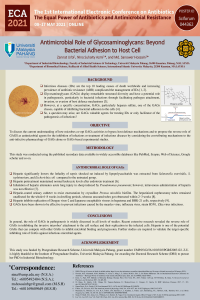
Glycosaminoglycans (GAGs) are complex unbranched polysaccharides widely found in intracellular compartments, at the cell surface, and in the extracellular environment in living organisms. This availability facilitates attachment of a wide variety of microbial pathogens, including viruses, bacteria, parasites, and fungi, to the host cells and invasion or evasion of host defence mechanisms. There are no doubt GAGs has a potential role in pathogenesis in infectious diseases, and at the same time, GAGs have multiple applications in the medical, veterinary, pharmaceutical, and cosmetic fields. However, little is known about the mechanistic role of GAGs as therapeutic agents, particularly antimicrobial agents. Several documented literature reported primary findings of the antibacterial, antiviral and antiparasitic role of GAGs in controlling infections. Heparin, one kind of GAGs, can prevent biofilm formation for a more extended period in ureteral stents. Desulfated heparins also reduced bacterial adhesion to different extents depending on the bacterium and the sulfated residue. Are GAGs valuable agents for the treatment of infectious diseases or only facilitator of the pathogenesis of infections? This perspective study aims to discuss the current understanding of how microbes co-opt GAGs activities to bypass host defence mechanisms and to propose the reverse role of GAGS as antimicrobial agents for the inhibition of infections or treatment of infectious diseases by considering the contributing mechanisms to the anti-infective pharmacology of GAGs alone or GAGs-based experimental studies.
Keywords
antimicrobials
glycosaminoglycans
pathogenic bacteria
infection
host interaction
Manuscript
sciforum-044362.pdf
Poster
ECA2021 GAGs.pdf
Multidrug-resistant methicillin-resistant Staphylococcus aureus (MRSA) isolated from quails
Antimicrobial resistance and susceptibility testing in cystic fibrosis lung infections