Event submissions
Published

This submission belongs to the session S9. Corrosion and Degradation of Biomaterials of the event 1st Corrosion and Materials Degradation Web Conference
Published date
08 May, 2021
Citation
Zoran Bobić, Bojan Petrović, Sanja Kojić, Vladimir Terek, Branko Škorić, Lazar Kovačević, Pal Terek, Nano topography evaluation of NiTi alloy exposed to artificial saliva and different mouthwashes, in Proceedings of 1st Corrosion and Materials Degradation Web Conference, 17 May–19 May 2021, MDPI: Basel, Switzerland, doi: 10.3390/CMDWC2021-09948
Share
Email
Facebook
Twitter
LinkedIn
Nano topography evaluation of NiTi alloy exposed to artificial saliva and different mouthwashes
'%3e%3cpath%20d='M12.6647%2010.9104C12.4176%2010.325%2012.0589%209.7933%2011.6088%209.34485C11.16%208.89511%2010.6283%208.53653%2010.0432%208.28891C10.038%208.28629%2010.0327%208.28498%2010.0275%208.28236C10.8437%207.69282%2011.3743%206.73252%2011.3743%205.64907C11.3743%203.85423%209.92005%202.40002%208.12522%202.40002C6.33038%202.40002%204.87618%203.85423%204.87618%205.64907C4.87618%206.73252%205.40677%207.69282%206.22296%208.28367C6.21772%208.28629%206.21248%208.2876%206.20724%208.29022C5.62031%208.53783%205.09365%208.89287%204.64167%209.34616C4.19192%209.79496%203.83334%2010.3266%203.58573%2010.9117C3.34247%2011.4846%203.21128%2012.0987%203.19925%2012.721C3.1989%2012.735%203.20135%2012.7489%203.20646%2012.7619C3.21157%2012.7749%203.21924%2012.7868%203.22901%2012.7968C3.23877%2012.8068%203.25045%2012.8148%203.26334%2012.8202C3.27623%2012.8256%203.29007%2012.8284%203.30406%2012.8284H4.09012C4.14776%2012.8284%204.19362%2012.7825%204.19493%2012.7262C4.22113%2011.7148%204.62726%2010.7676%205.34519%2010.0497C6.08802%209.30686%207.07452%208.89811%208.12522%208.89811C9.17592%208.89811%2010.1624%209.30686%2010.9052%2010.0497C11.6232%2010.7676%2012.0293%2011.7148%2012.0555%2012.7262C12.0568%2012.7839%2012.1027%2012.8284%2012.1603%2012.8284H12.9464C12.9604%2012.8284%2012.9742%2012.8256%2012.9871%2012.8202C13%2012.8148%2013.0117%2012.8068%2013.0214%2012.7968C13.0312%2012.7868%2013.0389%2012.7749%2013.044%2012.7619C13.0491%2012.7489%2013.0515%2012.735%2013.0512%2012.721C13.0381%2012.0947%2012.9084%2011.4856%2012.6647%2010.9104ZM8.12522%207.90243C7.52388%207.90243%206.95792%207.66793%206.53214%207.24215C6.10636%206.81636%205.87185%206.2504%205.87185%205.64907C5.87185%205.04773%206.10636%204.48177%206.53214%204.05599C6.95792%203.63021%207.52388%203.3957%208.12522%203.3957C8.72655%203.3957%209.29252%203.63021%209.7183%204.05599C10.1441%204.48177%2010.3786%205.04773%2010.3786%205.64907C10.3786%206.2504%2010.1441%206.81636%209.7183%207.24215C9.29252%207.66793%208.72655%207.90243%208.12522%207.90243Z'%20fill='%235D1EE1'/%3e%3c/g%3e%3c/svg%3e)
Zoran Bobić 1

Bojan Petrović 2

Sanja Kojić 1
Vladimir Terek 1
Branko Škorić 1
Lazar Kovačević 1

Pal Terek 1
1. University of Novi Sad, Faculty of Technical Sciences, Trg Dositeja Obradovića 6, Novi Sad, 21000, Serbia
2. University of Novi Sad, Faculty of Medicine, Hajduk Veljkova 3, Novi Sad, 21000, Serbia
Abstract
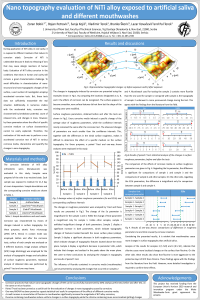
Evaluation of NiTi alloy corrosion behavior in conditions that exist in the oral cavity still remains a great characterization challenge. Such characterization is commonly simplified by avoiding the use of non-accelerated corrosion tests. Accordingly, the difficulties in characterization of material changes on a nano level are avoided and results do not sufficiently resemble the real situation. Therefore, the motivation of this work was to perform a non-accelerated corrosion test, characterize the nano topographic changes and to evaluate the obtained results by statistical methods. In this study, we examined the behavior of NiTi alloy (50% Ni, 50% Ti) archwires exposed for 21 days to different corrosive mediums: artificial saliva, Eludril®, Aquafresh® and Listerine®. The corrosion was characterized by means of changes in surface topography. This was done by contact mode atomic force microscopy on all samples at 5 locations of 10x10 µm areas, before and after the corrosion tests. Image analysis software was used for analysis of topographic images and calculation of surface roughness parameters Sa and S10z. The changes of roughness parameters were statistically analyzed by Anova. Sa and S10z parameters displayed changes with trend for all treatments. However, the confidence interval for all cases was overlapped. Statistically analysed data revealed that all samples exposed to mouthwashes displayed significant changes in parameter S10z, while only samples exposed to Aquafresh® and Eludril® displayed significant changes in parameter Sa. On the other side, sample exposed to artificial saliva did not display significant changes in any parameter. As such it is implied that mouthwashes have significantly higher effect on surface topography. Differences in confidence interval of Sa parameter indicate that changes in roughness parameters caused by corrosion does not depend on the initial surface roughness. In this study statistical analysis methods have been proven as a useful tool in characterization of nano topographic changes caused by corrosion in real conditions.
Keywords
biomaterial
NiTi
corrosion
artificial saliva
mouthwash
AFM
topography
nano changes
Anova
Manuscript
Nano topography evaluation of NiTi alloy exposed to artificial saliva and different mouthwashes.pdf
Poster
Nano topography evaluation of NiTi alloy exposed to artificial saliva and different mouthwashes.pdf
Cork composites degradation - exposure to ultraviolet
Formation of hybrid bioactive coatings on magnesium alloy for biomedical applications