Event submissions
Published

This submission belongs to the session S15. General Corrosion Session of the event 1st Corrosion and Materials Degradation Web Conference
Published date
08 May, 2021
Citation
Vonica Denisa, Mitrica Dumitru, Burada Marian, Olaru Mihai Tudor, Serban Beatrice Adriana, Badea Cristina Ioana, Anasiei Ioana, Corrosion behavior of Al₇Cu₀.₂Si₀.₂Zn₀.₂Mg₀.₁ complex concentrated alloy, in 3wt% and 5wt% NaCl solution, in Proceedings of 1st Corrosion and Materials Degradation Web Conference, 17 May–19 May 2021, MDPI: Basel, Switzerland, doi: 10.3390/CMDWC2021-09953
Share
Email
Facebook
Twitter
LinkedIn
Corrosion behavior of Al7Cu0.2Si0.2Zn0.2Mg0.1 complex concentrated alloy, in 3wt% and 5wt% NaCl solution

Vonica Denisa 1

Mitrica Dumitru 1
'%3e%3cpath%20d='M12.6647%2010.9104C12.4176%2010.325%2012.0589%209.7933%2011.6088%209.34485C11.16%208.89511%2010.6283%208.53653%2010.0432%208.28891C10.038%208.28629%2010.0327%208.28498%2010.0275%208.28236C10.8437%207.69282%2011.3743%206.73252%2011.3743%205.64907C11.3743%203.85423%209.92005%202.40002%208.12522%202.40002C6.33038%202.40002%204.87618%203.85423%204.87618%205.64907C4.87618%206.73252%205.40677%207.69282%206.22296%208.28367C6.21772%208.28629%206.21248%208.2876%206.20724%208.29022C5.62031%208.53783%205.09365%208.89287%204.64167%209.34616C4.19192%209.79496%203.83334%2010.3266%203.58573%2010.9117C3.34247%2011.4846%203.21128%2012.0987%203.19925%2012.721C3.1989%2012.735%203.20135%2012.7489%203.20646%2012.7619C3.21157%2012.7749%203.21924%2012.7868%203.22901%2012.7968C3.23877%2012.8068%203.25045%2012.8148%203.26334%2012.8202C3.27623%2012.8256%203.29007%2012.8284%203.30406%2012.8284H4.09012C4.14776%2012.8284%204.19362%2012.7825%204.19493%2012.7262C4.22113%2011.7148%204.62726%2010.7676%205.34519%2010.0497C6.08802%209.30686%207.07452%208.89811%208.12522%208.89811C9.17592%208.89811%2010.1624%209.30686%2010.9052%2010.0497C11.6232%2010.7676%2012.0293%2011.7148%2012.0555%2012.7262C12.0568%2012.7839%2012.1027%2012.8284%2012.1603%2012.8284H12.9464C12.9604%2012.8284%2012.9742%2012.8256%2012.9871%2012.8202C13%2012.8148%2013.0117%2012.8068%2013.0214%2012.7968C13.0312%2012.7868%2013.0389%2012.7749%2013.044%2012.7619C13.0491%2012.7489%2013.0515%2012.735%2013.0512%2012.721C13.0381%2012.0947%2012.9084%2011.4856%2012.6647%2010.9104ZM8.12522%207.90243C7.52388%207.90243%206.95792%207.66793%206.53214%207.24215C6.10636%206.81636%205.87185%206.2504%205.87185%205.64907C5.87185%205.04773%206.10636%204.48177%206.53214%204.05599C6.95792%203.63021%207.52388%203.3957%208.12522%203.3957C8.72655%203.3957%209.29252%203.63021%209.7183%204.05599C10.1441%204.48177%2010.3786%205.04773%2010.3786%205.64907C10.3786%206.2504%2010.1441%206.81636%209.7183%207.24215C9.29252%207.66793%208.72655%207.90243%208.12522%207.90243Z'%20fill='%235D1EE1'/%3e%3c/g%3e%3c/svg%3e)
Burada Marian 1
Olaru Mihai Tudor 1
Serban Beatrice Adriana 1
Badea Cristina Ioana 1
Anasiei Ioana 1
1. National R&D Institute for Nonferrous and Rare Metals – IMNR, 102 Biruintei Blvd, Pantelimon, Ilfov, Romania
Abstract
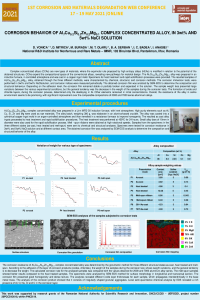
Complex concentrated alloys (CCAs) are new types of materials, where the equimolar rule proposed by high entropy alloys (HEAs) is modified in relation to the potential of the obtained structures. CCAs expend the compositional space of the conventional alloys, revealing new pathways for material design. The Al7Cu0.2Si0.2Zn0.2Mg0.1 alloy was prepared in an induction furnace, in controlled atmosphere and was cast in a copper ingot mold. The resulted samples of Al7Cu0.2Si0.2Zn0.2Mg0.1 were analysed by chemical, structural, and corrosion resistance. Also, the alloy has been subjected to mechanical tests of hardness, elongation and tensile strength. The corrosion immersion tests, were performed in 3wt% and 5wt% NaClsolution, and corrosion indices were measured periodically. The obtained corrosion film was analized by SEM-EDS to determine the composition and structural behaviour. Depending on the adhesion level, the corrosion film remained stable or partially broken and separated in the solution. The sample weight loss presented large variations between the various experimental conditions, but the general tendency was the decrease in the weight of the samples during the corrosion tests. The formation of oxide and chloride layers, during the corrosion process, determined only the dealloying in Al. Other elements remained in initial concentrations. Overall, the resistance of the alloy in saline environment seems to be promising, with significant improvement over the comparable compositions of 2000 and 7000 series alluminum alloys.
Keywords
Complex concentrated alloys
induction melting
corrosion immersion tests
Manuscript
sciforum-044916.pdf
Poster
Denisa_Vonica_ poster CMDWC 2021.pdf
Towards understanding hydrogen embrittlement of duplex atainless steel using operando high-energy X-ray diffraction and digital image correlation technique
Evaluation of atmospheric corrosivity index in museums by RFID sensors: application to the monitoring of pollution emitted by archeological woods