Event submissions
Published

This submission belongs to the session S2. Corrosion in Concrete and Porous Media of the event 1st Corrosion and Materials Degradation Web Conference
Published date
08 May, 2021
Citation
Armando Benenato, Barbara Ferracuti, Stefania Imperatore, Mahdi Kioumarsi, Experimental test on flexural performance of prestressed concrete beams damaged by corrosion, in Proceedings of 1st Corrosion and Materials Degradation Web Conference, 17 May–19 May 2021, MDPI: Basel, Switzerland, doi: 10.3390/CMDWC2021-09974
Share
Email
Facebook
Twitter
LinkedIn
Experimental test on flexural performance of prestressed concrete beams damaged by corrosion
'%3e%3cpath%20d='M12.6647%2010.9104C12.4176%2010.325%2012.0589%209.7933%2011.6088%209.34485C11.16%208.89511%2010.6283%208.53653%2010.0432%208.28891C10.038%208.28629%2010.0327%208.28498%2010.0275%208.28236C10.8437%207.69282%2011.3743%206.73252%2011.3743%205.64907C11.3743%203.85423%209.92005%202.40002%208.12522%202.40002C6.33038%202.40002%204.87618%203.85423%204.87618%205.64907C4.87618%206.73252%205.40677%207.69282%206.22296%208.28367C6.21772%208.28629%206.21248%208.2876%206.20724%208.29022C5.62031%208.53783%205.09365%208.89287%204.64167%209.34616C4.19192%209.79496%203.83334%2010.3266%203.58573%2010.9117C3.34247%2011.4846%203.21128%2012.0987%203.19925%2012.721C3.1989%2012.735%203.20135%2012.7489%203.20646%2012.7619C3.21157%2012.7749%203.21924%2012.7868%203.22901%2012.7968C3.23877%2012.8068%203.25045%2012.8148%203.26334%2012.8202C3.27623%2012.8256%203.29007%2012.8284%203.30406%2012.8284H4.09012C4.14776%2012.8284%204.19362%2012.7825%204.19493%2012.7262C4.22113%2011.7148%204.62726%2010.7676%205.34519%2010.0497C6.08802%209.30686%207.07452%208.89811%208.12522%208.89811C9.17592%208.89811%2010.1624%209.30686%2010.9052%2010.0497C11.6232%2010.7676%2012.0293%2011.7148%2012.0555%2012.7262C12.0568%2012.7839%2012.1027%2012.8284%2012.1603%2012.8284H12.9464C12.9604%2012.8284%2012.9742%2012.8256%2012.9871%2012.8202C13%2012.8148%2013.0117%2012.8068%2013.0214%2012.7968C13.0312%2012.7868%2013.0389%2012.7749%2013.044%2012.7619C13.0491%2012.7489%2013.0515%2012.735%2013.0512%2012.721C13.0381%2012.0947%2012.9084%2011.4856%2012.6647%2010.9104ZM8.12522%207.90243C7.52388%207.90243%206.95792%207.66793%206.53214%207.24215C6.10636%206.81636%205.87185%206.2504%205.87185%205.64907C5.87185%205.04773%206.10636%204.48177%206.53214%204.05599C6.95792%203.63021%207.52388%203.3957%208.12522%203.3957C8.72655%203.3957%209.29252%203.63021%209.7183%204.05599C10.1441%204.48177%2010.3786%205.04773%2010.3786%205.64907C10.3786%206.2504%2010.1441%206.81636%209.7183%207.24215C9.29252%207.66793%208.72655%207.90243%208.12522%207.90243Z'%20fill='%235D1EE1'/%3e%3c/g%3e%3c/svg%3e)
Armando Benenato 1

Barbara Ferracuti 1

Stefania Imperatore 1
Mahdi Kioumarsi 2
1. Department of Civil Engineering, “Niccolò Cusano” University, Via Don Carlo Gnocchi, 3, 00166 Rome, Italy
2. Department of Civil Engineering and Energy Technology, Oslo Metropolitan University, Pilestredet 35, 0166 Oslo, Norway.
Abstract
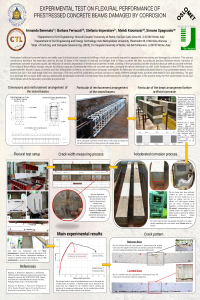
Prestressed reinforced concrete beams are widely used in industrial and commercial buildings, which are commonly exposed to aggressive environments and damaged by corrosion. This precast construction technique has been also used for the last 50 years in the majority of viaducts and bridges built in many countries like Italy. According to previous literature results, corrosion of prestressed concrete structures causes size reduction of strands, degradation of mechanical properties of steel, cracking of the surrounding concrete and bond decay at steel‐to‐concrete interface. The mixing of these effects strongly reduces the bearing-capacity of prestressed reinforced concrete members, changing the failure mechanism as well. In the framework of the OPTION research project between Niccolò Cusano University and Oslo Metropolitan University, an experimental campaign investigates the behaviour of corroded prestressed beams. Four prestressed beams (cross section size 200 × 300; total length 3000 mm; clear span 2700 mm) were first subjected to artificial corrosion, to obtain different damage levels, and then were tested in four-point bending. The goal is to estimate the corrosion level making a deteriorated prestressed reinforced concrete beam less ductile keeping the strength unchanged. In the present study, the first experimental results and some details about the laboratory procedure are presented.
Keywords
Strand corrosion
P/C beams
Experimental tests
Accelerated corrosion
Manuscript
POSTER_TRAVI.pdf
Poster
POSTER_TRAVI.pdf
Microbial induced corrosion of 3D printed stainless steels: a surface science investigation
Metallic Coatings for Mitigating Marine Corrosion