Event submissions
Published

This submission belongs to the session S2. Corrosion in Concrete and Porous Media of the event 1st Corrosion and Materials Degradation Web Conference
Published date
08 May, 2021
Citation
Sofia Tsouli, Christos Nikolaidis, Spyridon Kleftakis, Angeliki G. Lekatou, The effect of pH and fly ash on the electrochemical performance of AISI 304L stainless steel concrete reinforcement in harsh environments, in Proceedings of 1st Corrosion and Materials Degradation Web Conference, 17 May–19 May 2021, MDPI: Basel, Switzerland, doi: 10.3390/CMDWC2021-09976
Share
Email
Facebook
Twitter
LinkedIn
The effect of pH and fly ash on the electrochemical performance of AISI 304L stainless steel concrete reinforcement in harsh environments
'%3e%3cpath%20d='M12.6647%2010.9104C12.4176%2010.325%2012.0589%209.7933%2011.6088%209.34485C11.16%208.89511%2010.6283%208.53653%2010.0432%208.28891C10.038%208.28629%2010.0327%208.28498%2010.0275%208.28236C10.8437%207.69282%2011.3743%206.73252%2011.3743%205.64907C11.3743%203.85423%209.92005%202.40002%208.12522%202.40002C6.33038%202.40002%204.87618%203.85423%204.87618%205.64907C4.87618%206.73252%205.40677%207.69282%206.22296%208.28367C6.21772%208.28629%206.21248%208.2876%206.20724%208.29022C5.62031%208.53783%205.09365%208.89287%204.64167%209.34616C4.19192%209.79496%203.83334%2010.3266%203.58573%2010.9117C3.34247%2011.4846%203.21128%2012.0987%203.19925%2012.721C3.1989%2012.735%203.20135%2012.7489%203.20646%2012.7619C3.21157%2012.7749%203.21924%2012.7868%203.22901%2012.7968C3.23877%2012.8068%203.25045%2012.8148%203.26334%2012.8202C3.27623%2012.8256%203.29007%2012.8284%203.30406%2012.8284H4.09012C4.14776%2012.8284%204.19362%2012.7825%204.19493%2012.7262C4.22113%2011.7148%204.62726%2010.7676%205.34519%2010.0497C6.08802%209.30686%207.07452%208.89811%208.12522%208.89811C9.17592%208.89811%2010.1624%209.30686%2010.9052%2010.0497C11.6232%2010.7676%2012.0293%2011.7148%2012.0555%2012.7262C12.0568%2012.7839%2012.1027%2012.8284%2012.1603%2012.8284H12.9464C12.9604%2012.8284%2012.9742%2012.8256%2012.9871%2012.8202C13%2012.8148%2013.0117%2012.8068%2013.0214%2012.7968C13.0312%2012.7868%2013.0389%2012.7749%2013.044%2012.7619C13.0491%2012.7489%2013.0515%2012.735%2013.0512%2012.721C13.0381%2012.0947%2012.9084%2011.4856%2012.6647%2010.9104ZM8.12522%207.90243C7.52388%207.90243%206.95792%207.66793%206.53214%207.24215C6.10636%206.81636%205.87185%206.2504%205.87185%205.64907C5.87185%205.04773%206.10636%204.48177%206.53214%204.05599C6.95792%203.63021%207.52388%203.3957%208.12522%203.3957C8.72655%203.3957%209.29252%203.63021%209.7183%204.05599C10.1441%204.48177%2010.3786%205.04773%2010.3786%205.64907C10.3786%206.2504%2010.1441%206.81636%209.7183%207.24215C9.29252%207.66793%208.72655%207.90243%208.12522%207.90243Z'%20fill='%235D1EE1'/%3e%3c/g%3e%3c/svg%3e)
Sofia Tsouli 1
Christos Nikolaidis 2
Spyridon Kleftakis 3

Angeliki G. Lekatou 4,5
1. Laboratory of Applied Metallurgy, Department of Materials Science and Engineering, School of Engineering, University of Ioannina, 45110, Ioannina, Greece; stsouli@uoi.gr
2. Laboratory of Applied Metallurgy, Department of Materials Science and Engineering, School of Engineering, University of Ioannina, 45110, Ioannina, Greece; chrisnikolaid@hotmail.com
3. Laboratory of Applied Metallurgy, Department of Materials Science and Engineering, School of Engineering, University of Ioannina, 45110, Ioannina, Greece; skleftak@uoi.gr
4. Laboratory of Applied Metallurgy, Department of Materials Science and Engineering, School of Engineering, University of Ioannina, Ioannina, Greece; alekatou@uoi.gr
5. Institute of Materials Science and Computing, University Research Center of Ioannina (URCI), 45110, Ioannina, Greece; alekatou@uoi.gr
Abstract
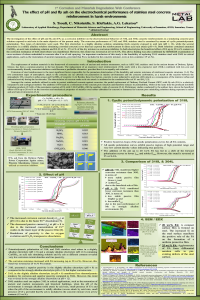
The investigation of the effect of pH and fly ash (FA) as a corrosion inhibitor on the electrochemical behavior of 316L and 304L concrete reinforcement in a simulating concrete pore solution exposed to aggressive environments, i.e. acid rain, is the main objective of the present study. The corrosion performance of 316L and 304L stainless steel is examined by means of cyclic (reverse) polarization in order to evaluate the susceptibility of the rebars to localized corrosion. Two types of electrolyte were used. The first electrolyte is a highly alkaline solution simulating fresh concrete exposed to acid rain (pH » 12), while the second electrolyte is a mildly alkaline solution simulating corroded concrete cover that exposed the reinforcement to direct acid rain attack (pH » 8). Both solutions contained saturated Ca(OH)2, an acid rain simulating solution and FA (0 wt.% - 25 wt.% of the dry mixture) as corrosion inhibitor. In both electrolytes the beneficial effect of FA up to 20 wt.% content on the corrosion resistance of both 316L and 304L rebars was manifested. However, this trend was reversed at 25 wt.% content due to the localized presence of agglomerates of FA on the surface of the steel. The above finding was confirmed by SEM/EDX examination of cross-sections after cyclic polarization. An important conclusion of this study was the feasibility of replacing 316L stainless steel with 304L in critical applications, such as the restoration of ancient monuments, provided that FA is included in the concrete mixture, even at low contents (10 or 15 wt.%).
Keywords
AISI 316L
AISI 304L rebars
fly ash
acid rain
cyclic potentiodynamic polarization
Manuscript
sciforum-044979.pdf
Poster
The effect of pH and fly ash on the electrochemical performance of stainless steel concrete reinforcement in harsh environments (Poster).pdf
Metallic Coatings for Mitigating Marine Corrosion
Self-healing anticorrosive coatings: Contributions from the phytochemicals