Event submissions
Published

This submission belongs to the session S4. Composite and Bonded Structures of the event 1st Corrosion and Materials Degradation Web Conference
Published date
08 May, 2021
Citation
Olesja Starkova, Oskars Platnieks, Alisa Sabalina, Sergejs Gaidukovs, Hydrothermal degradation of biobased poly(butylene succinate)/nanofibrillated cellulose composites, in Proceedings of 1st Corrosion and Materials Degradation Web Conference, 17 May–19 May 2021, MDPI: Basel, Switzerland, doi: 10.3390/CMDWC2021-09981
Share
Email
Facebook
Twitter
LinkedIn
Hydrothermal degradation of biobased poly(butylene succinate)/nanofibrillated cellulose composites
'%3e%3cpath%20d='M12.6647%2010.9104C12.4176%2010.325%2012.0589%209.7933%2011.6088%209.34485C11.16%208.89511%2010.6283%208.53653%2010.0432%208.28891C10.038%208.28629%2010.0327%208.28498%2010.0275%208.28236C10.8437%207.69282%2011.3743%206.73252%2011.3743%205.64907C11.3743%203.85423%209.92005%202.40002%208.12522%202.40002C6.33038%202.40002%204.87618%203.85423%204.87618%205.64907C4.87618%206.73252%205.40677%207.69282%206.22296%208.28367C6.21772%208.28629%206.21248%208.2876%206.20724%208.29022C5.62031%208.53783%205.09365%208.89287%204.64167%209.34616C4.19192%209.79496%203.83334%2010.3266%203.58573%2010.9117C3.34247%2011.4846%203.21128%2012.0987%203.19925%2012.721C3.1989%2012.735%203.20135%2012.7489%203.20646%2012.7619C3.21157%2012.7749%203.21924%2012.7868%203.22901%2012.7968C3.23877%2012.8068%203.25045%2012.8148%203.26334%2012.8202C3.27623%2012.8256%203.29007%2012.8284%203.30406%2012.8284H4.09012C4.14776%2012.8284%204.19362%2012.7825%204.19493%2012.7262C4.22113%2011.7148%204.62726%2010.7676%205.34519%2010.0497C6.08802%209.30686%207.07452%208.89811%208.12522%208.89811C9.17592%208.89811%2010.1624%209.30686%2010.9052%2010.0497C11.6232%2010.7676%2012.0293%2011.7148%2012.0555%2012.7262C12.0568%2012.7839%2012.1027%2012.8284%2012.1603%2012.8284H12.9464C12.9604%2012.8284%2012.9742%2012.8256%2012.9871%2012.8202C13%2012.8148%2013.0117%2012.8068%2013.0214%2012.7968C13.0312%2012.7868%2013.0389%2012.7749%2013.044%2012.7619C13.0491%2012.7489%2013.0515%2012.735%2013.0512%2012.721C13.0381%2012.0947%2012.9084%2011.4856%2012.6647%2010.9104ZM8.12522%207.90243C7.52388%207.90243%206.95792%207.66793%206.53214%207.24215C6.10636%206.81636%205.87185%206.2504%205.87185%205.64907C5.87185%205.04773%206.10636%204.48177%206.53214%204.05599C6.95792%203.63021%207.52388%203.3957%208.12522%203.3957C8.72655%203.3957%209.29252%203.63021%209.7183%204.05599C10.1441%204.48177%2010.3786%205.04773%2010.3786%205.64907C10.3786%206.2504%2010.1441%206.81636%209.7183%207.24215C9.29252%207.66793%208.72655%207.90243%208.12522%207.90243Z'%20fill='%235D1EE1'/%3e%3c/g%3e%3c/svg%3e)
Olesja Starkova 1
Oskars Platnieks 2
Alisa Sabalina 1

Sergejs Gaidukovs 2
1. Institute for Mechanics of Materials, University of Latvia
2. Institute of Polymer Materials, Faculty of Materials Science and Applied Chemistry, Riga Technical University
Abstract
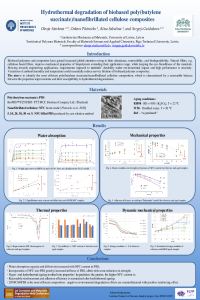
Biobased polymers and composites have gained increased global attention due to their abundant availability, renewability and biodegradability. Natural fillers, e.g. cellulose-based fillers, improve mechanical properties of biopolymers extending their application range, while keeping the ecofriendliness of the materials. Mowing towards engineering applications, requirements imposed to materials’ durability under environmental impact are increasing. Variations of ambient humidity and temperature could essentially reduce service lifetime of biobased polymer composites. This study is focused on hydrothermal degradation of poly(butylene succinate) (PBS) filled with nanofibrillated cellulose (NFC) up to 50 wt.% aimed to identify the most efficient PBS/NFC composition, while keeping a reasonable balance between the reinforcement effect and accelerated degradation inherent for most natural fillers. Water absorption and its effect on the structure, thermal, mechanical and thermomechanical properties were studied. Reasonably high reinforcement and adhesion efficiency is obtained for PBS/NFC composites that is maintained after their hydrothermal ageing. Water absorption capacity and diffusivity increased significantly with NFC content in PBS. Degradation of the mechanical properties is the higher, the higher NFC content in the polymer is. PBS filled with 20 wt.% of NFC is identified as the most efficient composition, for which negative environmental degradation effects are counterbalanced with the positive reinforcing effect.
Keywords
biopolymer
nanocellulose
durability
water absorption
mechanical properties
ageing
adhesion efficiency
biodegradation
modelling
Manuscript
CMDWC2021_Starkova_abstract.pdf
Poster
2021 CMDWC conference_ Starkova.pdf
Degradation of fusion reactor plasma-facing materials through surface plasma etching
Cr coatings to protect zirconium fuel claddings