Event submissions
Published
This submission belongs to the session S3. Animal Taxonomy of the event The 1st International Online Conference on Taxonomy
Published date
01 Dec, 2025
Academic Editor
'%3e%3cpath%20d='M12.6657%2010.9104C12.4185%2010.325%2012.0599%209.79327%2011.6097%209.34482C11.1609%208.89508%2010.6293%208.5365%2010.0442%208.28888C10.0389%208.28626%2010.0337%208.28495%2010.0285%208.28233C10.8446%207.69279%2011.3752%206.73249%2011.3752%205.64904C11.3752%203.8542%209.92103%202.39999%208.1262%202.39999C6.33136%202.39999%204.87715%203.8542%204.87715%205.64904C4.87715%206.73249%205.40774%207.69279%206.22393%208.28364C6.21869%208.28626%206.21345%208.28757%206.20821%208.29019C5.62129%208.5378%205.09463%208.89284%204.64265%209.34613C4.1929%209.79493%203.83432%2010.3266%203.58671%2010.9117C3.34345%2011.4845%203.21226%2012.0987%203.20023%2012.7209C3.19988%2012.7349%203.20233%2012.7488%203.20744%2012.7619C3.21255%2012.7749%203.22022%2012.7867%203.22998%2012.7968C3.23975%2012.8068%203.25142%2012.8147%203.26431%2012.8202C3.2772%2012.8256%203.29105%2012.8284%203.30504%2012.8284H4.09109C4.14874%2012.8284%204.19459%2012.7825%204.1959%2012.7262C4.2221%2011.7148%204.62823%2010.7676%205.34617%2010.0497C6.08899%209.30683%207.0755%208.89808%208.1262%208.89808C9.17689%208.89808%2010.1634%209.30683%2010.9062%2010.0497C11.6242%2010.7676%2012.0303%2011.7148%2012.0565%2012.7262C12.0578%2012.7838%2012.1037%2012.8284%2012.1613%2012.8284H12.9474C12.9613%2012.8284%2012.9752%2012.8256%2012.9881%2012.8202C13.001%2012.8147%2013.0126%2012.8068%2013.0224%2012.7968C13.0322%2012.7867%2013.0398%2012.7749%2013.0449%2012.7619C13.0501%2012.7488%2013.0525%2012.7349%2013.0522%2012.7209C13.0391%2012.0947%2012.9094%2011.4855%2012.6657%2010.9104ZM8.1262%207.9024C7.52486%207.9024%206.9589%207.6679%206.53312%207.24211C6.10733%206.81633%205.87283%206.25037%205.87283%205.64904C5.87283%205.0477%206.10733%204.48174%206.53312%204.05596C6.9589%203.63018%207.52486%203.39567%208.1262%203.39567C8.72753%203.39567%209.29349%203.63018%209.71927%204.05596C10.1451%204.48174%2010.3796%205.0477%2010.3796%205.64904C10.3796%206.25037%2010.1451%206.81633%209.71927%207.24211C9.29349%207.6679%208.72753%207.9024%208.1262%207.9024Z'%20fill='%235D1EE1'/%3e%3c/g%3e%3c/svg%3e) Mathias Harzhauser
Mathias HarzhauserCitation
Rita F. T. Pires, Cátia Bartilotti, Clara Lopes, Jorge Lobo-Arteaga, Shedding light on the hidden larvae of Benthesicymus laciniatus Rathbun, 1906 (Decapoda, Dendrobranchiata): An integrative taxonomic approach, in Proceedings of The 1st International Online Conference on Taxonomy, 3 December–4 December 2025, MDPI: Basel, Switzerland
Share
Email
Facebook
Twitter
LinkedIn
Shedding light on the hidden larvae of Benthesicymus laciniatus Rathbun, 1906 (Decapoda, Dendrobranchiata): An integrative taxonomic approach

Rita F. T. Pires 1,2

Cátia Bartilotti 1,3
'%3e%3cpath%20d='M12.6647%2010.9104C12.4176%2010.325%2012.0589%209.7933%2011.6088%209.34485C11.16%208.89511%2010.6283%208.53653%2010.0432%208.28891C10.038%208.28629%2010.0327%208.28498%2010.0275%208.28236C10.8437%207.69282%2011.3743%206.73252%2011.3743%205.64907C11.3743%203.85423%209.92005%202.40002%208.12522%202.40002C6.33038%202.40002%204.87618%203.85423%204.87618%205.64907C4.87618%206.73252%205.40677%207.69282%206.22296%208.28367C6.21772%208.28629%206.21248%208.2876%206.20724%208.29022C5.62031%208.53783%205.09365%208.89287%204.64167%209.34616C4.19192%209.79496%203.83334%2010.3266%203.58573%2010.9117C3.34247%2011.4846%203.21128%2012.0987%203.19925%2012.721C3.1989%2012.735%203.20135%2012.7489%203.20646%2012.7619C3.21157%2012.7749%203.21924%2012.7868%203.22901%2012.7968C3.23877%2012.8068%203.25045%2012.8148%203.26334%2012.8202C3.27623%2012.8256%203.29007%2012.8284%203.30406%2012.8284H4.09012C4.14776%2012.8284%204.19362%2012.7825%204.19493%2012.7262C4.22113%2011.7148%204.62726%2010.7676%205.34519%2010.0497C6.08802%209.30686%207.07452%208.89811%208.12522%208.89811C9.17592%208.89811%2010.1624%209.30686%2010.9052%2010.0497C11.6232%2010.7676%2012.0293%2011.7148%2012.0555%2012.7262C12.0568%2012.7839%2012.1027%2012.8284%2012.1603%2012.8284H12.9464C12.9604%2012.8284%2012.9742%2012.8256%2012.9871%2012.8202C13%2012.8148%2013.0117%2012.8068%2013.0214%2012.7968C13.0312%2012.7868%2013.0389%2012.7749%2013.044%2012.7619C13.0491%2012.7489%2013.0515%2012.735%2013.0512%2012.721C13.0381%2012.0947%2012.9084%2011.4856%2012.6647%2010.9104ZM8.12522%207.90243C7.52388%207.90243%206.95792%207.66793%206.53214%207.24215C6.10636%206.81636%205.87185%206.2504%205.87185%205.64907C5.87185%205.04773%206.10636%204.48177%206.53214%204.05599C6.95792%203.63021%207.52388%203.3957%208.12522%203.3957C8.72655%203.3957%209.29252%203.63021%209.7183%204.05599C10.1441%204.48177%2010.3786%205.04773%2010.3786%205.64907C10.3786%206.2504%2010.1441%206.81636%209.7183%207.24215C9.29252%207.66793%208.72655%207.90243%208.12522%207.90243Z'%20fill='%235D1EE1'/%3e%3c/g%3e%3c/svg%3e)
Clara Lopes 1,2

Jorge Lobo-Arteaga 1,3
1. Portuguese Institute for the Sea and Atmosphere (IPMA), Sea and Marine Resource Departament, Av. Doutor Alfredo Magalhães Ramalho 6, 1495-165 Algés, Portugal, Portugal
2. Interdisciplinary Centre of Marine and Environmental Research (CIIMAR), Terminal de Cruzeiros de Leixões. Av. General Norton de Matos s/n 4450-208 Matosinhos, Portugal
3. Marine and Environmental Sciences Centre (MARE), ARNET – Aquatic Research Network Associate Laboratory, Universidade NOVA de Lisboa, Campus de Caparica, 2829-516 Caparica, Portugal
Abstract
Advancing current knowledge about deep-sea shrimps is challenging, considering the difficulty in sampling organisms and the damaged state in which they arrive at the surface after collection. Thus, several aspects of their biology and ecology remain unknown or poorly understood, despite the importance of many species to worldwide fisheries. Integrative taxonomic approaches, merging morphological and DNA barcoding analyses, have been useful to obtain more information about these crustaceans. The family Benthesicymidae, which includes benthopelagic species inhabiting depths of 500 to 2000 m, remains among the least understood, since information available for both larvae and adults is scarce. The taxonomy of the family has been phylogenetically reviewed in recent years, as in the case of Benthesicymus, now considered a paraphyletic genus with two species—Benthesicymus crenatus and Benthesicymus laciniatus. Previously described species of the genus were reassigned to new and distinct genera within the family Benthesicymidae. The present study provides an extension of a previous work in which we reported the first description of the decapodid stage of B. laciniatus using integrative taxonomy by adding the first description of the zoeal stages of the species. Specimens were collected in the neuston layer (surface of the water column) during a sea survey in the Madeira-Tore geological complex in the north-eastern Atlantic. Several morphological characters distinguished the individuals from closely related taxa described in the literature, especially regarding the abdominal spines and the telson shape. The morphology of the sampled larval stages is discussed and compared with the available knowledge for Benthesicymidae shrimps, adding new knowledge for future taxonomic studies and clarifying older larval descriptions. Insights into the larval ecology of the species are provided, with a focus on its adaptations to a neustonic lifestyle.
Keywords
Crustaceans
Neuston
DNA barcode
Larval description
Madeira-Tore
Seamounts
Poster
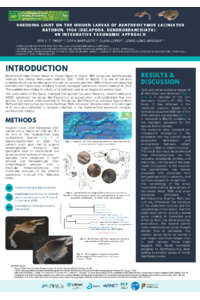
Pires et al_poster_Online Conf on taxonomy.pdf
Taxonomy of Demospongiae from the Indo-Pacific shallow waters
New molecular data for five dactylogyrid monogenean parasites of freshwater fishes in India and their molecular phylogeny