Event submissions
Published
This submission belongs to the session S4. Plant Taxonomy of the event The 1st International Online Conference on Taxonomy
Published date
01 Dec, 2025
Academic Editor
'%3e%3cpath%20d='M12.6657%2010.9104C12.4185%2010.325%2012.0599%209.79327%2011.6097%209.34482C11.1609%208.89508%2010.6293%208.5365%2010.0442%208.28888C10.0389%208.28626%2010.0337%208.28495%2010.0285%208.28233C10.8446%207.69279%2011.3752%206.73249%2011.3752%205.64904C11.3752%203.8542%209.92103%202.39999%208.1262%202.39999C6.33136%202.39999%204.87715%203.8542%204.87715%205.64904C4.87715%206.73249%205.40774%207.69279%206.22393%208.28364C6.21869%208.28626%206.21345%208.28757%206.20821%208.29019C5.62129%208.5378%205.09463%208.89284%204.64265%209.34613C4.1929%209.79493%203.83432%2010.3266%203.58671%2010.9117C3.34345%2011.4845%203.21226%2012.0987%203.20023%2012.7209C3.19988%2012.7349%203.20233%2012.7488%203.20744%2012.7619C3.21255%2012.7749%203.22022%2012.7867%203.22998%2012.7968C3.23975%2012.8068%203.25142%2012.8147%203.26431%2012.8202C3.2772%2012.8256%203.29105%2012.8284%203.30504%2012.8284H4.09109C4.14874%2012.8284%204.19459%2012.7825%204.1959%2012.7262C4.2221%2011.7148%204.62823%2010.7676%205.34617%2010.0497C6.08899%209.30683%207.0755%208.89808%208.1262%208.89808C9.17689%208.89808%2010.1634%209.30683%2010.9062%2010.0497C11.6242%2010.7676%2012.0303%2011.7148%2012.0565%2012.7262C12.0578%2012.7838%2012.1037%2012.8284%2012.1613%2012.8284H12.9474C12.9613%2012.8284%2012.9752%2012.8256%2012.9881%2012.8202C13.001%2012.8147%2013.0126%2012.8068%2013.0224%2012.7968C13.0322%2012.7867%2013.0398%2012.7749%2013.0449%2012.7619C13.0501%2012.7488%2013.0525%2012.7349%2013.0522%2012.7209C13.0391%2012.0947%2012.9094%2011.4855%2012.6657%2010.9104ZM8.1262%207.9024C7.52486%207.9024%206.9589%207.6679%206.53312%207.24211C6.10733%206.81633%205.87283%206.25037%205.87283%205.64904C5.87283%205.0477%206.10733%204.48174%206.53312%204.05596C6.9589%203.63018%207.52486%203.39567%208.1262%203.39567C8.72753%203.39567%209.29349%203.63018%209.71927%204.05596C10.1451%204.48174%2010.3796%205.0477%2010.3796%205.64904C10.3796%206.25037%2010.1451%206.81633%209.71927%207.24211C9.29349%207.6679%208.72753%207.9024%208.1262%207.9024Z'%20fill='%235D1EE1'/%3e%3c/g%3e%3c/svg%3e) Saraj Bahadur
Saraj BahadurCitation
Vanja Milovanović, Jasmina Šinžar Sekulić, Gordana Subakov Simić, Ivana Trbojević, Challenges in using Chara contraria A.Braun ex Kützing oospores as taxonomic markers, in Proceedings of The 1st International Online Conference on Taxonomy, 3 December–4 December 2025, MDPI: Basel, Switzerland
Share
Email
Facebook
Twitter
LinkedIn
Challenges in using Chara contraria A.Braun ex Kützing oospores as taxonomic markers
'%3e%3cpath%20d='M12.6647%2010.9104C12.4176%2010.325%2012.0589%209.7933%2011.6088%209.34485C11.16%208.89511%2010.6283%208.53653%2010.0432%208.28891C10.038%208.28629%2010.0327%208.28498%2010.0275%208.28236C10.8437%207.69282%2011.3743%206.73252%2011.3743%205.64907C11.3743%203.85423%209.92005%202.40002%208.12522%202.40002C6.33038%202.40002%204.87618%203.85423%204.87618%205.64907C4.87618%206.73252%205.40677%207.69282%206.22296%208.28367C6.21772%208.28629%206.21248%208.2876%206.20724%208.29022C5.62031%208.53783%205.09365%208.89287%204.64167%209.34616C4.19192%209.79496%203.83334%2010.3266%203.58573%2010.9117C3.34247%2011.4846%203.21128%2012.0987%203.19925%2012.721C3.1989%2012.735%203.20135%2012.7489%203.20646%2012.7619C3.21157%2012.7749%203.21924%2012.7868%203.22901%2012.7968C3.23877%2012.8068%203.25045%2012.8148%203.26334%2012.8202C3.27623%2012.8256%203.29007%2012.8284%203.30406%2012.8284H4.09012C4.14776%2012.8284%204.19362%2012.7825%204.19493%2012.7262C4.22113%2011.7148%204.62726%2010.7676%205.34519%2010.0497C6.08802%209.30686%207.07452%208.89811%208.12522%208.89811C9.17592%208.89811%2010.1624%209.30686%2010.9052%2010.0497C11.6232%2010.7676%2012.0293%2011.7148%2012.0555%2012.7262C12.0568%2012.7839%2012.1027%2012.8284%2012.1603%2012.8284H12.9464C12.9604%2012.8284%2012.9742%2012.8256%2012.9871%2012.8202C13%2012.8148%2013.0117%2012.8068%2013.0214%2012.7968C13.0312%2012.7868%2013.0389%2012.7749%2013.044%2012.7619C13.0491%2012.7489%2013.0515%2012.735%2013.0512%2012.721C13.0381%2012.0947%2012.9084%2011.4856%2012.6647%2010.9104ZM8.12522%207.90243C7.52388%207.90243%206.95792%207.66793%206.53214%207.24215C6.10636%206.81636%205.87185%206.2504%205.87185%205.64907C5.87185%205.04773%206.10636%204.48177%206.53214%204.05599C6.95792%203.63021%207.52388%203.3957%208.12522%203.3957C8.72655%203.3957%209.29252%203.63021%209.7183%204.05599C10.1441%204.48177%2010.3786%205.04773%2010.3786%205.64907C10.3786%206.2504%2010.1441%206.81636%209.7183%207.24215C9.29252%207.66793%208.72655%207.90243%208.12522%207.90243Z'%20fill='%235D1EE1'/%3e%3c/g%3e%3c/svg%3e)
Vanja Milovanović 1
Jasmina Šinžar Sekulić 2
Gordana Subakov Simić 1

Ivana Trbojević 1
1. Department of Algology and Mycology, Institute of Botany and Botanical Garden "Jevremovac", Faculty of Biology, University of Belgrade, Takovska 43, 11000 Belgrade, Serbia, Serbia
2. Department of Plant Ecology and Phytogeography, Institute of Botany and Botanical Garden "Jevremovac", Faculty of Biology, University of Belgrade, Takovska 43, 11000 Belgrade, Serbia, Serbia
Abstract
Chara contraria A.Braun ex Kützing is an endangered charophyte species in Serbia, widely recognized for its highly variable thallus morphology, which often hinders precise and reliable identification, leading to misidentification. Oospores, resistant reproductive structures, had already been used as promising taxonomic markers for the delineation of several charophyte species in Serbia. However, the oospores of this highly variable species have not been examined in Serbia before. In this study, we aimed to describe C. contraria oospores and to explore their usefulness as taxonomic parameters. A total number of 537 C. contraria oosporangia containing mature oospores were collected from the individuals from various localities in Serbia. The oosporangia were left in 30% hydrogen peroxide for up to 10 minutes, after which the spiral cells and coronula were removed, and the oospores were prepared for further analysis. First, visual inspection was performed, based on the general appearance of the oospores and the appearance of their apical and basal poles. The oospores were photographed and a standard set of quantitative characteristics was measured. Analyzed oospore specimens were subjected to K-means clustering, an unsupervised machine learning procedure, to determine the potential existence of homogeneous subgroups within them and further investigate their variability. The oospores of C. contraria ranged in color from dark brown to black and showed considerable variability in their general appearance. K-means cluster analysis further confirmed the observed qualitative variability, by identifying three clusters. The parameters that contributed most to the separation into clusters were oospore height, length, and the isopolarity index. Our results suggest that the application of C. contraria oospores as taxonomic parameters is limited by the pronounced variability of both qualitative and quantitative characteristics. Integrating molecular and morphological approaches is recommended to enhance the reliability of taxonomic assessments.
Keywords
oospores
variability
taxonomic parameters
Poster
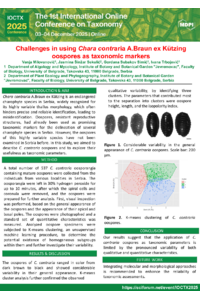
Milovanovic et al. 2025 Taxonomy Poster.pdf
Adaptive shifts and diversification of Ferricixius planthoppers in Brazilian caves (Hemiptera: Cixiidae)
Genus Amphinema Haeckel, 1879 (Cnidaria, Hydrozoa): A brief taxonomic review with the description of a new species?