Event submissions
Published
This submission belongs to the session S5. "Paleotaxonomy" of the event The 1st International Online Conference on Taxonomy
Published date
01 Dec, 2025
Academic Editor
'%3e%3cpath%20d='M12.6657%2010.9104C12.4185%2010.325%2012.0599%209.79327%2011.6097%209.34482C11.1609%208.89508%2010.6293%208.5365%2010.0442%208.28888C10.0389%208.28626%2010.0337%208.28495%2010.0285%208.28233C10.8446%207.69279%2011.3752%206.73249%2011.3752%205.64904C11.3752%203.8542%209.92103%202.39999%208.1262%202.39999C6.33136%202.39999%204.87715%203.8542%204.87715%205.64904C4.87715%206.73249%205.40774%207.69279%206.22393%208.28364C6.21869%208.28626%206.21345%208.28757%206.20821%208.29019C5.62129%208.5378%205.09463%208.89284%204.64265%209.34613C4.1929%209.79493%203.83432%2010.3266%203.58671%2010.9117C3.34345%2011.4845%203.21226%2012.0987%203.20023%2012.7209C3.19988%2012.7349%203.20233%2012.7488%203.20744%2012.7619C3.21255%2012.7749%203.22022%2012.7867%203.22998%2012.7968C3.23975%2012.8068%203.25142%2012.8147%203.26431%2012.8202C3.2772%2012.8256%203.29105%2012.8284%203.30504%2012.8284H4.09109C4.14874%2012.8284%204.19459%2012.7825%204.1959%2012.7262C4.2221%2011.7148%204.62823%2010.7676%205.34617%2010.0497C6.08899%209.30683%207.0755%208.89808%208.1262%208.89808C9.17689%208.89808%2010.1634%209.30683%2010.9062%2010.0497C11.6242%2010.7676%2012.0303%2011.7148%2012.0565%2012.7262C12.0578%2012.7838%2012.1037%2012.8284%2012.1613%2012.8284H12.9474C12.9613%2012.8284%2012.9752%2012.8256%2012.9881%2012.8202C13.001%2012.8147%2013.0126%2012.8068%2013.0224%2012.7968C13.0322%2012.7867%2013.0398%2012.7749%2013.0449%2012.7619C13.0501%2012.7488%2013.0525%2012.7349%2013.0522%2012.7209C13.0391%2012.0947%2012.9094%2011.4855%2012.6657%2010.9104ZM8.1262%207.9024C7.52486%207.9024%206.9589%207.6679%206.53312%207.24211C6.10733%206.81633%205.87283%206.25037%205.87283%205.64904C5.87283%205.0477%206.10733%204.48174%206.53312%204.05596C6.9589%203.63018%207.52486%203.39567%208.1262%203.39567C8.72753%203.39567%209.29349%203.63018%209.71927%204.05596C10.1451%204.48174%2010.3796%205.0477%2010.3796%205.64904C10.3796%206.25037%2010.1451%206.81633%209.71927%207.24211C9.29349%207.6679%208.72753%207.9024%208.1262%207.9024Z'%20fill='%235D1EE1'/%3e%3c/g%3e%3c/svg%3e) Davit Vasilyan
Davit VasilyanCitation
Clarice Assumpção, Camila Cupello, Paulo Brito, Taxonomic Review and Anatomical Analysis of Chondrichthyes from the Paraíba–Pernambuco Basin: Itamaracá, Gramame, and Maria Farinha Formations , in Proceedings of The 1st International Online Conference on Taxonomy, 3 December–4 December 2025, MDPI: Basel, Switzerland
Share
Email
Facebook
Twitter
LinkedIn
Taxonomic Review and Anatomical Analysis of Chondrichthyes from the Paraíba–Pernambuco Basin: Itamaracá, Gramame, and Maria Farinha Formations
'%3e%3cpath%20d='M12.6647%2010.9104C12.4176%2010.325%2012.0589%209.7933%2011.6088%209.34485C11.16%208.89511%2010.6283%208.53653%2010.0432%208.28891C10.038%208.28629%2010.0327%208.28498%2010.0275%208.28236C10.8437%207.69282%2011.3743%206.73252%2011.3743%205.64907C11.3743%203.85423%209.92005%202.40002%208.12522%202.40002C6.33038%202.40002%204.87618%203.85423%204.87618%205.64907C4.87618%206.73252%205.40677%207.69282%206.22296%208.28367C6.21772%208.28629%206.21248%208.2876%206.20724%208.29022C5.62031%208.53783%205.09365%208.89287%204.64167%209.34616C4.19192%209.79496%203.83334%2010.3266%203.58573%2010.9117C3.34247%2011.4846%203.21128%2012.0987%203.19925%2012.721C3.1989%2012.735%203.20135%2012.7489%203.20646%2012.7619C3.21157%2012.7749%203.21924%2012.7868%203.22901%2012.7968C3.23877%2012.8068%203.25045%2012.8148%203.26334%2012.8202C3.27623%2012.8256%203.29007%2012.8284%203.30406%2012.8284H4.09012C4.14776%2012.8284%204.19362%2012.7825%204.19493%2012.7262C4.22113%2011.7148%204.62726%2010.7676%205.34519%2010.0497C6.08802%209.30686%207.07452%208.89811%208.12522%208.89811C9.17592%208.89811%2010.1624%209.30686%2010.9052%2010.0497C11.6232%2010.7676%2012.0293%2011.7148%2012.0555%2012.7262C12.0568%2012.7839%2012.1027%2012.8284%2012.1603%2012.8284H12.9464C12.9604%2012.8284%2012.9742%2012.8256%2012.9871%2012.8202C13%2012.8148%2013.0117%2012.8068%2013.0214%2012.7968C13.0312%2012.7868%2013.0389%2012.7749%2013.044%2012.7619C13.0491%2012.7489%2013.0515%2012.735%2013.0512%2012.721C13.0381%2012.0947%2012.9084%2011.4856%2012.6647%2010.9104ZM8.12522%207.90243C7.52388%207.90243%206.95792%207.66793%206.53214%207.24215C6.10636%206.81636%205.87185%206.2504%205.87185%205.64907C5.87185%205.04773%206.10636%204.48177%206.53214%204.05599C6.95792%203.63021%207.52388%203.3957%208.12522%203.3957C8.72655%203.3957%209.29252%203.63021%209.7183%204.05599C10.1441%204.48177%2010.3786%205.04773%2010.3786%205.64907C10.3786%206.2504%2010.1441%206.81636%209.7183%207.24215C9.29252%207.66793%208.72655%207.90243%208.12522%207.90243Z'%20fill='%235D1EE1'/%3e%3c/g%3e%3c/svg%3e)
Clarice Assumpção 1
Camila Cupello 2
Paulo Brito 1
1. Department of Zoology, Roberto Alcântara Gomes Institute of Biology, Rio de Janeiro State University, Rua São Francisco Xavier, 524, Maracanã, Rio de Janeiro 20550-013, RJ, Brazil., Brazil
2. Department of Archaeology, Rio de Janeiro State University, Rua São Francisco Xavier, 524, Maracanã, Rio de Janeiro 20550-013, RJ, Brazil, Brazil
Abstract
The Paraíba–Pernambuco Basin, located between Recife and Mamanguape, Northeastern Brazil, is notable for its remarkable Mesozoic chondrichthyan fauna and its critical role in the geological evolution of the South Atlantic. Geological evidence indicates that this basin was among the last regions to separate during the fragmentation of Gondwana. The fossil assemblages preserved in this area hold global significance for paleontological research, particularly in relation to the evolution and paleobiogeography of elasmobranchs throughout the Cretaceous period. This study aims to provide an anatomical and taxonomic redescription of the chondrichthyes from the Paraíba–Pernambuco Basin, based on dentition and its morphological variations. A total of 128 fossil chondrichthyan teeth from the Itamaracá (Campanian–Maastrichtian), Gramame (Maastrichtian), and Maria Farinha (Paleocene) formations, housed in scientific collections at Brazilian universities, were examined, some of which have been described in earlier studies. Anatomical and taxonomic assessments were conducted based on criteria such as main cusp angulation, the number of accessory cusps, crown shape and size, the presence of serrations, and overall proportions. Additionally, morphological comparisons with living species were employed to infer the original tooth position within the jaw. The morphological analyses enabled the identification of the specimens and the reconstruction of their jaw positioning, thereby enhancing our understanding of elasmobranch jaw architecture. Taxonomic revisions included the reclassification of Notidanus microdon as Hexanchus microdon, Odontaspis tingitana as Carcharias tingitana, and the reassignment of all previously identified Lamna species to the genus Cretolamna. Notably, Ptychodus whipplei was recorded for the first time in the Itamaracá Formation, extending its known geographic distribution. The findings underscore the value of integrating fossil and living morphological data to refine taxonomic identifications. Moreover, the Paraíba–Pernambuco Basin is reaffirmed as a key fossil locality for elucidating elasmobranch diversity and biogeography during the Mesozoic period. This study contributes valuable insights for future taxonomic and paleoecological investigations in the region.
Keywords
Chondrichthyes
Elasmobranchii
Paraíba-Pernambuco Basin
Late Cretaceous
Maastrichtian
Poster
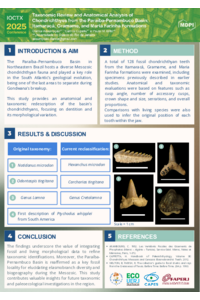
Poster International Online Conference on Taxonomy (1).pdf
Using New Technologies to Classify the Pennsylvanian (307-Million-Year-Old) Problematica Fossil, Tullimonstrum gregarium
Hidden species diversity of micro-gastropods from the Late Pleistocene deposits in Taiwan