Event submissions
Published
This submission belongs to the session S1. Gravitation and Cosmology of the event The 3rd International Online Conference on Universe
Published date
27 Feb, 2026
Academic Editor
'%3e%3cpath%20d='M12.6657%2010.9104C12.4185%2010.325%2012.0599%209.79327%2011.6097%209.34482C11.1609%208.89508%2010.6293%208.5365%2010.0442%208.28888C10.0389%208.28626%2010.0337%208.28495%2010.0285%208.28233C10.8446%207.69279%2011.3752%206.73249%2011.3752%205.64904C11.3752%203.8542%209.92103%202.39999%208.1262%202.39999C6.33136%202.39999%204.87715%203.8542%204.87715%205.64904C4.87715%206.73249%205.40774%207.69279%206.22393%208.28364C6.21869%208.28626%206.21345%208.28757%206.20821%208.29019C5.62129%208.5378%205.09463%208.89284%204.64265%209.34613C4.1929%209.79493%203.83432%2010.3266%203.58671%2010.9117C3.34345%2011.4845%203.21226%2012.0987%203.20023%2012.7209C3.19988%2012.7349%203.20233%2012.7488%203.20744%2012.7619C3.21255%2012.7749%203.22022%2012.7867%203.22998%2012.7968C3.23975%2012.8068%203.25142%2012.8147%203.26431%2012.8202C3.2772%2012.8256%203.29105%2012.8284%203.30504%2012.8284H4.09109C4.14874%2012.8284%204.19459%2012.7825%204.1959%2012.7262C4.2221%2011.7148%204.62823%2010.7676%205.34617%2010.0497C6.08899%209.30683%207.0755%208.89808%208.1262%208.89808C9.17689%208.89808%2010.1634%209.30683%2010.9062%2010.0497C11.6242%2010.7676%2012.0303%2011.7148%2012.0565%2012.7262C12.0578%2012.7838%2012.1037%2012.8284%2012.1613%2012.8284H12.9474C12.9613%2012.8284%2012.9752%2012.8256%2012.9881%2012.8202C13.001%2012.8147%2013.0126%2012.8068%2013.0224%2012.7968C13.0322%2012.7867%2013.0398%2012.7749%2013.0449%2012.7619C13.0501%2012.7488%2013.0525%2012.7349%2013.0522%2012.7209C13.0391%2012.0947%2012.9094%2011.4855%2012.6657%2010.9104ZM8.1262%207.9024C7.52486%207.9024%206.9589%207.6679%206.53312%207.24211C6.10733%206.81633%205.87283%206.25037%205.87283%205.64904C5.87283%205.0477%206.10733%204.48174%206.53312%204.05596C6.9589%203.63018%207.52486%203.39567%208.1262%203.39567C8.72753%203.39567%209.29349%203.63018%209.71927%204.05596C10.1451%204.48174%2010.3796%205.0477%2010.3796%205.64904C10.3796%206.25037%2010.1451%206.81633%209.71927%207.24211C9.29349%207.6679%208.72753%207.9024%208.1262%207.9024Z'%20fill='%235D1EE1'/%3e%3c/g%3e%3c/svg%3e) Lorenzo Iorio
Lorenzo IorioCitation
SATYAJIT PAL, An Analysis of Triply Ionised Carbon Absorption in the Spectrum of Q1422+23, in Proceedings of The 3rd International Online Conference on Universe, 4 March–6 March 2026, MDPI: Basel, Switzerland
Share
Email
Facebook
Twitter
LinkedIn
An Analysis of Triply Ionised Carbon Absorption in the Spectrum of Q1422+23
'%3e%3cpath%20d='M12.6647%2010.9104C12.4176%2010.325%2012.0589%209.7933%2011.6088%209.34485C11.16%208.89511%2010.6283%208.53653%2010.0432%208.28891C10.038%208.28629%2010.0327%208.28498%2010.0275%208.28236C10.8437%207.69282%2011.3743%206.73252%2011.3743%205.64907C11.3743%203.85423%209.92005%202.40002%208.12522%202.40002C6.33038%202.40002%204.87618%203.85423%204.87618%205.64907C4.87618%206.73252%205.40677%207.69282%206.22296%208.28367C6.21772%208.28629%206.21248%208.2876%206.20724%208.29022C5.62031%208.53783%205.09365%208.89287%204.64167%209.34616C4.19192%209.79496%203.83334%2010.3266%203.58573%2010.9117C3.34247%2011.4846%203.21128%2012.0987%203.19925%2012.721C3.1989%2012.735%203.20135%2012.7489%203.20646%2012.7619C3.21157%2012.7749%203.21924%2012.7868%203.22901%2012.7968C3.23877%2012.8068%203.25045%2012.8148%203.26334%2012.8202C3.27623%2012.8256%203.29007%2012.8284%203.30406%2012.8284H4.09012C4.14776%2012.8284%204.19362%2012.7825%204.19493%2012.7262C4.22113%2011.7148%204.62726%2010.7676%205.34519%2010.0497C6.08802%209.30686%207.07452%208.89811%208.12522%208.89811C9.17592%208.89811%2010.1624%209.30686%2010.9052%2010.0497C11.6232%2010.7676%2012.0293%2011.7148%2012.0555%2012.7262C12.0568%2012.7839%2012.1027%2012.8284%2012.1603%2012.8284H12.9464C12.9604%2012.8284%2012.9742%2012.8256%2012.9871%2012.8202C13%2012.8148%2013.0117%2012.8068%2013.0214%2012.7968C13.0312%2012.7868%2013.0389%2012.7749%2013.044%2012.7619C13.0491%2012.7489%2013.0515%2012.735%2013.0512%2012.721C13.0381%2012.0947%2012.9084%2011.4856%2012.6647%2010.9104ZM8.12522%207.90243C7.52388%207.90243%206.95792%207.66793%206.53214%207.24215C6.10636%206.81636%205.87185%206.2504%205.87185%205.64907C5.87185%205.04773%206.10636%204.48177%206.53214%204.05599C6.95792%203.63021%207.52388%203.3957%208.12522%203.3957C8.72655%203.3957%209.29252%203.63021%209.7183%204.05599C10.1441%204.48177%2010.3786%205.04773%2010.3786%205.64907C10.3786%206.2504%2010.1441%206.81636%209.7183%207.24215C9.29252%207.66793%208.72655%207.90243%208.12522%207.90243Z'%20fill='%235D1EE1'/%3e%3c/g%3e%3c/svg%3e)
SATYAJIT PAL 1,2
1. Department of Mathematics, The University of Burdwan, Burdwan, India, India
2. Department of Mathematics, Dr. Bhupendra Nath Dutta Smriti Mahavidyalaya, Hatgobindapur, India
Abstract
Intervening and intrinsic absorbers leave characteristic signatures on a quasar spectrum because each system removes light at wavelengths set by its own redshift and internal physical conditions. These differences reflect variations in cosmological distance, peculiar velocity, temperature and ionisation state of the absorbing gas. In this study, the spectrum of the high-redshift quasar Q1422+23 (RA 14:24:38.1, DEC +22:56:01), situated close to the bright star Arcturus, is examined with the goal of identifying and analysing triply ionised carbon (C IV) absorption systems along the line of sight. The emission redshift of the quasar is estimated to be about 3.62, placing it at a distance where metal-enriched gas associated with early galaxy formation can be probed in detail. The focus is on the C IV doublet at rest wavelengths 1548.204 Å and 1550.774 Å, a widely used tracer of highly ionised gas in both the intergalactic medium and the circumgalactic regions of galaxies. These lines provide a reliable measure of the ionisation structure and chemical content of the intervening systems. To extract accurate physical parameters, each detected feature is modelled with a Voigt profile that combines Gaussian broadening, caused by thermal motions and small-scale turbulence, with Lorentzian wings arising from natural line broadening. This approach allows a consistent determination of absorber redshift, line-of-sight velocity, cosmological distance, Doppler parameter and the relative contributions of thermal and non-thermal motions. Column densities are also derived to quantify the amount of ionised carbon in each component. The analysis reveals clear variations in redshift, velocity, width and column density among the identified absorption systems. These differences point to a diverse population of ionised structures enriched by earlier episodes of star formation and feedback. The results contribute to a better understanding of how metals are distributed and transported through the high-redshift universe and how the ionised gas evolves over cosmic time.
Keywords
Quasar Absorption Lines
C IV doublet
Voigt profile fitting
Absorber Redshift
Doppler Parameter
Column Density
Intergalactic Medium
Poster
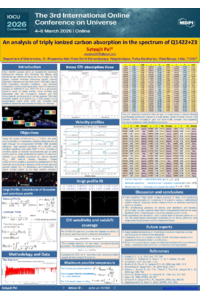
Satyajit Pal (Poster Presentation)_IOCU.pdf
The Snowball Chamber: A Multidisciplinary Radiation Detector
Study of the effect of the area and curvature terms in the quark and gluon density of states on the transition temperature