Event submissions
Published
This submission belongs to the session 4. Biochemical and Biological Control of the event The 1st International Electronic Conference on Plant Protection
Published date
01 Mar, 2026
Academic Editor
'%3e%3cpath%20d='M12.6657%2010.9104C12.4185%2010.325%2012.0599%209.79327%2011.6097%209.34482C11.1609%208.89508%2010.6293%208.5365%2010.0442%208.28888C10.0389%208.28626%2010.0337%208.28495%2010.0285%208.28233C10.8446%207.69279%2011.3752%206.73249%2011.3752%205.64904C11.3752%203.8542%209.92103%202.39999%208.1262%202.39999C6.33136%202.39999%204.87715%203.8542%204.87715%205.64904C4.87715%206.73249%205.40774%207.69279%206.22393%208.28364C6.21869%208.28626%206.21345%208.28757%206.20821%208.29019C5.62129%208.5378%205.09463%208.89284%204.64265%209.34613C4.1929%209.79493%203.83432%2010.3266%203.58671%2010.9117C3.34345%2011.4845%203.21226%2012.0987%203.20023%2012.7209C3.19988%2012.7349%203.20233%2012.7488%203.20744%2012.7619C3.21255%2012.7749%203.22022%2012.7867%203.22998%2012.7968C3.23975%2012.8068%203.25142%2012.8147%203.26431%2012.8202C3.2772%2012.8256%203.29105%2012.8284%203.30504%2012.8284H4.09109C4.14874%2012.8284%204.19459%2012.7825%204.1959%2012.7262C4.2221%2011.7148%204.62823%2010.7676%205.34617%2010.0497C6.08899%209.30683%207.0755%208.89808%208.1262%208.89808C9.17689%208.89808%2010.1634%209.30683%2010.9062%2010.0497C11.6242%2010.7676%2012.0303%2011.7148%2012.0565%2012.7262C12.0578%2012.7838%2012.1037%2012.8284%2012.1613%2012.8284H12.9474C12.9613%2012.8284%2012.9752%2012.8256%2012.9881%2012.8202C13.001%2012.8147%2013.0126%2012.8068%2013.0224%2012.7968C13.0322%2012.7867%2013.0398%2012.7749%2013.0449%2012.7619C13.0501%2012.7488%2013.0525%2012.7349%2013.0522%2012.7209C13.0391%2012.0947%2012.9094%2011.4855%2012.6657%2010.9104ZM8.1262%207.9024C7.52486%207.9024%206.9589%207.6679%206.53312%207.24211C6.10733%206.81633%205.87283%206.25037%205.87283%205.64904C5.87283%205.0477%206.10733%204.48174%206.53312%204.05596C6.9589%203.63018%207.52486%203.39567%208.1262%203.39567C8.72753%203.39567%209.29349%203.63018%209.71927%204.05596C10.1451%204.48174%2010.3796%205.0477%2010.3796%205.64904C10.3796%206.25037%2010.1451%206.81633%209.71927%207.24211C9.29349%207.6679%208.72753%207.9024%208.1262%207.9024Z'%20fill='%235D1EE1'/%3e%3c/g%3e%3c/svg%3e) Jorge M. S. Faria
Jorge M. S. FariaCitation
Silvio Almeida-Junior, Jhuan Luiz Silva, Igor Lima Soares, Giulia Maria Camara Leme, José Ricardo Lopes de Castro, Isabela Cristina Gomes Honorio, Gabriel Gomes Mendes, Juliana da Silva Coppede, Computational evaluation of the insecticidal potential of heptane extract compounds from Pyrostegia venusta against Helicoverpa armigera and Anticarsia gemmatalis, in Proceedings of The 1st International Electronic Conference on Plant Protection, 2 March–8 March 2026, MDPI: Basel, Switzerland
Share
Email
Facebook
Twitter
LinkedIn
Computational evaluation of the insecticidal potential of heptane extract compounds from Pyrostegia venusta against Helicoverpa armigera and Anticarsia gemmatalis
'%3e%3cpath%20d='M12.6647%2010.9104C12.4176%2010.325%2012.0589%209.7933%2011.6088%209.34485C11.16%208.89511%2010.6283%208.53653%2010.0432%208.28891C10.038%208.28629%2010.0327%208.28498%2010.0275%208.28236C10.8437%207.69282%2011.3743%206.73252%2011.3743%205.64907C11.3743%203.85423%209.92005%202.40002%208.12522%202.40002C6.33038%202.40002%204.87618%203.85423%204.87618%205.64907C4.87618%206.73252%205.40677%207.69282%206.22296%208.28367C6.21772%208.28629%206.21248%208.2876%206.20724%208.29022C5.62031%208.53783%205.09365%208.89287%204.64167%209.34616C4.19192%209.79496%203.83334%2010.3266%203.58573%2010.9117C3.34247%2011.4846%203.21128%2012.0987%203.19925%2012.721C3.1989%2012.735%203.20135%2012.7489%203.20646%2012.7619C3.21157%2012.7749%203.21924%2012.7868%203.22901%2012.7968C3.23877%2012.8068%203.25045%2012.8148%203.26334%2012.8202C3.27623%2012.8256%203.29007%2012.8284%203.30406%2012.8284H4.09012C4.14776%2012.8284%204.19362%2012.7825%204.19493%2012.7262C4.22113%2011.7148%204.62726%2010.7676%205.34519%2010.0497C6.08802%209.30686%207.07452%208.89811%208.12522%208.89811C9.17592%208.89811%2010.1624%209.30686%2010.9052%2010.0497C11.6232%2010.7676%2012.0293%2011.7148%2012.0555%2012.7262C12.0568%2012.7839%2012.1027%2012.8284%2012.1603%2012.8284H12.9464C12.9604%2012.8284%2012.9742%2012.8256%2012.9871%2012.8202C13%2012.8148%2013.0117%2012.8068%2013.0214%2012.7968C13.0312%2012.7868%2013.0389%2012.7749%2013.044%2012.7619C13.0491%2012.7489%2013.0515%2012.735%2013.0512%2012.721C13.0381%2012.0947%2012.9084%2011.4856%2012.6647%2010.9104ZM8.12522%207.90243C7.52388%207.90243%206.95792%207.66793%206.53214%207.24215C6.10636%206.81636%205.87185%206.2504%205.87185%205.64907C5.87185%205.04773%206.10636%204.48177%206.53214%204.05599C6.95792%203.63021%207.52388%203.3957%208.12522%203.3957C8.72655%203.3957%209.29252%203.63021%209.7183%204.05599C10.1441%204.48177%2010.3786%205.04773%2010.3786%205.64907C10.3786%206.2504%2010.1441%206.81636%209.7183%207.24215C9.29252%207.66793%208.72655%207.90243%208.12522%207.90243Z'%20fill='%235D1EE1'/%3e%3c/g%3e%3c/svg%3e)
Silvio Almeida-Junior 1,2
Jhuan Luiz Silva 3
Igor Lima Soares 4,5
Giulia Maria Camara Leme 6
José Ricardo Lopes de Castro 3
Isabela Cristina Gomes Honorio 7
Gabriel Gomes Mendes 8
Juliana da Silva Coppede 6
1. Biosciences and Health Laboratory, Department of Biosciences, State University of Minas Gerais, Passos, Brazil, Brazil
2. Post Graduate Program in Biotechnology, University of Ribeirão Preto, Ribeirão Preto, Brazil
3. Post Graduate Program in Health Promotion, University of Franca, Franca, Brazil, Brazil
4. Faculty of Pharmacy, University of Coimbra, Coimbra, Portugal, Portugal
5. Post Graduate Program in Technological Development and Innovation in Medicines, Federal University of Ceará, Fortaleza, Brazil
6. Post Graduate Program in Biotechnology, University of Ribeirão Preto, Ribeirão Preto, Brazil, Brazil
7. Department of Agricultural and Earth Sciences, State University of Minas Gerais, Passos, Brazil, Brazil
8. Engineering Department, State University of Minas Gerais, Passos, Brazil, Brazil
Abstract
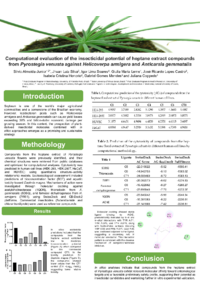
Introduction: Soybean is one of the world’s major agricultural commodities and a cornerstone of the Brazilian economy. However, lepidopteran pests such as Helicoverpa armigera and Anticarsia gemmatalis can cause yield losses exceeding 30% and billion-dollar economic damage per growing season. In this context, the prospection of plant-derived insecticidal molecules combined with in silico approaches emerges as a promising and sustainable strategy. Methodology: Compounds from the heptane extract of Pyrostegia venusta flowers were previously identified, and their chemical structures were retrieved from public databases and optimized for computational analyses. Cytotoxicity was predicted in human cell lines (HEK-293, HEK-293T, HaCaT, and HUVEC) using quantitative structure–activity relationship models. Ecotoxicological assessment included predictions of bioconcentration factor (BCF) and aquatic toxicity toward Daphnia magna. Mechanisms of action were investigated through molecular docking against acetylcholinesterase (1QON), thioredoxin from A. gemmatalis (5DBQ), and farnesol dehydrogenase from H. armigera (7W61), using SwissDock and CB-Dock2 platforms. Commercial insecticides (flubendiamide and chlorantraniliprole) were used as reference compounds. Results: The natural compounds exhibited predicted cytotoxicity values ranging from pIC₅₀ 2.82 to 5.25 and bioconcentration factors between 0.35 and 1.25 Log₁₀(BCF). Predicted toxicity toward D. magna ranged from 2.42 to 4.13 LC₅₀ −Log₁₀(mol/L), lower than those of the synthetic controls. Docking analyses revealed stable interactions with ΔG values between −5.52 and −6.47 kcal/mol, highlighting allyl acetate and 2,2-dimethylpentanal. Conclusion: In silico analyses indicate that compounds from the heptane extract of Pyrostegia venusta exhibit relevant molecular affinity toward entomological targets and a favorable preliminary safety profile, supporting their potential as insecticidal candidates and warranting further in vitro experimental validation.
Keywords
Biopesticides
Bioinformatics
Natural Products
Precision Agriculture
Soybeans
Poster
poster.pdf
Sustainable management of Root Knot Nematodes in Pomegranate: Impact of Biocontrol Agents on Yield and Grower Profitability
Hypochlorous acid as a tool for sustainable plant disease management