Event submissions
Published
This submission belongs to the session S1. Inorganic Crystalline Materials of the event The 5th International Online Conference on Crystals
Published date
10 Jun, 2026
Academic Editor
'%3e%3cpath%20d='M12.6657%2010.9104C12.4185%2010.325%2012.0599%209.79327%2011.6097%209.34482C11.1609%208.89508%2010.6293%208.5365%2010.0442%208.28888C10.0389%208.28626%2010.0337%208.28495%2010.0285%208.28233C10.8446%207.69279%2011.3752%206.73249%2011.3752%205.64904C11.3752%203.8542%209.92103%202.39999%208.1262%202.39999C6.33136%202.39999%204.87715%203.8542%204.87715%205.64904C4.87715%206.73249%205.40774%207.69279%206.22393%208.28364C6.21869%208.28626%206.21345%208.28757%206.20821%208.29019C5.62129%208.5378%205.09463%208.89284%204.64265%209.34613C4.1929%209.79493%203.83432%2010.3266%203.58671%2010.9117C3.34345%2011.4845%203.21226%2012.0987%203.20023%2012.7209C3.19988%2012.7349%203.20233%2012.7488%203.20744%2012.7619C3.21255%2012.7749%203.22022%2012.7867%203.22998%2012.7968C3.23975%2012.8068%203.25142%2012.8147%203.26431%2012.8202C3.2772%2012.8256%203.29105%2012.8284%203.30504%2012.8284H4.09109C4.14874%2012.8284%204.19459%2012.7825%204.1959%2012.7262C4.2221%2011.7148%204.62823%2010.7676%205.34617%2010.0497C6.08899%209.30683%207.0755%208.89808%208.1262%208.89808C9.17689%208.89808%2010.1634%209.30683%2010.9062%2010.0497C11.6242%2010.7676%2012.0303%2011.7148%2012.0565%2012.7262C12.0578%2012.7838%2012.1037%2012.8284%2012.1613%2012.8284H12.9474C12.9613%2012.8284%2012.9752%2012.8256%2012.9881%2012.8202C13.001%2012.8147%2013.0126%2012.8068%2013.0224%2012.7968C13.0322%2012.7867%2013.0398%2012.7749%2013.0449%2012.7619C13.0501%2012.7488%2013.0525%2012.7349%2013.0522%2012.7209C13.0391%2012.0947%2012.9094%2011.4855%2012.6657%2010.9104ZM8.1262%207.9024C7.52486%207.9024%206.9589%207.6679%206.53312%207.24211C6.10733%206.81633%205.87283%206.25037%205.87283%205.64904C5.87283%205.0477%206.10733%204.48174%206.53312%204.05596C6.9589%203.63018%207.52486%203.39567%208.1262%203.39567C8.72753%203.39567%209.29349%203.63018%209.71927%204.05596C10.1451%204.48174%2010.3796%205.0477%2010.3796%205.64904C10.3796%206.25037%2010.1451%206.81633%209.71927%207.24211C9.29349%207.6679%208.72753%207.9024%208.1262%207.9024Z'%20fill='%235D1EE1'/%3e%3c/g%3e%3c/svg%3e) John Parthenios
John PartheniosCitation
Sopheap Sam, Muhammad Ibrar, Kosuke Yamazaki, Hiroshi Nakatsugawa, Crystal Structure and Thermal Conductivity of Al-Doped β-FeSi₂, in Proceedings of The 5th International Online Conference on Crystals, 15 June–17 June 2026, MDPI: Basel, Switzerland
Share
Email
Facebook
Twitter
LinkedIn
Crystal Structure and Thermal Conductivity of Al-Doped β-FeSi2

Sopheap Sam 1,2
'%3e%3cpath%20d='M12.6647%2010.9104C12.4176%2010.325%2012.0589%209.7933%2011.6088%209.34485C11.16%208.89511%2010.6283%208.53653%2010.0432%208.28891C10.038%208.28629%2010.0327%208.28498%2010.0275%208.28236C10.8437%207.69282%2011.3743%206.73252%2011.3743%205.64907C11.3743%203.85423%209.92005%202.40002%208.12522%202.40002C6.33038%202.40002%204.87618%203.85423%204.87618%205.64907C4.87618%206.73252%205.40677%207.69282%206.22296%208.28367C6.21772%208.28629%206.21248%208.2876%206.20724%208.29022C5.62031%208.53783%205.09365%208.89287%204.64167%209.34616C4.19192%209.79496%203.83334%2010.3266%203.58573%2010.9117C3.34247%2011.4846%203.21128%2012.0987%203.19925%2012.721C3.1989%2012.735%203.20135%2012.7489%203.20646%2012.7619C3.21157%2012.7749%203.21924%2012.7868%203.22901%2012.7968C3.23877%2012.8068%203.25045%2012.8148%203.26334%2012.8202C3.27623%2012.8256%203.29007%2012.8284%203.30406%2012.8284H4.09012C4.14776%2012.8284%204.19362%2012.7825%204.19493%2012.7262C4.22113%2011.7148%204.62726%2010.7676%205.34519%2010.0497C6.08802%209.30686%207.07452%208.89811%208.12522%208.89811C9.17592%208.89811%2010.1624%209.30686%2010.9052%2010.0497C11.6232%2010.7676%2012.0293%2011.7148%2012.0555%2012.7262C12.0568%2012.7839%2012.1027%2012.8284%2012.1603%2012.8284H12.9464C12.9604%2012.8284%2012.9742%2012.8256%2012.9871%2012.8202C13%2012.8148%2013.0117%2012.8068%2013.0214%2012.7968C13.0312%2012.7868%2013.0389%2012.7749%2013.044%2012.7619C13.0491%2012.7489%2013.0515%2012.735%2013.0512%2012.721C13.0381%2012.0947%2012.9084%2011.4856%2012.6647%2010.9104ZM8.12522%207.90243C7.52388%207.90243%206.95792%207.66793%206.53214%207.24215C6.10636%206.81636%205.87185%206.2504%205.87185%205.64907C5.87185%205.04773%206.10636%204.48177%206.53214%204.05599C6.95792%203.63021%207.52388%203.3957%208.12522%203.3957C8.72655%203.3957%209.29252%203.63021%209.7183%204.05599C10.1441%204.48177%2010.3786%205.04773%2010.3786%205.64907C10.3786%206.2504%2010.1441%206.81636%209.7183%207.24215C9.29252%207.66793%208.72655%207.90243%208.12522%207.90243Z'%20fill='%235D1EE1'/%3e%3c/g%3e%3c/svg%3e)
Muhammad Ibrar 3
Kosuke Yamazaki 4
Hiroshi Nakatsugawa 3
1. Department of Industrial and Mechanical Engineering, Faculty of Electrical Engineering, Institute of Technology of Cambodia, Russian Federation Blvd, P.O. Box 86, Phnom Penh 120404, Cambodia, Cambodia
2. Research and Innovation Center, Institute of Technology of Cambodia, Russian Federation Blvd, P.O. Box 86, Phnom Penh 120404, Cambodia
3. Graduate School of Engineering Science, Yokohama National University, 79-5 Tokiwadai, Hodogaya, Yokohama, 240-8501, Kanagawa, Japan, Japan
4. Japan Ground Self-Defense Force, Test and Evaluation Command, 481-27 Subashiri Oyama-cho, Sunto-gun, Shizuoka-ken 410-1431, Japan, Japan
Abstract
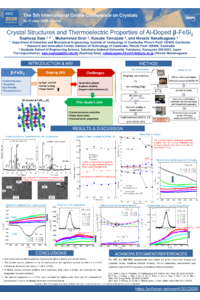
Iron silicide (β-FeSi2) is an important semiconductor that has attracted significant attention for optoelectronic, photovoltaic, and thermoelectric applications. Its conductivity can be tuned to either n-type or p-type through doping, providing flexibility for device design. In thermoelectric (TE) applications, however, the introduction of dopants often leads to the formation of secondary metallic phases, which can degrade TE performance. The thermoelectric performance of p-type β-FeSi2 is generally inferior to that of n-type material. Therefore, it is necessary to investigate the crystal structures and transport properties of p-type Al-doped β-FeSi2.
The polycrystalline FeSi2−xAlx samples were prepared by arc melting followed by a heat treatment process to obtain the β-phase. The crystal structures were identified using X-ray diffraction, and the phase fractions were quantified by Rietveld refinement. The electrical resistivity and Seebeck coefficient were measured using both a Hall effect measurement system (ResiTest8300) and a homemade device. Thermal conductivity was measured using a power efficiency measurement system.
As a result, undoped FeSi2 samples were initially crystallized in the ε and α-phases and transformed into a semiconducting β-phase (~97%) after heat treatment, confirming the essential role of thermal processing in β-phase formation. The unit cell volume increases with increasing Al doping level, which can be attributed to the larger atomic radius of Al compared to Si, indicating substitutional incorporation of Al into the Si sublattice. It is found that Al incorporation significantly affected secondary phase formation, reducing the β-phase fraction to below 70% for x ≥ 0.04. This result reveals a strong destabilization effect of Al on β-FeSi2, which has not been clearly quantified in previous studies. Meanwhile, thermal conductivity decreased with increasing Al content, likely due to enhanced phonon scattering from point defects caused by Al substitution, consistent with previous reports. This study provides useful insights for material design and thermal-to-energy conversion applications.
Keywords
Crystal structure
Transport properties
Phase transition
Thermal conductivity
Silicides
Poster
sciforum-178342-Poster-Al-doped-R1.pdf
Crystallographic Insight and Functional Properties of Zn-Modified Sr₅CaTi₂Nb₈O₃₀ Tungsten Bronze Ceramics
Governing growth and performance of Fe(Se,Te) epitaxial superconductors on TiN buffered metal substrates