Event submissions
Published
This submission belongs to the session S1. Inorganic Crystalline Materials of the event The 5th International Online Conference on Crystals
Published date
10 Jun, 2026
Academic Editor
'%3e%3cpath%20d='M12.6657%2010.9104C12.4185%2010.325%2012.0599%209.79327%2011.6097%209.34482C11.1609%208.89508%2010.6293%208.5365%2010.0442%208.28888C10.0389%208.28626%2010.0337%208.28495%2010.0285%208.28233C10.8446%207.69279%2011.3752%206.73249%2011.3752%205.64904C11.3752%203.8542%209.92103%202.39999%208.1262%202.39999C6.33136%202.39999%204.87715%203.8542%204.87715%205.64904C4.87715%206.73249%205.40774%207.69279%206.22393%208.28364C6.21869%208.28626%206.21345%208.28757%206.20821%208.29019C5.62129%208.5378%205.09463%208.89284%204.64265%209.34613C4.1929%209.79493%203.83432%2010.3266%203.58671%2010.9117C3.34345%2011.4845%203.21226%2012.0987%203.20023%2012.7209C3.19988%2012.7349%203.20233%2012.7488%203.20744%2012.7619C3.21255%2012.7749%203.22022%2012.7867%203.22998%2012.7968C3.23975%2012.8068%203.25142%2012.8147%203.26431%2012.8202C3.2772%2012.8256%203.29105%2012.8284%203.30504%2012.8284H4.09109C4.14874%2012.8284%204.19459%2012.7825%204.1959%2012.7262C4.2221%2011.7148%204.62823%2010.7676%205.34617%2010.0497C6.08899%209.30683%207.0755%208.89808%208.1262%208.89808C9.17689%208.89808%2010.1634%209.30683%2010.9062%2010.0497C11.6242%2010.7676%2012.0303%2011.7148%2012.0565%2012.7262C12.0578%2012.7838%2012.1037%2012.8284%2012.1613%2012.8284H12.9474C12.9613%2012.8284%2012.9752%2012.8256%2012.9881%2012.8202C13.001%2012.8147%2013.0126%2012.8068%2013.0224%2012.7968C13.0322%2012.7867%2013.0398%2012.7749%2013.0449%2012.7619C13.0501%2012.7488%2013.0525%2012.7349%2013.0522%2012.7209C13.0391%2012.0947%2012.9094%2011.4855%2012.6657%2010.9104ZM8.1262%207.9024C7.52486%207.9024%206.9589%207.6679%206.53312%207.24211C6.10733%206.81633%205.87283%206.25037%205.87283%205.64904C5.87283%205.0477%206.10733%204.48174%206.53312%204.05596C6.9589%203.63018%207.52486%203.39567%208.1262%203.39567C8.72753%203.39567%209.29349%203.63018%209.71927%204.05596C10.1451%204.48174%2010.3796%205.0477%2010.3796%205.64904C10.3796%206.25037%2010.1451%206.81633%209.71927%207.24211C9.29349%207.6679%208.72753%207.9024%208.1262%207.9024Z'%20fill='%235D1EE1'/%3e%3c/g%3e%3c/svg%3e) John Parthenios
John PartheniosCitation
Andrea Masi, Achille Angrisani Armenio, Giuseppe Celentano, Alexander Meledin, Laura Piperno, Alessandro Rufoloni, Angelo Vannozzi, Antonella Mancini, Governing growth and performance of Fe(Se,Te) epitaxial superconductors on TiN buffered metal substrates, in Proceedings of The 5th International Online Conference on Crystals, 15 June–17 June 2026, MDPI: Basel, Switzerland
Share
Email
Facebook
Twitter
LinkedIn
Governing growth and performance of Fe(Se,Te) epitaxial superconductors on TiN buffered metal substrates
'%3e%3cpath%20d='M12.6647%2010.9104C12.4176%2010.325%2012.0589%209.7933%2011.6088%209.34485C11.16%208.89511%2010.6283%208.53653%2010.0432%208.28891C10.038%208.28629%2010.0327%208.28498%2010.0275%208.28236C10.8437%207.69282%2011.3743%206.73252%2011.3743%205.64907C11.3743%203.85423%209.92005%202.40002%208.12522%202.40002C6.33038%202.40002%204.87618%203.85423%204.87618%205.64907C4.87618%206.73252%205.40677%207.69282%206.22296%208.28367C6.21772%208.28629%206.21248%208.2876%206.20724%208.29022C5.62031%208.53783%205.09365%208.89287%204.64167%209.34616C4.19192%209.79496%203.83334%2010.3266%203.58573%2010.9117C3.34247%2011.4846%203.21128%2012.0987%203.19925%2012.721C3.1989%2012.735%203.20135%2012.7489%203.20646%2012.7619C3.21157%2012.7749%203.21924%2012.7868%203.22901%2012.7968C3.23877%2012.8068%203.25045%2012.8148%203.26334%2012.8202C3.27623%2012.8256%203.29007%2012.8284%203.30406%2012.8284H4.09012C4.14776%2012.8284%204.19362%2012.7825%204.19493%2012.7262C4.22113%2011.7148%204.62726%2010.7676%205.34519%2010.0497C6.08802%209.30686%207.07452%208.89811%208.12522%208.89811C9.17592%208.89811%2010.1624%209.30686%2010.9052%2010.0497C11.6232%2010.7676%2012.0293%2011.7148%2012.0555%2012.7262C12.0568%2012.7839%2012.1027%2012.8284%2012.1603%2012.8284H12.9464C12.9604%2012.8284%2012.9742%2012.8256%2012.9871%2012.8202C13%2012.8148%2013.0117%2012.8068%2013.0214%2012.7968C13.0312%2012.7868%2013.0389%2012.7749%2013.044%2012.7619C13.0491%2012.7489%2013.0515%2012.735%2013.0512%2012.721C13.0381%2012.0947%2012.9084%2011.4856%2012.6647%2010.9104ZM8.12522%207.90243C7.52388%207.90243%206.95792%207.66793%206.53214%207.24215C6.10636%206.81636%205.87185%206.2504%205.87185%205.64907C5.87185%205.04773%206.10636%204.48177%206.53214%204.05599C6.95792%203.63021%207.52388%203.3957%208.12522%203.3957C8.72655%203.3957%209.29252%203.63021%209.7183%204.05599C10.1441%204.48177%2010.3786%205.04773%2010.3786%205.64907C10.3786%206.2504%2010.1441%206.81636%209.7183%207.24215C9.29252%207.66793%208.72655%207.90243%208.12522%207.90243Z'%20fill='%235D1EE1'/%3e%3c/g%3e%3c/svg%3e)
Andrea Masi 1
Achille Angrisani Armenio 1
Giuseppe Celentano 1
Alexander Meledin 2
Laura Piperno 1
Alessandro Rufoloni 1
Angelo Vannozzi 1
Antonella Mancini 1
1. Superconductivity Laboratory, ENEA National Agency for New Technologies Energy and Economic Sustainable Development,
Frascati, Roma, Italy, Italy
2. Thermo Fisher Scientific Inc, Eindhoven, North Brabant, The Netherlands, The Netherlands
Abstract
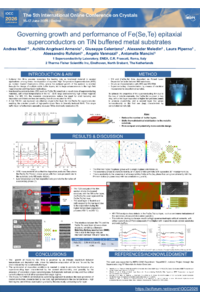
Epitaxial thin films assume nowadays the leading role as functional material in several applications: among these, the deposition of cuprate High-Temperature Superconductors (HTSs) as modern Coated Conductors (CCs), where the epitaxial growth of the material is enabled through multiple oxide buffer layers, has led to huge advancements in the high-field magnet sector and thus fusion technology.
Iron-based superconductors (IBSs) constitute a novel class of superconducting materials, with critical temperatures in the 10 – 60 K range and extremely high critical magnetic fields. For IBS CCs, the materials' characteristics reduce the need for strict texturing, and deposition conditions are less demanding than those required for HTSs. Recently, we showed that a thin TiN film can represent an effective single buffer layer for an Fe(Se,Te) superconductor, enabling the oriented growth of high-performance films on biaxially textured Ni-W. This single buffer layer is furthermore appealing because TiN is electrically conductive. The resulting structure, fabricated by pulsed laser deposition, is characterized by simplicity and good performance.
However, several aspects require careful control, with a multi-layered system characterized by several critical interfaces: the chalcogenide and TiN are characterized by a high lattice mismatch (26 %). High-Resolution TEM images highlight, however, the epitaxy of Fe(Se,Te) on TiN, showing how a domain-matching epitaxy mechanism drives the film orientation. Moreover, the performance of the superconducting film is influenced by the structure and the presence of secondary phase inclusions at grain boundaries, affecting the regularity of the layered chalcogenide, as observed by TEM and diffraction analyses.
The results shown here unveil how different parameters influence the microstructural properties down to the atomic scale and how these are reflected in the superconducting behaviour, providing guidelines for the optimization of Fe(Se,Te) growth on simplified coated conductor architectures for a novel generation of superconducting tapes.
Keywords
Superconducting materials
Epitaxial thin film
Iron Based Superconductors
Coated Conductors
Poster
sciforum-178681.pdf
Crystal Structure and Thermal Conductivity of Al-Doped β-FeSi2
Photorefraction and photochromism in bismuth–magnesium-codoped stoichiometric lithium niobate