Event submissions
Published
This submission belongs to the session S1. Inorganic Crystalline Materials of the event The 5th International Online Conference on Crystals
Published date
10 Jun, 2026
Academic Editor
'%3e%3cpath%20d='M12.6657%2010.9104C12.4185%2010.325%2012.0599%209.79327%2011.6097%209.34482C11.1609%208.89508%2010.6293%208.5365%2010.0442%208.28888C10.0389%208.28626%2010.0337%208.28495%2010.0285%208.28233C10.8446%207.69279%2011.3752%206.73249%2011.3752%205.64904C11.3752%203.8542%209.92103%202.39999%208.1262%202.39999C6.33136%202.39999%204.87715%203.8542%204.87715%205.64904C4.87715%206.73249%205.40774%207.69279%206.22393%208.28364C6.21869%208.28626%206.21345%208.28757%206.20821%208.29019C5.62129%208.5378%205.09463%208.89284%204.64265%209.34613C4.1929%209.79493%203.83432%2010.3266%203.58671%2010.9117C3.34345%2011.4845%203.21226%2012.0987%203.20023%2012.7209C3.19988%2012.7349%203.20233%2012.7488%203.20744%2012.7619C3.21255%2012.7749%203.22022%2012.7867%203.22998%2012.7968C3.23975%2012.8068%203.25142%2012.8147%203.26431%2012.8202C3.2772%2012.8256%203.29105%2012.8284%203.30504%2012.8284H4.09109C4.14874%2012.8284%204.19459%2012.7825%204.1959%2012.7262C4.2221%2011.7148%204.62823%2010.7676%205.34617%2010.0497C6.08899%209.30683%207.0755%208.89808%208.1262%208.89808C9.17689%208.89808%2010.1634%209.30683%2010.9062%2010.0497C11.6242%2010.7676%2012.0303%2011.7148%2012.0565%2012.7262C12.0578%2012.7838%2012.1037%2012.8284%2012.1613%2012.8284H12.9474C12.9613%2012.8284%2012.9752%2012.8256%2012.9881%2012.8202C13.001%2012.8147%2013.0126%2012.8068%2013.0224%2012.7968C13.0322%2012.7867%2013.0398%2012.7749%2013.0449%2012.7619C13.0501%2012.7488%2013.0525%2012.7349%2013.0522%2012.7209C13.0391%2012.0947%2012.9094%2011.4855%2012.6657%2010.9104ZM8.1262%207.9024C7.52486%207.9024%206.9589%207.6679%206.53312%207.24211C6.10733%206.81633%205.87283%206.25037%205.87283%205.64904C5.87283%205.0477%206.10733%204.48174%206.53312%204.05596C6.9589%203.63018%207.52486%203.39567%208.1262%203.39567C8.72753%203.39567%209.29349%203.63018%209.71927%204.05596C10.1451%204.48174%2010.3796%205.0477%2010.3796%205.64904C10.3796%206.25037%2010.1451%206.81633%209.71927%207.24211C9.29349%207.6679%208.72753%207.9024%208.1262%207.9024Z'%20fill='%235D1EE1'/%3e%3c/g%3e%3c/svg%3e) Zongyou Yin
Zongyou YinCitation
Anamarija Stanković, Patricija Rupe, Klara Formbaher, Jelena Ivanović, Nikolina Filipović, Jelena Brdarić Kosanović, Ana Amić, Nives Matijaković Mlinarić, Oliver Pavlović, Interaction Between Phthalate Plasticizers and Calcium Oxalate: Impacts on Precipitation Behavior, in Proceedings of The 5th International Online Conference on Crystals, 15 June–17 June 2026, MDPI: Basel, Switzerland
Share
Email
Facebook
Twitter
LinkedIn
Interaction Between Phthalate Plasticizers and Calcium Oxalate: Impacts on Precipitation Behavior
'%3e%3cpath%20d='M12.6647%2010.9104C12.4176%2010.325%2012.0589%209.7933%2011.6088%209.34485C11.16%208.89511%2010.6283%208.53653%2010.0432%208.28891C10.038%208.28629%2010.0327%208.28498%2010.0275%208.28236C10.8437%207.69282%2011.3743%206.73252%2011.3743%205.64907C11.3743%203.85423%209.92005%202.40002%208.12522%202.40002C6.33038%202.40002%204.87618%203.85423%204.87618%205.64907C4.87618%206.73252%205.40677%207.69282%206.22296%208.28367C6.21772%208.28629%206.21248%208.2876%206.20724%208.29022C5.62031%208.53783%205.09365%208.89287%204.64167%209.34616C4.19192%209.79496%203.83334%2010.3266%203.58573%2010.9117C3.34247%2011.4846%203.21128%2012.0987%203.19925%2012.721C3.1989%2012.735%203.20135%2012.7489%203.20646%2012.7619C3.21157%2012.7749%203.21924%2012.7868%203.22901%2012.7968C3.23877%2012.8068%203.25045%2012.8148%203.26334%2012.8202C3.27623%2012.8256%203.29007%2012.8284%203.30406%2012.8284H4.09012C4.14776%2012.8284%204.19362%2012.7825%204.19493%2012.7262C4.22113%2011.7148%204.62726%2010.7676%205.34519%2010.0497C6.08802%209.30686%207.07452%208.89811%208.12522%208.89811C9.17592%208.89811%2010.1624%209.30686%2010.9052%2010.0497C11.6232%2010.7676%2012.0293%2011.7148%2012.0555%2012.7262C12.0568%2012.7839%2012.1027%2012.8284%2012.1603%2012.8284H12.9464C12.9604%2012.8284%2012.9742%2012.8256%2012.9871%2012.8202C13%2012.8148%2013.0117%2012.8068%2013.0214%2012.7968C13.0312%2012.7868%2013.0389%2012.7749%2013.044%2012.7619C13.0491%2012.7489%2013.0515%2012.735%2013.0512%2012.721C13.0381%2012.0947%2012.9084%2011.4856%2012.6647%2010.9104ZM8.12522%207.90243C7.52388%207.90243%206.95792%207.66793%206.53214%207.24215C6.10636%206.81636%205.87185%206.2504%205.87185%205.64907C5.87185%205.04773%206.10636%204.48177%206.53214%204.05599C6.95792%203.63021%207.52388%203.3957%208.12522%203.3957C8.72655%203.3957%209.29252%203.63021%209.7183%204.05599C10.1441%204.48177%2010.3786%205.04773%2010.3786%205.64907C10.3786%206.2504%2010.1441%206.81636%209.7183%207.24215C9.29252%207.66793%208.72655%207.90243%208.12522%207.90243Z'%20fill='%235D1EE1'/%3e%3c/g%3e%3c/svg%3e)
Patricija Rupe 1
Klara Formbaher 1
Jelena Ivanović 1

Nikolina Filipović 1
Jelena Brdarić Kosanović 1
Ana Amić 1

Nives Matijaković Mlinarić 2
Oliver Pavlović 3

Anamarija Stanković 1
1. Department of Chemistry, Josip Juraj Strossmayer University of Osijek, Osijek, Croatia, Croatia
2. Ruđer Bošković Institute, Bijenička cesta 54, 10000 Zagreb, Croatia, Croatia
3. Faculty of Medicine in Osijek, Josip Juraj Strossmayer University of Osijek, Osijek, Croatia, Croatia
Abstract
Introduction:
Calcium oxalate (CaOx) is the dominant mineral phase in human kidney stones, making the understanding of its nucleation, growth, and phase selection essential for elucidating urolithiasis mechanisms. Phthalate esters are ubiquitous plasticizers with diverse hydrophobic and steric properties, and rising human exposure has increased interest in their potential interactions with urinary constituents. This study investigates how structurally distinct phthalates (DIDP, DINP, DEHP, DNOP, BBP, DBP, DIBP) influence CaOx precipitation under physiologically relevant conditions.
Methods:
CaOx was precipitated in aqueous media in the presence or absence of individual phthalates under controlled conditions (pH 6.5, ionic strength 0.05 M, 37 °C). Crystal morphology was assessed using light microscopy, and phase composition was determined by PXRD and FTIR.
Results:
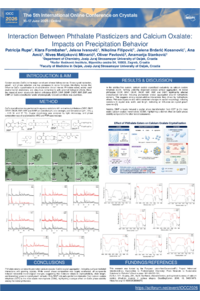
In the additive‑free system, crystallization yielded exclusively COT, with crystals uniformly dispersed throughout the solution. In contrast, all phthalate-containing systems exhibited pronounced aggregation of crystals around hydrophobic additive domains. This aggregation was accompanied by clear morphological alterations, including variations in crystal dimensions and habit. While most phthalates had no measurable impact on phase composition, DINP uniquely induced partial transformation from COT to the thermodynamically more stable calcium oxalate monohydrate, indicating a structure-dependent effect on CaOx stability.
Conclusions:
Phthalate esters consistently promoted crystal aggregation and induced morphology changes, supporting predominantly surface‑mediated interactions influenced by molecular size, hydrophobicity, and chain branching. DINP was the only compound capable of modifying CaOx phase stability, likely due to its branched isononyl structure perturbing the hydration environment of COT. These findings indicate that aggregation is a common response to all tested phthalates. However, more detailed investigations are required to fully clarify the underlying mechanisms.
Funding:
This research was funded by the European Union—NextGenerationEU. Project “Advanced Interdisciplinary Approaches to Environmental Chemistry: From Materials to Sustainable Solutions for Pollution” (Grant number: 581-UNIOS-101).
Keywords
phthalate
plasticizers
calcium Oxalate
precipitation
Poster
Interaction Between Phthalate Plasticizers and Calcium Oxalate Impacts on Precipitation Behavior_Rupe.pdf
Preparation and Characterization of Zinc(II) Complexes with Coumalic Acid
PHASE FORMATION IN THE Ag2S−Sb2S3−GeS2 SYSTEM