Event submissions
Published
This submission belongs to the session S1. Inorganic Crystalline Materials of the event The 5th International Online Conference on Crystals
Published date
10 Jun, 2026
Academic Editor
'%3e%3cpath%20d='M12.6657%2010.9104C12.4185%2010.325%2012.0599%209.79327%2011.6097%209.34482C11.1609%208.89508%2010.6293%208.5365%2010.0442%208.28888C10.0389%208.28626%2010.0337%208.28495%2010.0285%208.28233C10.8446%207.69279%2011.3752%206.73249%2011.3752%205.64904C11.3752%203.8542%209.92103%202.39999%208.1262%202.39999C6.33136%202.39999%204.87715%203.8542%204.87715%205.64904C4.87715%206.73249%205.40774%207.69279%206.22393%208.28364C6.21869%208.28626%206.21345%208.28757%206.20821%208.29019C5.62129%208.5378%205.09463%208.89284%204.64265%209.34613C4.1929%209.79493%203.83432%2010.3266%203.58671%2010.9117C3.34345%2011.4845%203.21226%2012.0987%203.20023%2012.7209C3.19988%2012.7349%203.20233%2012.7488%203.20744%2012.7619C3.21255%2012.7749%203.22022%2012.7867%203.22998%2012.7968C3.23975%2012.8068%203.25142%2012.8147%203.26431%2012.8202C3.2772%2012.8256%203.29105%2012.8284%203.30504%2012.8284H4.09109C4.14874%2012.8284%204.19459%2012.7825%204.1959%2012.7262C4.2221%2011.7148%204.62823%2010.7676%205.34617%2010.0497C6.08899%209.30683%207.0755%208.89808%208.1262%208.89808C9.17689%208.89808%2010.1634%209.30683%2010.9062%2010.0497C11.6242%2010.7676%2012.0303%2011.7148%2012.0565%2012.7262C12.0578%2012.7838%2012.1037%2012.8284%2012.1613%2012.8284H12.9474C12.9613%2012.8284%2012.9752%2012.8256%2012.9881%2012.8202C13.001%2012.8147%2013.0126%2012.8068%2013.0224%2012.7968C13.0322%2012.7867%2013.0398%2012.7749%2013.0449%2012.7619C13.0501%2012.7488%2013.0525%2012.7349%2013.0522%2012.7209C13.0391%2012.0947%2012.9094%2011.4855%2012.6657%2010.9104ZM8.1262%207.9024C7.52486%207.9024%206.9589%207.6679%206.53312%207.24211C6.10733%206.81633%205.87283%206.25037%205.87283%205.64904C5.87283%205.0477%206.10733%204.48174%206.53312%204.05596C6.9589%203.63018%207.52486%203.39567%208.1262%203.39567C8.72753%203.39567%209.29349%203.63018%209.71927%204.05596C10.1451%204.48174%2010.3796%205.0477%2010.3796%205.64904C10.3796%206.25037%2010.1451%206.81633%209.71927%207.24211C9.29349%207.6679%208.72753%207.9024%208.1262%207.9024Z'%20fill='%235D1EE1'/%3e%3c/g%3e%3c/svg%3e) John Parthenios
John PartheniosCitation
Evangelia Karali, Christos Michail, George Fountos, Nektarios Kalyvas, Ioannis Valais, Investigation of detector technology alternatives in Cone beam CT—A Simulation study, in Proceedings of The 5th International Online Conference on Crystals, 15 June–17 June 2026, MDPI: Basel, Switzerland
Share
Email
Facebook
Twitter
LinkedIn
Investigation of detector technology alternatives in Cone beam CT—A Simulation study

Evangelia Karali 1

Christos Michail 1

George Fountos 1
'%3e%3cpath%20d='M12.6647%2010.9104C12.4176%2010.325%2012.0589%209.7933%2011.6088%209.34485C11.16%208.89511%2010.6283%208.53653%2010.0432%208.28891C10.038%208.28629%2010.0327%208.28498%2010.0275%208.28236C10.8437%207.69282%2011.3743%206.73252%2011.3743%205.64907C11.3743%203.85423%209.92005%202.40002%208.12522%202.40002C6.33038%202.40002%204.87618%203.85423%204.87618%205.64907C4.87618%206.73252%205.40677%207.69282%206.22296%208.28367C6.21772%208.28629%206.21248%208.2876%206.20724%208.29022C5.62031%208.53783%205.09365%208.89287%204.64167%209.34616C4.19192%209.79496%203.83334%2010.3266%203.58573%2010.9117C3.34247%2011.4846%203.21128%2012.0987%203.19925%2012.721C3.1989%2012.735%203.20135%2012.7489%203.20646%2012.7619C3.21157%2012.7749%203.21924%2012.7868%203.22901%2012.7968C3.23877%2012.8068%203.25045%2012.8148%203.26334%2012.8202C3.27623%2012.8256%203.29007%2012.8284%203.30406%2012.8284H4.09012C4.14776%2012.8284%204.19362%2012.7825%204.19493%2012.7262C4.22113%2011.7148%204.62726%2010.7676%205.34519%2010.0497C6.08802%209.30686%207.07452%208.89811%208.12522%208.89811C9.17592%208.89811%2010.1624%209.30686%2010.9052%2010.0497C11.6232%2010.7676%2012.0293%2011.7148%2012.0555%2012.7262C12.0568%2012.7839%2012.1027%2012.8284%2012.1603%2012.8284H12.9464C12.9604%2012.8284%2012.9742%2012.8256%2012.9871%2012.8202C13%2012.8148%2013.0117%2012.8068%2013.0214%2012.7968C13.0312%2012.7868%2013.0389%2012.7749%2013.044%2012.7619C13.0491%2012.7489%2013.0515%2012.735%2013.0512%2012.721C13.0381%2012.0947%2012.9084%2011.4856%2012.6647%2010.9104ZM8.12522%207.90243C7.52388%207.90243%206.95792%207.66793%206.53214%207.24215C6.10636%206.81636%205.87185%206.2504%205.87185%205.64907C5.87185%205.04773%206.10636%204.48177%206.53214%204.05599C6.95792%203.63021%207.52388%203.3957%208.12522%203.3957C8.72655%203.3957%209.29252%203.63021%209.7183%204.05599C10.1441%204.48177%2010.3786%205.04773%2010.3786%205.64907C10.3786%206.2504%2010.1441%206.81636%209.7183%207.24215C9.29252%207.66793%208.72655%207.90243%208.12522%207.90243Z'%20fill='%235D1EE1'/%3e%3c/g%3e%3c/svg%3e)
Nektarios Kalyvas 1

Ioannis Valais 1
1. Department of Biomedical Engineering, University of West Attica, Ag. Spyridonos, 12210 Athens, Greece, Greece
Abstract
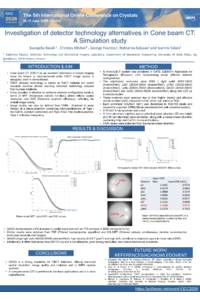
Introduction: Cone beam CT (CBCT) is an excellent alternative in breast imaging since the breast is uncompressed while CBCT image quality is adequate, even in a dense breast. CBCT detector technology is based on CsI:Tl material, but recent research has explored photon counting detector technology adapted from nuclear medicine. A key question is whether an optimum detector configuration exists in terms of MTF (modulation transfer function), which reflects spatial resolution, and DQE (detective quantum efficiency), reflecting the overall image quality.
Methods: A micro-CBCT system was simulated in GATE (GEANT4 Application for Tomographic Emission) v.9.2, incorporating seven different detector configurations. The scintillators evaluated were BGO (light yield: 8000-10000 photons/MeV), LSO (25000-30000 photons/MeV), LYSO (30000-38000 photons/MeV), LaBr3 (60000-70000 photons/MeV), GAGG (40000-60000 photons/MeV) and LuAG (18000-25000 photons/MeV) along with CZT as a semiconductor. These materials were selected due to their higher density and effective atomic number (Zeff) compared to CsI, which can enhance DQE. Each scintillator (50x50x1 mm3) was discretized in 100x100 pixels and coupled to a generic SiPM (silicon photomultiplier) with a pixelated readout. A 40 keV X-ray spectrum was used. A 1 mm aluminum capillary and a cylindrical water phantom (20 mm height and 16 mm diameter) were simulated.
Results: GAGG demonstrated a 4% increase in spatial resolution and an 11% increase in DQE compared to CsI. Similar results were obtained from FBP (filtered backprojection algorithm) and OS-SIRT (ordered subset simultaneous iterative reconstruction technique)-reconstructed images. GAGG’s high light yield (40000-60000 photons/MeV), high density (6.6-6.7 g/cm3) and high Zeff contribute to an improved signal-to-noise ratio (SNR). Additionally, it offers a fast decay time (80-100 ns) and low afterglow, good energy resolution, and robust mechanical properties.
Conclusions: GAGG is a strong candidate for CBCT detectors, offering improved spatial resolution, image quality and matching in SiPM readout systems.
Keywords
CBCT
photon counting detectors
GAGG
CZT
breast imaging
scintillators
semiconductors
GATE
Poster
E_Karali_et_al_flash_poster_iocc26.pdf
Design of Mono- and Multimetal Oxide Nanoparticles for Enhanced Antimicrobial Surface Applications
Layered chalcogenides of the FeGa2S4 structure type: synthesis, crystal structure, and magnetic properties