Event submissions
Published
This submission belongs to the session S1. Inorganic Crystalline Materials of the event The 5th International Online Conference on Crystals
Published date
10 Jun, 2026
Academic Editor
'%3e%3cpath%20d='M12.6657%2010.9104C12.4185%2010.325%2012.0599%209.79327%2011.6097%209.34482C11.1609%208.89508%2010.6293%208.5365%2010.0442%208.28888C10.0389%208.28626%2010.0337%208.28495%2010.0285%208.28233C10.8446%207.69279%2011.3752%206.73249%2011.3752%205.64904C11.3752%203.8542%209.92103%202.39999%208.1262%202.39999C6.33136%202.39999%204.87715%203.8542%204.87715%205.64904C4.87715%206.73249%205.40774%207.69279%206.22393%208.28364C6.21869%208.28626%206.21345%208.28757%206.20821%208.29019C5.62129%208.5378%205.09463%208.89284%204.64265%209.34613C4.1929%209.79493%203.83432%2010.3266%203.58671%2010.9117C3.34345%2011.4845%203.21226%2012.0987%203.20023%2012.7209C3.19988%2012.7349%203.20233%2012.7488%203.20744%2012.7619C3.21255%2012.7749%203.22022%2012.7867%203.22998%2012.7968C3.23975%2012.8068%203.25142%2012.8147%203.26431%2012.8202C3.2772%2012.8256%203.29105%2012.8284%203.30504%2012.8284H4.09109C4.14874%2012.8284%204.19459%2012.7825%204.1959%2012.7262C4.2221%2011.7148%204.62823%2010.7676%205.34617%2010.0497C6.08899%209.30683%207.0755%208.89808%208.1262%208.89808C9.17689%208.89808%2010.1634%209.30683%2010.9062%2010.0497C11.6242%2010.7676%2012.0303%2011.7148%2012.0565%2012.7262C12.0578%2012.7838%2012.1037%2012.8284%2012.1613%2012.8284H12.9474C12.9613%2012.8284%2012.9752%2012.8256%2012.9881%2012.8202C13.001%2012.8147%2013.0126%2012.8068%2013.0224%2012.7968C13.0322%2012.7867%2013.0398%2012.7749%2013.0449%2012.7619C13.0501%2012.7488%2013.0525%2012.7349%2013.0522%2012.7209C13.0391%2012.0947%2012.9094%2011.4855%2012.6657%2010.9104ZM8.1262%207.9024C7.52486%207.9024%206.9589%207.6679%206.53312%207.24211C6.10733%206.81633%205.87283%206.25037%205.87283%205.64904C5.87283%205.0477%206.10733%204.48174%206.53312%204.05596C6.9589%203.63018%207.52486%203.39567%208.1262%203.39567C8.72753%203.39567%209.29349%203.63018%209.71927%204.05596C10.1451%204.48174%2010.3796%205.0477%2010.3796%205.64904C10.3796%206.25037%2010.1451%206.81633%209.71927%207.24211C9.29349%207.6679%208.72753%207.9024%208.1262%207.9024Z'%20fill='%235D1EE1'/%3e%3c/g%3e%3c/svg%3e) John Parthenios
John PartheniosCitation
Yaroslav P. Biryukov, Almaz L. Zinnatullin, Maxim D. Kuznetsov, Yulia S. Gokhfeld, Natalia V. Kazak, Maria G. Krzhizhanovskaya, Farit G. Vagizov, Rimma S. Bubnova, TUNABLE LOW THERMAL EXPANSION IN CALCITE-TYPE FeBO₃ AND CrBO₃ BORATES, in Proceedings of The 5th International Online Conference on Crystals, 15 June–17 June 2026, MDPI: Basel, Switzerland
Share
Email
Facebook
Twitter
LinkedIn
TUNABLE LOW THERMAL EXPANSION IN CALCITE-TYPE FeBO3 AND CrBO3 BORATES
'%3e%3cpath%20d='M12.6647%2010.9104C12.4176%2010.325%2012.0589%209.7933%2011.6088%209.34485C11.16%208.89511%2010.6283%208.53653%2010.0432%208.28891C10.038%208.28629%2010.0327%208.28498%2010.0275%208.28236C10.8437%207.69282%2011.3743%206.73252%2011.3743%205.64907C11.3743%203.85423%209.92005%202.40002%208.12522%202.40002C6.33038%202.40002%204.87618%203.85423%204.87618%205.64907C4.87618%206.73252%205.40677%207.69282%206.22296%208.28367C6.21772%208.28629%206.21248%208.2876%206.20724%208.29022C5.62031%208.53783%205.09365%208.89287%204.64167%209.34616C4.19192%209.79496%203.83334%2010.3266%203.58573%2010.9117C3.34247%2011.4846%203.21128%2012.0987%203.19925%2012.721C3.1989%2012.735%203.20135%2012.7489%203.20646%2012.7619C3.21157%2012.7749%203.21924%2012.7868%203.22901%2012.7968C3.23877%2012.8068%203.25045%2012.8148%203.26334%2012.8202C3.27623%2012.8256%203.29007%2012.8284%203.30406%2012.8284H4.09012C4.14776%2012.8284%204.19362%2012.7825%204.19493%2012.7262C4.22113%2011.7148%204.62726%2010.7676%205.34519%2010.0497C6.08802%209.30686%207.07452%208.89811%208.12522%208.89811C9.17592%208.89811%2010.1624%209.30686%2010.9052%2010.0497C11.6232%2010.7676%2012.0293%2011.7148%2012.0555%2012.7262C12.0568%2012.7839%2012.1027%2012.8284%2012.1603%2012.8284H12.9464C12.9604%2012.8284%2012.9742%2012.8256%2012.9871%2012.8202C13%2012.8148%2013.0117%2012.8068%2013.0214%2012.7968C13.0312%2012.7868%2013.0389%2012.7749%2013.044%2012.7619C13.0491%2012.7489%2013.0515%2012.735%2013.0512%2012.721C13.0381%2012.0947%2012.9084%2011.4856%2012.6647%2010.9104ZM8.12522%207.90243C7.52388%207.90243%206.95792%207.66793%206.53214%207.24215C6.10636%206.81636%205.87185%206.2504%205.87185%205.64907C5.87185%205.04773%206.10636%204.48177%206.53214%204.05599C6.95792%203.63021%207.52388%203.3957%208.12522%203.3957C8.72655%203.3957%209.29252%203.63021%209.7183%204.05599C10.1441%204.48177%2010.3786%205.04773%2010.3786%205.64907C10.3786%206.2504%2010.1441%206.81636%209.7183%207.24215C9.29252%207.66793%208.72655%207.90243%208.12522%207.90243Z'%20fill='%235D1EE1'/%3e%3c/g%3e%3c/svg%3e)
Yaroslav P. Biryukov 1

Almaz L. Zinnatullin 2
Maxim D. Kuznetsov 1,3
Yulia S. Gokhfeld 4
Natalia V. Kazak 4
Maria G. Krzhizhanovskaya 5
Farit G. Vagizov 2
Rimma S. Bubnova 1
1. Laboratory of structural chemistry of oxides, Institute of Silicate Chemistry, 2 Makarova Emb., Saint Petersburg, 199034, Russian Federation, Russia
2. Institute of Physics, Kazan Federal University, 18 Kremlyovskaya street, Kazan, 420008, Russian Federation, Russia
3. Institute of Physics, Kazan Federal University, 18 Kremlyovskaya street, Kazan, 420008, Russian Federation
4. Kirensky Institute of Physics, Federal Research Center KSC SB RAS, 50/38 Akademgorodok, Krasnoyarsk, 660036, Russian Federation, Russia
5. Institute of Earth Science, St. Petersburg State University, 7/9 Universitetskaya Emb., St. Petersburg, 199034, Russian Federation, Russia
Abstract
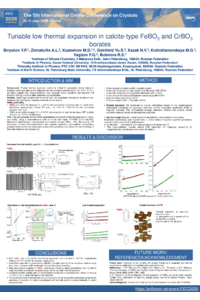
Transition metal borates have attracted considerable interest due to their rich crystal chemistry and diverse functional properties (magnetic, electrochemical, optical and others). These materials exhibit rare phenomena such as high magnetic ordering temperatures, cascades of magnetic transitions, and spin-liquid, glass and ice states. Owing to its unique combination of properties, FeBO3 has been developed as a commercial Mössbauer source for synchrotron facilities [1]. In FeBO3, the magnetic ordering temperature is high (TN ≈ 348 K), whereas in Fe1–xCrxBO3, it decreases with increasing Cr content [2].
In this work, FeBO3 and CrBO3 were investigated by in situ high-temperature powder X-ray diffraction (Rigaku Ultima IV, Cu Kα, 295–1173 K). Near TN, FeBO3 exhibits anomalous unit-cell behavior, whereas CrBO3 shows no such anomalies. Both borates display positive uniaxial thermal expansion with low average coefficients: α = 8 (FeBO3) and 6 × 10⁻⁶K−1 (CrBO3). The slight reduction in the expansion upon the Cr → Fe substitution arises from the smaller ionic radius of VICr3+ and shorter Cr–O bonds. FeBO3 remains stable up to ~900 K, where a recrystallization to α-Fe2O3appears, while CrBO3 is stable up to 1173 K. Thermal expansion is maximum along the c axis, i.e., perpendicularly to planes of the isolated BO3 triangles, and minimum in the ab plane. These findings suggest that Fe1–xCrxBO3 borates are promising candidates for synchrotron, optical and magnetic applications requiring tunable low thermal expansion.
The work is funded by the Russian Science Foundation [25-73-00080].
- Potapkin, A.I. Chumakov, G.V Smirnov, J.-P. Celse, R. Rüffer, C. McCammon & L. Dubrovinsky, The 57Fe Synchrotron Mössbauer Source at the ESRF, J. Synchrotron Radiation. 19 (2012) 559–569.
- Muller, M.P. O'Horo, J.F. O'Neill, FeBO3 solid solutions: Synthesis, crystal chemistry, and magnetic properties, J. Solid State Chemistry. 23 (1978) 115–128.
Keywords
borates
crystal structure
low thermal expansion
magnetic materials
Poster
Biryukov poster.pdf
Hafnium-Substituted Magnetite with Tunable Heating Performance for Hyperthermia Therapy
Er-activated nanoparticles as probes in biothermal imaging