Event submissions
Published
This submission belongs to the session S1. Inorganic Crystalline Materials of the event The 5th International Online Conference on Crystals
Published date
10 Jun, 2026
Academic Editor
'%3e%3cpath%20d='M12.6657%2010.9104C12.4185%2010.325%2012.0599%209.79327%2011.6097%209.34482C11.1609%208.89508%2010.6293%208.5365%2010.0442%208.28888C10.0389%208.28626%2010.0337%208.28495%2010.0285%208.28233C10.8446%207.69279%2011.3752%206.73249%2011.3752%205.64904C11.3752%203.8542%209.92103%202.39999%208.1262%202.39999C6.33136%202.39999%204.87715%203.8542%204.87715%205.64904C4.87715%206.73249%205.40774%207.69279%206.22393%208.28364C6.21869%208.28626%206.21345%208.28757%206.20821%208.29019C5.62129%208.5378%205.09463%208.89284%204.64265%209.34613C4.1929%209.79493%203.83432%2010.3266%203.58671%2010.9117C3.34345%2011.4845%203.21226%2012.0987%203.20023%2012.7209C3.19988%2012.7349%203.20233%2012.7488%203.20744%2012.7619C3.21255%2012.7749%203.22022%2012.7867%203.22998%2012.7968C3.23975%2012.8068%203.25142%2012.8147%203.26431%2012.8202C3.2772%2012.8256%203.29105%2012.8284%203.30504%2012.8284H4.09109C4.14874%2012.8284%204.19459%2012.7825%204.1959%2012.7262C4.2221%2011.7148%204.62823%2010.7676%205.34617%2010.0497C6.08899%209.30683%207.0755%208.89808%208.1262%208.89808C9.17689%208.89808%2010.1634%209.30683%2010.9062%2010.0497C11.6242%2010.7676%2012.0303%2011.7148%2012.0565%2012.7262C12.0578%2012.7838%2012.1037%2012.8284%2012.1613%2012.8284H12.9474C12.9613%2012.8284%2012.9752%2012.8256%2012.9881%2012.8202C13.001%2012.8147%2013.0126%2012.8068%2013.0224%2012.7968C13.0322%2012.7867%2013.0398%2012.7749%2013.0449%2012.7619C13.0501%2012.7488%2013.0525%2012.7349%2013.0522%2012.7209C13.0391%2012.0947%2012.9094%2011.4855%2012.6657%2010.9104ZM8.1262%207.9024C7.52486%207.9024%206.9589%207.6679%206.53312%207.24211C6.10733%206.81633%205.87283%206.25037%205.87283%205.64904C5.87283%205.0477%206.10733%204.48174%206.53312%204.05596C6.9589%203.63018%207.52486%203.39567%208.1262%203.39567C8.72753%203.39567%209.29349%203.63018%209.71927%204.05596C10.1451%204.48174%2010.3796%205.0477%2010.3796%205.64904C10.3796%206.25037%2010.1451%206.81633%209.71927%207.24211C9.29349%207.6679%208.72753%207.9024%208.1262%207.9024Z'%20fill='%235D1EE1'/%3e%3c/g%3e%3c/svg%3e) Zongyou Yin
Zongyou YinCitation
Constantinos D. Zeinalipour-Yazdi, Geometry of the Adsorption Sites in Metal Nanoparticles and Surfaces, in Proceedings of The 5th International Online Conference on Crystals, 15 June–17 June 2026, MDPI: Basel, Switzerland
Share
Email
Facebook
Twitter
LinkedIn
Geometry of the Adsorption Sites in Metal Nanoparticles and Surfaces

Constantinos D. Zeinalipour-Yazdi 1
1. Bioscience and Chemistry, Faculty of Computing, Mathematics, Engineering and Natural Sciences, Northeastern University London, London E1W 1LP, United Kingdom, UK
Abstract
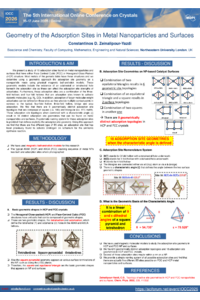
We present a study of 18 adsorption sites found on metal nanoparticles and surfaces that have either a Face-Centred Cubic (FCC) or Hexagonal Close-Packed (HCP) structure. Most metals in the periodic table have these structures, and we determine using a geometric approach the adsorption site geometry on a nanoparticle made using physical magnetic ball-and-stick models. These geometric models include the existence of an octahedral or tetrahedral hole beneath the adsorption site, as these can affect the adsorption site strength of adsorbates. Furthermore, these adsorption sites are a combination of the three-fold hollows and four-fold hollows, which are adsorption sites known to activate diatomic molecules (e.g. N2, CO). In addition, adsorption of larger molecular weight adsorbates can be defined on these sites as they provide multiple contact points in contrast to the typical, four-fold hollow, three-fold hollow, bridge and atop adsorption. We find that there are 9 geometrically distinct adsorption site topologies that are composed of square (i.e. 100) and triangular (i.e. 111) motifs. These adsorption site topologies when combined with a characteristic angle (ζ) result in 18 distinct adsorption site geometries that can be found on metal nanoparticles and surfaces. A systematic naming system for these adsorption sites is provided that explicitly defines the adsorption site geometry. Using this approach we find that there are five different type of B5 sites, an adsorption site that has been previously found to activate dinitrogen on ruthenium for the ammonia synthesis reaction.
Keywords
ball-and-stick models
FCC
HCP
Nanoparticles
Surfaces
Metals
Poster
Constantinos_Zeinalipou_IOCC_2026_poster.pdf
X-ray luminescence performance of a BGO single crystal under the influence of external temperatures: Comparison with BaF2
Enhancement in the crystallinity of ZnO nanostructures induced by rapid thermal annealing