Event submissions
Published
This submission belongs to the session S2. Liquid Crystals of the event The 5th International Online Conference on Crystals
Published date
10 Jun, 2026
Academic Editor
'%3e%3cpath%20d='M12.6657%2010.9104C12.4185%2010.325%2012.0599%209.79327%2011.6097%209.34482C11.1609%208.89508%2010.6293%208.5365%2010.0442%208.28888C10.0389%208.28626%2010.0337%208.28495%2010.0285%208.28233C10.8446%207.69279%2011.3752%206.73249%2011.3752%205.64904C11.3752%203.8542%209.92103%202.39999%208.1262%202.39999C6.33136%202.39999%204.87715%203.8542%204.87715%205.64904C4.87715%206.73249%205.40774%207.69279%206.22393%208.28364C6.21869%208.28626%206.21345%208.28757%206.20821%208.29019C5.62129%208.5378%205.09463%208.89284%204.64265%209.34613C4.1929%209.79493%203.83432%2010.3266%203.58671%2010.9117C3.34345%2011.4845%203.21226%2012.0987%203.20023%2012.7209C3.19988%2012.7349%203.20233%2012.7488%203.20744%2012.7619C3.21255%2012.7749%203.22022%2012.7867%203.22998%2012.7968C3.23975%2012.8068%203.25142%2012.8147%203.26431%2012.8202C3.2772%2012.8256%203.29105%2012.8284%203.30504%2012.8284H4.09109C4.14874%2012.8284%204.19459%2012.7825%204.1959%2012.7262C4.2221%2011.7148%204.62823%2010.7676%205.34617%2010.0497C6.08899%209.30683%207.0755%208.89808%208.1262%208.89808C9.17689%208.89808%2010.1634%209.30683%2010.9062%2010.0497C11.6242%2010.7676%2012.0303%2011.7148%2012.0565%2012.7262C12.0578%2012.7838%2012.1037%2012.8284%2012.1613%2012.8284H12.9474C12.9613%2012.8284%2012.9752%2012.8256%2012.9881%2012.8202C13.001%2012.8147%2013.0126%2012.8068%2013.0224%2012.7968C13.0322%2012.7867%2013.0398%2012.7749%2013.0449%2012.7619C13.0501%2012.7488%2013.0525%2012.7349%2013.0522%2012.7209C13.0391%2012.0947%2012.9094%2011.4855%2012.6657%2010.9104ZM8.1262%207.9024C7.52486%207.9024%206.9589%207.6679%206.53312%207.24211C6.10733%206.81633%205.87283%206.25037%205.87283%205.64904C5.87283%205.0477%206.10733%204.48174%206.53312%204.05596C6.9589%203.63018%207.52486%203.39567%208.1262%203.39567C8.72753%203.39567%209.29349%203.63018%209.71927%204.05596C10.1451%204.48174%2010.3796%205.0477%2010.3796%205.64904C10.3796%206.25037%2010.1451%206.81633%209.71927%207.24211C9.29349%207.6679%208.72753%207.9024%208.1262%207.9024Z'%20fill='%235D1EE1'/%3e%3c/g%3e%3c/svg%3e) Vladimir Chigrinov
Vladimir ChigrinovCitation
Rabab Zehra, Maurizio Nobili, Daniel Stoenescu, Serigne Cheikh Faye, Claire Meyer, Patrick Davidson, Ivan Dozov, Christophe Blanc, Role of elastic constants in the textures of 8CB-CB7CB mixtures, in Proceedings of The 5th International Online Conference on Crystals, 15 June–17 June 2026, MDPI: Basel, Switzerland
Share
Email
Facebook
Twitter
LinkedIn
Role of elastic constants in the textures of 8CB-CB7CB mixtures
'%3e%3cpath%20d='M12.6647%2010.9104C12.4176%2010.325%2012.0589%209.7933%2011.6088%209.34485C11.16%208.89511%2010.6283%208.53653%2010.0432%208.28891C10.038%208.28629%2010.0327%208.28498%2010.0275%208.28236C10.8437%207.69282%2011.3743%206.73252%2011.3743%205.64907C11.3743%203.85423%209.92005%202.40002%208.12522%202.40002C6.33038%202.40002%204.87618%203.85423%204.87618%205.64907C4.87618%206.73252%205.40677%207.69282%206.22296%208.28367C6.21772%208.28629%206.21248%208.2876%206.20724%208.29022C5.62031%208.53783%205.09365%208.89287%204.64167%209.34616C4.19192%209.79496%203.83334%2010.3266%203.58573%2010.9117C3.34247%2011.4846%203.21128%2012.0987%203.19925%2012.721C3.1989%2012.735%203.20135%2012.7489%203.20646%2012.7619C3.21157%2012.7749%203.21924%2012.7868%203.22901%2012.7968C3.23877%2012.8068%203.25045%2012.8148%203.26334%2012.8202C3.27623%2012.8256%203.29007%2012.8284%203.30406%2012.8284H4.09012C4.14776%2012.8284%204.19362%2012.7825%204.19493%2012.7262C4.22113%2011.7148%204.62726%2010.7676%205.34519%2010.0497C6.08802%209.30686%207.07452%208.89811%208.12522%208.89811C9.17592%208.89811%2010.1624%209.30686%2010.9052%2010.0497C11.6232%2010.7676%2012.0293%2011.7148%2012.0555%2012.7262C12.0568%2012.7839%2012.1027%2012.8284%2012.1603%2012.8284H12.9464C12.9604%2012.8284%2012.9742%2012.8256%2012.9871%2012.8202C13%2012.8148%2013.0117%2012.8068%2013.0214%2012.7968C13.0312%2012.7868%2013.0389%2012.7749%2013.044%2012.7619C13.0491%2012.7489%2013.0515%2012.735%2013.0512%2012.721C13.0381%2012.0947%2012.9084%2011.4856%2012.6647%2010.9104ZM8.12522%207.90243C7.52388%207.90243%206.95792%207.66793%206.53214%207.24215C6.10636%206.81636%205.87185%206.2504%205.87185%205.64907C5.87185%205.04773%206.10636%204.48177%206.53214%204.05599C6.95792%203.63021%207.52388%203.3957%208.12522%203.3957C8.72655%203.3957%209.29252%203.63021%209.7183%204.05599C10.1441%204.48177%2010.3786%205.04773%2010.3786%205.64907C10.3786%206.2504%2010.1441%206.81636%209.7183%207.24215C9.29252%207.66793%208.72655%207.90243%208.12522%207.90243Z'%20fill='%235D1EE1'/%3e%3c/g%3e%3c/svg%3e)
Rabab Zehra 1
Maurizio Nobili 1
Daniel Stoenescu 2
Serigne Cheikh Faye 3
Claire Meyer 3
Patrick Davidson 4
Ivan Dozov 4

Christophe Blanc 1
1. Laboratoire Charles Coulomb (L2C), Université de Montpellier, CNRS, Montpellier, 34090, France, France
2. Département Optique, IMT- Atlantique, Brest, 29280, France, France
3. Physique des Systèmes Complexes (PSC), Université de Picardie Jules Verne, Amiens, 80039, France, France
4. Laboratoire de Physique des Solides (LPS), Université Paris Saclay, CNRS, Paris, 91400, France, France
Abstract
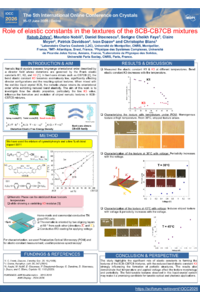
Nematic liquid crystals possess long‑range orientational order described by a director field whose distortions are mainly determined by the Frank elastic constants for splay (K₁₁), twist (K₂₂), and bend (K₃₃)1. In bent‑shaped dimers such as CB7CB, the bend elastic constant K₃₃ becomes anomalously low near the nematic twist–bend phase2, strongly influencing director configurations and electro‑optic textures. When CB7CB is mixed with the rod‑like compound 8CB, the resulting nematic phase maintains the usual orientational order while inheriting a very low3 K33 value, making the system ideal for studying elasticity‑affected textures.
This work demonstrates how such variations in elastic constants¹ shape the texture of a chiralized nematic. Usually adding a small amount of a chiral dopant to a nematic phase only induces a spontaneous twist and results in homogeneous textures. We show this is no longer the case with a reduced bend constant. Mixtures of 8CB and CB7CB were prepared and filled into planar and twisted‑nematic cells. Elastic constants K₁₁, K₂₂, and K₃₃ were then measured with changes in temperature and composition using impedance spectroscopy and electro‑optic response analysis. The texture evolution of these mixtures doped with the chiral compound S811 was observed using polarized optical microscopy. Mixtures with higher CB7CB content show a significant reduction in K₃₃, while K₁₁ and K₂₂ vary more moderately. This low‑K₃₃ regime leads to voltage‑induced striped and heliconical‑like textures, with periodicity varying with the temperature. Elastic anisotropy—particularly when K₃₃ becomes very small—plays a central role in forming and stabilizing non‑uniform nematic textures.
References: 1F. C. Frank, Discuss. Faraday Soc. 25, 19 (1958).
2I. Dozov, Europhys. Lett. 56, 247 (2001).
3A. Aouini, M. Nobili, E. Chauveau, P. Dieudonné‑George, G. Damême, D. Stoenescu, I. Dozov, and C. Blanc, Crystals 10, 1110 (2020).
Keywords
Nematic
Elastic constants
K11
K222
K33
Poster
Rabab_ZEHRA_University of Montpellier (L2C).pdf
INFLUENCE OF BIOLOGICALLY ACTIVE ADDITIVES ON THE VISCOSITY OF LAMELLAR LIQUID CRYSTALS
Exploring Inter-Nanoparticle Repulsion Effects on Structural Phases and Diffusivity in Polymer Nanocomposites: A Langevin Dynamics Simulation Study