Event submissions
Published
This submission belongs to the session S4. Hybrid and Composite Crystalline Materials of the event The 5th International Online Conference on Crystals
Published date
10 Jun, 2026
Academic Editor
'%3e%3cpath%20d='M12.6657%2010.9104C12.4185%2010.325%2012.0599%209.79327%2011.6097%209.34482C11.1609%208.89508%2010.6293%208.5365%2010.0442%208.28888C10.0389%208.28626%2010.0337%208.28495%2010.0285%208.28233C10.8446%207.69279%2011.3752%206.73249%2011.3752%205.64904C11.3752%203.8542%209.92103%202.39999%208.1262%202.39999C6.33136%202.39999%204.87715%203.8542%204.87715%205.64904C4.87715%206.73249%205.40774%207.69279%206.22393%208.28364C6.21869%208.28626%206.21345%208.28757%206.20821%208.29019C5.62129%208.5378%205.09463%208.89284%204.64265%209.34613C4.1929%209.79493%203.83432%2010.3266%203.58671%2010.9117C3.34345%2011.4845%203.21226%2012.0987%203.20023%2012.7209C3.19988%2012.7349%203.20233%2012.7488%203.20744%2012.7619C3.21255%2012.7749%203.22022%2012.7867%203.22998%2012.7968C3.23975%2012.8068%203.25142%2012.8147%203.26431%2012.8202C3.2772%2012.8256%203.29105%2012.8284%203.30504%2012.8284H4.09109C4.14874%2012.8284%204.19459%2012.7825%204.1959%2012.7262C4.2221%2011.7148%204.62823%2010.7676%205.34617%2010.0497C6.08899%209.30683%207.0755%208.89808%208.1262%208.89808C9.17689%208.89808%2010.1634%209.30683%2010.9062%2010.0497C11.6242%2010.7676%2012.0303%2011.7148%2012.0565%2012.7262C12.0578%2012.7838%2012.1037%2012.8284%2012.1613%2012.8284H12.9474C12.9613%2012.8284%2012.9752%2012.8256%2012.9881%2012.8202C13.001%2012.8147%2013.0126%2012.8068%2013.0224%2012.7968C13.0322%2012.7867%2013.0398%2012.7749%2013.0449%2012.7619C13.0501%2012.7488%2013.0525%2012.7349%2013.0522%2012.7209C13.0391%2012.0947%2012.9094%2011.4855%2012.6657%2010.9104ZM8.1262%207.9024C7.52486%207.9024%206.9589%207.6679%206.53312%207.24211C6.10733%206.81633%205.87283%206.25037%205.87283%205.64904C5.87283%205.0477%206.10733%204.48174%206.53312%204.05596C6.9589%203.63018%207.52486%203.39567%208.1262%203.39567C8.72753%203.39567%209.29349%203.63018%209.71927%204.05596C10.1451%204.48174%2010.3796%205.0477%2010.3796%205.64904C10.3796%206.25037%2010.1451%206.81633%209.71927%207.24211C9.29349%207.6679%208.72753%207.9024%208.1262%207.9024Z'%20fill='%235D1EE1'/%3e%3c/g%3e%3c/svg%3e) Ferdinando Costantino
Ferdinando CostantinoCitation
Milind Janardan Kulkarni, Pravin P. Pawar, Rajendra R. Deshmukh, Laxman V. Jathar, Modika Madhav Kulkarni, Thermal Behavior, Crystallization Kinetics, and Morphology of PBT/MWCNT Composites: A Combined DSC and Hot-Stage POM Study, in Proceedings of The 5th International Online Conference on Crystals, 15 June–17 June 2026, MDPI: Basel, Switzerland
Share
Email
Facebook
Twitter
LinkedIn
Thermal Behavior, Crystallization Kinetics, and Morphology of PBT/MWCNT Composites: A Combined DSC and Hot-Stage POM Study
'%3e%3cpath%20d='M12.6647%2010.9104C12.4176%2010.325%2012.0589%209.7933%2011.6088%209.34485C11.16%208.89511%2010.6283%208.53653%2010.0432%208.28891C10.038%208.28629%2010.0327%208.28498%2010.0275%208.28236C10.8437%207.69282%2011.3743%206.73252%2011.3743%205.64907C11.3743%203.85423%209.92005%202.40002%208.12522%202.40002C6.33038%202.40002%204.87618%203.85423%204.87618%205.64907C4.87618%206.73252%205.40677%207.69282%206.22296%208.28367C6.21772%208.28629%206.21248%208.2876%206.20724%208.29022C5.62031%208.53783%205.09365%208.89287%204.64167%209.34616C4.19192%209.79496%203.83334%2010.3266%203.58573%2010.9117C3.34247%2011.4846%203.21128%2012.0987%203.19925%2012.721C3.1989%2012.735%203.20135%2012.7489%203.20646%2012.7619C3.21157%2012.7749%203.21924%2012.7868%203.22901%2012.7968C3.23877%2012.8068%203.25045%2012.8148%203.26334%2012.8202C3.27623%2012.8256%203.29007%2012.8284%203.30406%2012.8284H4.09012C4.14776%2012.8284%204.19362%2012.7825%204.19493%2012.7262C4.22113%2011.7148%204.62726%2010.7676%205.34519%2010.0497C6.08802%209.30686%207.07452%208.89811%208.12522%208.89811C9.17592%208.89811%2010.1624%209.30686%2010.9052%2010.0497C11.6232%2010.7676%2012.0293%2011.7148%2012.0555%2012.7262C12.0568%2012.7839%2012.1027%2012.8284%2012.1603%2012.8284H12.9464C12.9604%2012.8284%2012.9742%2012.8256%2012.9871%2012.8202C13%2012.8148%2013.0117%2012.8068%2013.0214%2012.7968C13.0312%2012.7868%2013.0389%2012.7749%2013.044%2012.7619C13.0491%2012.7489%2013.0515%2012.735%2013.0512%2012.721C13.0381%2012.0947%2012.9084%2011.4856%2012.6647%2010.9104ZM8.12522%207.90243C7.52388%207.90243%206.95792%207.66793%206.53214%207.24215C6.10636%206.81636%205.87185%206.2504%205.87185%205.64907C5.87185%205.04773%206.10636%204.48177%206.53214%204.05599C6.95792%203.63021%207.52388%203.3957%208.12522%203.3957C8.72655%203.3957%209.29252%203.63021%209.7183%204.05599C10.1441%204.48177%2010.3786%205.04773%2010.3786%205.64907C10.3786%206.2504%2010.1441%206.81636%209.7183%207.24215C9.29252%207.66793%208.72655%207.90243%208.12522%207.90243Z'%20fill='%235D1EE1'/%3e%3c/g%3e%3c/svg%3e)
Modika Madhav Kulkarni 1
Rajendra R. Deshmukh 2
Pravin P. Pawar 3
Laxman V. Jathar 4
Milind Janardan Kulkarni 5
1. Cyber Security Department, Shah & Anchor Kutchhi Engineering College, Mumbai – 400 088, India, India
2. Department of Physics, Institute of Chemical Technology, Mumbai, Maharashtra 400019, India, India
3. Department of Physics, Thakur College of Science & Commerce, Mumbai - 400101, India, India
4. Department of Physics, R.D. & S.H. National College, Mumbai- 400050, India, India
5. Department of Physics, R.D.National College affiliated with University of Mumbai, Mumbai, Maharashtra, India, India
Abstract
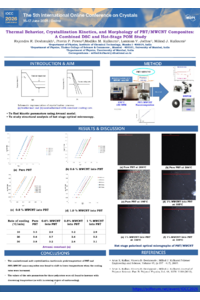
Poly(butylene terephthalate) (PBT)/multiwalled carbon nanotube (MWCNT) composites were prepared using a simple and reliable melt mixing technique to understand how the addition of nanotubes affects the crystallization behavior and thermal properties of PBT. The non-isothermal crystallization process was studied using differential scanning calorimetry (DSC), while hot-stage polarized optical microscopy (HSPOM) was used to observe changes in microstructure at different cooling rates.
From a practical point of view, adding MWCNTs changes how PBT crystallizes. As the nanotube content increases, the viscosity of the system also increases, which restricts the movement of PBT chains and makes crystallization more difficult. Kinetic analysis shows that the basic crystallization mechanism remains similar, but the rate is influenced by the presence of MWCNTs. For pure PBT, the modified Avrami exponent (n) is 3.0 at a cooling rate of 15 °C min⁻¹ and increases to 3.7 at 30 °C min⁻¹. When 1 wt% MWCNT is added, the values slightly decrease to 2.9 and 3.1 at 15 °C min⁻¹ and 30 °C min⁻¹, respectively, indicating heterogeneous nucleation with minor changes in growth behavior. Kissinger analysis also suggests that higher energy is required for crystallization after adding MWCNTs.
Another important observation is the reduction in the crystal growth parameter after adding MWCNTs. It decreases from 6.1× 10⁴ for pure PBT to 3. × 104 for the 1 % MWCNT into PBT. This shows that although MWCNTs help in nucleation, they also act as barriers that slow down the growth of crystals.
X-ray diffraction (XRD) results confirm that the crystal structure of PBT does not change with the addition of MWCNTs, as no new peaks are observed. However, a slight increase in crystallinity is seen due to the nucleating effect of the nanotubes.
Overall, MWCNTs play a dual role in the PBT matrix: they promote nucleation while also restricting chain movement and crystal growth. This balance leads to a more controlled crystallization process, which can be useful for improving material performance in practical applications.
Keywords
Differential Scanning Calorimeter (DSC)
Hot-Stage Polarized Optical Microscopy (HSPOM)
Poly(ButyleneTterephthalate) (PBT)
Multiwalled Carbon Nanotube (MWCNT)
Crystallization Kinetics
Poster
MJK IOCC 2026.pdf
An Ultramicroporous Fe(II)-Anilato MOF for CO2 Capture and Environmental Applications
Chiral Redox-Active Metal–Organic Frameworks Based on Benzoquinone-Derived Linkers