Event submissions
Published
This submission belongs to the session S4. Hybrid and Composite Crystalline Materials of the event The 5th International Online Conference on Crystals
Published date
10 Jun, 2026
Academic Editor
'%3e%3cpath%20d='M12.6657%2010.9104C12.4185%2010.325%2012.0599%209.79327%2011.6097%209.34482C11.1609%208.89508%2010.6293%208.5365%2010.0442%208.28888C10.0389%208.28626%2010.0337%208.28495%2010.0285%208.28233C10.8446%207.69279%2011.3752%206.73249%2011.3752%205.64904C11.3752%203.8542%209.92103%202.39999%208.1262%202.39999C6.33136%202.39999%204.87715%203.8542%204.87715%205.64904C4.87715%206.73249%205.40774%207.69279%206.22393%208.28364C6.21869%208.28626%206.21345%208.28757%206.20821%208.29019C5.62129%208.5378%205.09463%208.89284%204.64265%209.34613C4.1929%209.79493%203.83432%2010.3266%203.58671%2010.9117C3.34345%2011.4845%203.21226%2012.0987%203.20023%2012.7209C3.19988%2012.7349%203.20233%2012.7488%203.20744%2012.7619C3.21255%2012.7749%203.22022%2012.7867%203.22998%2012.7968C3.23975%2012.8068%203.25142%2012.8147%203.26431%2012.8202C3.2772%2012.8256%203.29105%2012.8284%203.30504%2012.8284H4.09109C4.14874%2012.8284%204.19459%2012.7825%204.1959%2012.7262C4.2221%2011.7148%204.62823%2010.7676%205.34617%2010.0497C6.08899%209.30683%207.0755%208.89808%208.1262%208.89808C9.17689%208.89808%2010.1634%209.30683%2010.9062%2010.0497C11.6242%2010.7676%2012.0303%2011.7148%2012.0565%2012.7262C12.0578%2012.7838%2012.1037%2012.8284%2012.1613%2012.8284H12.9474C12.9613%2012.8284%2012.9752%2012.8256%2012.9881%2012.8202C13.001%2012.8147%2013.0126%2012.8068%2013.0224%2012.7968C13.0322%2012.7867%2013.0398%2012.7749%2013.0449%2012.7619C13.0501%2012.7488%2013.0525%2012.7349%2013.0522%2012.7209C13.0391%2012.0947%2012.9094%2011.4855%2012.6657%2010.9104ZM8.1262%207.9024C7.52486%207.9024%206.9589%207.6679%206.53312%207.24211C6.10733%206.81633%205.87283%206.25037%205.87283%205.64904C5.87283%205.0477%206.10733%204.48174%206.53312%204.05596C6.9589%203.63018%207.52486%203.39567%208.1262%203.39567C8.72753%203.39567%209.29349%203.63018%209.71927%204.05596C10.1451%204.48174%2010.3796%205.0477%2010.3796%205.64904C10.3796%206.25037%2010.1451%206.81633%209.71927%207.24211C9.29349%207.6679%208.72753%207.9024%208.1262%207.9024Z'%20fill='%235D1EE1'/%3e%3c/g%3e%3c/svg%3e) Ferdinando Costantino
Ferdinando CostantinoCitation
Atsushi Suzuki, Rina Tanaka, Takeo Oku, Tomoharu Tachikawa, Sakiko Fukunishi, Additive effect of ytterbium and neodymium for efficient and stable CH₃NH₃PbI₃ perovskite solar cells, in Proceedings of The 5th International Online Conference on Crystals, 15 June–17 June 2026, MDPI: Basel, Switzerland
Share
Email
Facebook
Twitter
LinkedIn
Additive effect of ytterbium and neodymium for efficient and stable CH3NH3PbI3 perovskite solar cells
'%3e%3cpath%20d='M12.6647%2010.9104C12.4176%2010.325%2012.0589%209.7933%2011.6088%209.34485C11.16%208.89511%2010.6283%208.53653%2010.0432%208.28891C10.038%208.28629%2010.0327%208.28498%2010.0275%208.28236C10.8437%207.69282%2011.3743%206.73252%2011.3743%205.64907C11.3743%203.85423%209.92005%202.40002%208.12522%202.40002C6.33038%202.40002%204.87618%203.85423%204.87618%205.64907C4.87618%206.73252%205.40677%207.69282%206.22296%208.28367C6.21772%208.28629%206.21248%208.2876%206.20724%208.29022C5.62031%208.53783%205.09365%208.89287%204.64167%209.34616C4.19192%209.79496%203.83334%2010.3266%203.58573%2010.9117C3.34247%2011.4846%203.21128%2012.0987%203.19925%2012.721C3.1989%2012.735%203.20135%2012.7489%203.20646%2012.7619C3.21157%2012.7749%203.21924%2012.7868%203.22901%2012.7968C3.23877%2012.8068%203.25045%2012.8148%203.26334%2012.8202C3.27623%2012.8256%203.29007%2012.8284%203.30406%2012.8284H4.09012C4.14776%2012.8284%204.19362%2012.7825%204.19493%2012.7262C4.22113%2011.7148%204.62726%2010.7676%205.34519%2010.0497C6.08802%209.30686%207.07452%208.89811%208.12522%208.89811C9.17592%208.89811%2010.1624%209.30686%2010.9052%2010.0497C11.6232%2010.7676%2012.0293%2011.7148%2012.0555%2012.7262C12.0568%2012.7839%2012.1027%2012.8284%2012.1603%2012.8284H12.9464C12.9604%2012.8284%2012.9742%2012.8256%2012.9871%2012.8202C13%2012.8148%2013.0117%2012.8068%2013.0214%2012.7968C13.0312%2012.7868%2013.0389%2012.7749%2013.044%2012.7619C13.0491%2012.7489%2013.0515%2012.735%2013.0512%2012.721C13.0381%2012.0947%2012.9084%2011.4856%2012.6647%2010.9104ZM8.12522%207.90243C7.52388%207.90243%206.95792%207.66793%206.53214%207.24215C6.10636%206.81636%205.87185%206.2504%205.87185%205.64907C5.87185%205.04773%206.10636%204.48177%206.53214%204.05599C6.95792%203.63021%207.52388%203.3957%208.12522%203.3957C8.72655%203.3957%209.29252%203.63021%209.7183%204.05599C10.1441%204.48177%2010.3786%205.04773%2010.3786%205.64907C10.3786%206.2504%2010.1441%206.81636%209.7183%207.24215C9.29252%207.66793%208.72655%207.90243%208.12522%207.90243Z'%20fill='%235D1EE1'/%3e%3c/g%3e%3c/svg%3e)
Atsushi Suzuki 1
Rina Tanaka 1
Takeo Oku 1
Tomoharu Tachikawa 2
Sakiko Fukunishi 2
1. Department of Materials Chemistry, The University of Shiga Prefecture,
2500 Hassaka, Hikone, Shiga 522-8533, Japan., Japan
2. Osaka Gas Chemicals Co., Ltd., Konohana-ku, Osaka 554-0051, Japan, Japan
Abstract
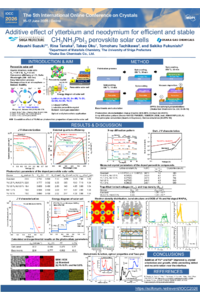
Co-additive effects of ytterbium (Yb) and neodymium (Nd) for efficient and stable CH3NH3PbI3 (MAPbI3) perovskite solar cells were investigated. Compared to single addition, co-addition of 0.5 at% Yb and Nd supported improvements in the photovoltaic characteristics, resulting in an increase in open-circuit voltage (Voc), short-circuit current density (Jsc), conversion efficiency (η) and stability. Morphological observation and crystal structure analysis showed that the grain boundaries within the perovskite layer were reduced, and stable, dense films were formed through crystal growth and orientation. Surface observation and composition analysis using energy-dispersive X-ray spectroscopy confirmed the presence of Pb, I, Yb and Nd elements in the perovskite crystal grain. The band structure and density of states predicted the state of carrier mobility near the valence and conduction band states. The electron density distribution of 4f and 5d orbitals of Yb and Nd ions and 5p orbital of the I ion was expected to promote the charge transfer related to the semi-conductive properties. The optical properties from ultraviolet to near-infrared regions were based on the excitation process between the 4f and 5d orbitals of Yb and Nd ions in the crystal. The co-doped system had stabilization while suppressing distortion in the coordination structure. The photovoltaic characteristics were discussed by comparing experimental and calculated results in J-V curves of the solar cell using SCAPS-1D simulation. The photovoltaic characteristics originate from the state of carrier diffusion while suppressing carrier recombination near the grain boundaries and interface between the perovskite film and hole-transporting layer. In the co-addition system, passivation occurred more effectively than in the single-addition system, resulting in photovoltaic characteristics with an increase in Jsc, Voc, η and stability.
Keywords
perovskite solar cell
rear metal
photovoltaic characteristics
X-ray diffraction
morphology
first-principles calculation
Poster
IOCC2026(suzuki)-P02.pdf
Electrical and Structural Characterization of Graphene–Polypyrrole Composite Thin Films for Flexible Wearable Electrodes
Formation and Crystallization Behavior of a New Organic–Inorganic Hybrid Crystalline Compound in the Ca(ClO₃)₂·2CO(NH₂)₂ – CH₂ClCOOH·(C₂H₄OH)₃N – H₂O System