Event submissions
Published
This submission belongs to the session S4. Hybrid and Composite Crystalline Materials of the event The 5th International Online Conference on Crystals
Published date
10 Jun, 2026
Academic Editor
'%3e%3cpath%20d='M12.6657%2010.9104C12.4185%2010.325%2012.0599%209.79327%2011.6097%209.34482C11.1609%208.89508%2010.6293%208.5365%2010.0442%208.28888C10.0389%208.28626%2010.0337%208.28495%2010.0285%208.28233C10.8446%207.69279%2011.3752%206.73249%2011.3752%205.64904C11.3752%203.8542%209.92103%202.39999%208.1262%202.39999C6.33136%202.39999%204.87715%203.8542%204.87715%205.64904C4.87715%206.73249%205.40774%207.69279%206.22393%208.28364C6.21869%208.28626%206.21345%208.28757%206.20821%208.29019C5.62129%208.5378%205.09463%208.89284%204.64265%209.34613C4.1929%209.79493%203.83432%2010.3266%203.58671%2010.9117C3.34345%2011.4845%203.21226%2012.0987%203.20023%2012.7209C3.19988%2012.7349%203.20233%2012.7488%203.20744%2012.7619C3.21255%2012.7749%203.22022%2012.7867%203.22998%2012.7968C3.23975%2012.8068%203.25142%2012.8147%203.26431%2012.8202C3.2772%2012.8256%203.29105%2012.8284%203.30504%2012.8284H4.09109C4.14874%2012.8284%204.19459%2012.7825%204.1959%2012.7262C4.2221%2011.7148%204.62823%2010.7676%205.34617%2010.0497C6.08899%209.30683%207.0755%208.89808%208.1262%208.89808C9.17689%208.89808%2010.1634%209.30683%2010.9062%2010.0497C11.6242%2010.7676%2012.0303%2011.7148%2012.0565%2012.7262C12.0578%2012.7838%2012.1037%2012.8284%2012.1613%2012.8284H12.9474C12.9613%2012.8284%2012.9752%2012.8256%2012.9881%2012.8202C13.001%2012.8147%2013.0126%2012.8068%2013.0224%2012.7968C13.0322%2012.7867%2013.0398%2012.7749%2013.0449%2012.7619C13.0501%2012.7488%2013.0525%2012.7349%2013.0522%2012.7209C13.0391%2012.0947%2012.9094%2011.4855%2012.6657%2010.9104ZM8.1262%207.9024C7.52486%207.9024%206.9589%207.6679%206.53312%207.24211C6.10733%206.81633%205.87283%206.25037%205.87283%205.64904C5.87283%205.0477%206.10733%204.48174%206.53312%204.05596C6.9589%203.63018%207.52486%203.39567%208.1262%203.39567C8.72753%203.39567%209.29349%203.63018%209.71927%204.05596C10.1451%204.48174%2010.3796%205.0477%2010.3796%205.64904C10.3796%206.25037%2010.1451%206.81633%209.71927%207.24211C9.29349%207.6679%208.72753%207.9024%208.1262%207.9024Z'%20fill='%235D1EE1'/%3e%3c/g%3e%3c/svg%3e) Ferdinando Costantino
Ferdinando CostantinoCitation
Madalina Bold, Anca Farkas, Izabell Craciunescu, Lucian Barbu-Tudoran, Antimicrobial activity of Iron oxide nanoparticles (IONPs) functionalized with anthocyanin extracted from blackcurrants (Ribes nigrum), in Proceedings of The 5th International Online Conference on Crystals, 15 June–17 June 2026, MDPI: Basel, Switzerland
Share
Email
Facebook
Twitter
LinkedIn
Antimicrobial activity of Iron oxide nanoparticles (IONPs) functionalized with anthocyanin extracted from blackcurrants (Ribes nigrum)
'%3e%3cpath%20d='M12.6647%2010.9104C12.4176%2010.325%2012.0589%209.7933%2011.6088%209.34485C11.16%208.89511%2010.6283%208.53653%2010.0432%208.28891C10.038%208.28629%2010.0327%208.28498%2010.0275%208.28236C10.8437%207.69282%2011.3743%206.73252%2011.3743%205.64907C11.3743%203.85423%209.92005%202.40002%208.12522%202.40002C6.33038%202.40002%204.87618%203.85423%204.87618%205.64907C4.87618%206.73252%205.40677%207.69282%206.22296%208.28367C6.21772%208.28629%206.21248%208.2876%206.20724%208.29022C5.62031%208.53783%205.09365%208.89287%204.64167%209.34616C4.19192%209.79496%203.83334%2010.3266%203.58573%2010.9117C3.34247%2011.4846%203.21128%2012.0987%203.19925%2012.721C3.1989%2012.735%203.20135%2012.7489%203.20646%2012.7619C3.21157%2012.7749%203.21924%2012.7868%203.22901%2012.7968C3.23877%2012.8068%203.25045%2012.8148%203.26334%2012.8202C3.27623%2012.8256%203.29007%2012.8284%203.30406%2012.8284H4.09012C4.14776%2012.8284%204.19362%2012.7825%204.19493%2012.7262C4.22113%2011.7148%204.62726%2010.7676%205.34519%2010.0497C6.08802%209.30686%207.07452%208.89811%208.12522%208.89811C9.17592%208.89811%2010.1624%209.30686%2010.9052%2010.0497C11.6232%2010.7676%2012.0293%2011.7148%2012.0555%2012.7262C12.0568%2012.7839%2012.1027%2012.8284%2012.1603%2012.8284H12.9464C12.9604%2012.8284%2012.9742%2012.8256%2012.9871%2012.8202C13%2012.8148%2013.0117%2012.8068%2013.0214%2012.7968C13.0312%2012.7868%2013.0389%2012.7749%2013.044%2012.7619C13.0491%2012.7489%2013.0515%2012.735%2013.0512%2012.721C13.0381%2012.0947%2012.9084%2011.4856%2012.6647%2010.9104ZM8.12522%207.90243C7.52388%207.90243%206.95792%207.66793%206.53214%207.24215C6.10636%206.81636%205.87185%206.2504%205.87185%205.64907C5.87185%205.04773%206.10636%204.48177%206.53214%204.05599C6.95792%203.63021%207.52388%203.3957%208.12522%203.3957C8.72655%203.3957%209.29252%203.63021%209.7183%204.05599C10.1441%204.48177%2010.3786%205.04773%2010.3786%205.64907C10.3786%206.2504%2010.1441%206.81636%209.7183%207.24215C9.29252%207.66793%208.72655%207.90243%208.12522%207.90243Z'%20fill='%235D1EE1'/%3e%3c/g%3e%3c/svg%3e)
Madalina Bold 1
Anca Farkas 1

Izabell Craciunescu 2

Lucian Barbu-Tudoran 2
1. Faculty of Biology and Geology, Babes-Bolyai University, 400084 Cluj-Napoca, Romania, Romania
2. National Institute for Research and Development of Isotopic and Molecular Technologies, Cluj-Napoca, Romania, Romania
Abstract
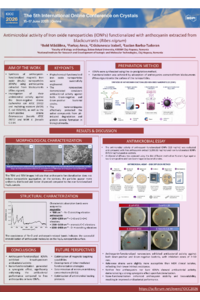
Iron oxide nanoparticles (IONPs) have attracted significant attention in recent years due to their versatility and facile synthesis. They are considered a promising platform for the development of novel antimicrobial delivery systems, particularly in the context of the emerging antibiotic-resistant pathogens that continue to pose a global threat. This study aims to investigate the potential antimicrobial efficacy of IONPs, synthesized using the co-precipitation method and functionalized with anthocyanins, which act as bioactive agents that have been extracted from
blackcurrants (Ribes nigrum), forming a core–shell architecture. Anthocyanins are pH-dependent phenolic pigments, naturally occurring in various berries and fruits, that exhibit a strong antioxidant activity, strongly associated with antimicrobial and anti-cancer properties.
The resulting bio-composite was characterized by scanning electron microscopy (SEM) and transmission electron microscopy (TEM), which confirmed its spherical morphology, with an average particle size of approximately 10 nm, while Fourier-transform infrared spectroscopy (FTIR) demonstrated the successful organic coating of the nanoparticles. Furthermore, the antimicrobial activity of the functionalized IONPs was assessed against both Gram-positive and Gram-negative bacteria using the disk-diffusion method and broth microdilution assays in 96 microtiter plates. The obtained results highlight the potential of anthocyanin-functionalized IONPs as sustainable, plant-derived antimicrobial agents.
By combining natural bioactive compounds with biocompatible nano-delivery systems, this approach offers a promising strategy for developing alternative antimicrobial therapies capable of overcoming resistance mechanisms.
Keywords
Antimicrobial activity
anthocyanin
bacteria
nanoparticles
Iron oxide nanoparticles
Poster
BOLD_Anthocyanin_functionalized_IONPs_Poster.pdf
Scaling of HKUST-1 metal–organic framework polymer with catalytic and adsorption properties
POLYPYRROLE-FUNCTIONALIZED MAGNETIC ZEOLITE FOR EFFICIENT RECOVERY OF WASTE OIL FROM WATER SURFACES