Event submissions
Published
This submission belongs to the session S5. Materials for Energy Applications of the event The 5th International Online Conference on Crystals
Published date
10 Jun, 2026
Academic Editor
'%3e%3cpath%20d='M12.6657%2010.9104C12.4185%2010.325%2012.0599%209.79327%2011.6097%209.34482C11.1609%208.89508%2010.6293%208.5365%2010.0442%208.28888C10.0389%208.28626%2010.0337%208.28495%2010.0285%208.28233C10.8446%207.69279%2011.3752%206.73249%2011.3752%205.64904C11.3752%203.8542%209.92103%202.39999%208.1262%202.39999C6.33136%202.39999%204.87715%203.8542%204.87715%205.64904C4.87715%206.73249%205.40774%207.69279%206.22393%208.28364C6.21869%208.28626%206.21345%208.28757%206.20821%208.29019C5.62129%208.5378%205.09463%208.89284%204.64265%209.34613C4.1929%209.79493%203.83432%2010.3266%203.58671%2010.9117C3.34345%2011.4845%203.21226%2012.0987%203.20023%2012.7209C3.19988%2012.7349%203.20233%2012.7488%203.20744%2012.7619C3.21255%2012.7749%203.22022%2012.7867%203.22998%2012.7968C3.23975%2012.8068%203.25142%2012.8147%203.26431%2012.8202C3.2772%2012.8256%203.29105%2012.8284%203.30504%2012.8284H4.09109C4.14874%2012.8284%204.19459%2012.7825%204.1959%2012.7262C4.2221%2011.7148%204.62823%2010.7676%205.34617%2010.0497C6.08899%209.30683%207.0755%208.89808%208.1262%208.89808C9.17689%208.89808%2010.1634%209.30683%2010.9062%2010.0497C11.6242%2010.7676%2012.0303%2011.7148%2012.0565%2012.7262C12.0578%2012.7838%2012.1037%2012.8284%2012.1613%2012.8284H12.9474C12.9613%2012.8284%2012.9752%2012.8256%2012.9881%2012.8202C13.001%2012.8147%2013.0126%2012.8068%2013.0224%2012.7968C13.0322%2012.7867%2013.0398%2012.7749%2013.0449%2012.7619C13.0501%2012.7488%2013.0525%2012.7349%2013.0522%2012.7209C13.0391%2012.0947%2012.9094%2011.4855%2012.6657%2010.9104ZM8.1262%207.9024C7.52486%207.9024%206.9589%207.6679%206.53312%207.24211C6.10733%206.81633%205.87283%206.25037%205.87283%205.64904C5.87283%205.0477%206.10733%204.48174%206.53312%204.05596C6.9589%203.63018%207.52486%203.39567%208.1262%203.39567C8.72753%203.39567%209.29349%203.63018%209.71927%204.05596C10.1451%204.48174%2010.3796%205.0477%2010.3796%205.64904C10.3796%206.25037%2010.1451%206.81633%209.71927%207.24211C9.29349%207.6679%208.72753%207.9024%208.1262%207.9024Z'%20fill='%235D1EE1'/%3e%3c/g%3e%3c/svg%3e) Jasmina Grbovic Novakovic
Jasmina Grbovic NovakovicCitation
Anastasiya DUCHENKO, Achille Angrisani Armenio, Luisa Barba, Chen Yangsong, Francesco Laviano, Pradip Kumar Mondal, Luigi Muzzi, Nicola Pompeo, Tsuyoshi Tamegai, Francesca Varsano, Andrea Masi, Single-Crystal X-ray Diffraction Study of Doped CaKFe₄As₄: Structural Distortions., in Proceedings of The 5th International Online Conference on Crystals, 15 June–17 June 2026, MDPI: Basel, Switzerland
Share
Email
Facebook
Twitter
LinkedIn
Single-Crystal X-ray Diffraction Study of Doped CaKFe₄As₄: Structural Distortions.
'%3e%3cpath%20d='M12.6647%2010.9104C12.4176%2010.325%2012.0589%209.7933%2011.6088%209.34485C11.16%208.89511%2010.6283%208.53653%2010.0432%208.28891C10.038%208.28629%2010.0327%208.28498%2010.0275%208.28236C10.8437%207.69282%2011.3743%206.73252%2011.3743%205.64907C11.3743%203.85423%209.92005%202.40002%208.12522%202.40002C6.33038%202.40002%204.87618%203.85423%204.87618%205.64907C4.87618%206.73252%205.40677%207.69282%206.22296%208.28367C6.21772%208.28629%206.21248%208.2876%206.20724%208.29022C5.62031%208.53783%205.09365%208.89287%204.64167%209.34616C4.19192%209.79496%203.83334%2010.3266%203.58573%2010.9117C3.34247%2011.4846%203.21128%2012.0987%203.19925%2012.721C3.1989%2012.735%203.20135%2012.7489%203.20646%2012.7619C3.21157%2012.7749%203.21924%2012.7868%203.22901%2012.7968C3.23877%2012.8068%203.25045%2012.8148%203.26334%2012.8202C3.27623%2012.8256%203.29007%2012.8284%203.30406%2012.8284H4.09012C4.14776%2012.8284%204.19362%2012.7825%204.19493%2012.7262C4.22113%2011.7148%204.62726%2010.7676%205.34519%2010.0497C6.08802%209.30686%207.07452%208.89811%208.12522%208.89811C9.17592%208.89811%2010.1624%209.30686%2010.9052%2010.0497C11.6232%2010.7676%2012.0293%2011.7148%2012.0555%2012.7262C12.0568%2012.7839%2012.1027%2012.8284%2012.1603%2012.8284H12.9464C12.9604%2012.8284%2012.9742%2012.8256%2012.9871%2012.8202C13%2012.8148%2013.0117%2012.8068%2013.0214%2012.7968C13.0312%2012.7868%2013.0389%2012.7749%2013.044%2012.7619C13.0491%2012.7489%2013.0515%2012.735%2013.0512%2012.721C13.0381%2012.0947%2012.9084%2011.4856%2012.6647%2010.9104ZM8.12522%207.90243C7.52388%207.90243%206.95792%207.66793%206.53214%207.24215C6.10636%206.81636%205.87185%206.2504%205.87185%205.64907C5.87185%205.04773%206.10636%204.48177%206.53214%204.05599C6.95792%203.63021%207.52388%203.3957%208.12522%203.3957C8.72655%203.3957%209.29252%203.63021%209.7183%204.05599C10.1441%204.48177%2010.3786%205.04773%2010.3786%205.64907C10.3786%206.2504%2010.1441%206.81636%209.7183%207.24215C9.29252%207.66793%208.72655%207.90243%208.12522%207.90243Z'%20fill='%235D1EE1'/%3e%3c/g%3e%3c/svg%3e)
Anastasiya DUCHENKO 1
Achille Angrisani Armenio 2
Luisa Barba 3
Chen Yangsong 4

Francesco Laviano 1,5
Pradip Kumar Mondal 6
Luigi Muzzi 2
Nicola Pompeo 7
Tsuyoshi Tamegai 4
Francesca Varsano 8
Andrea Masi 2
1. Department of Applied Science and Technology, Politecnico di Torino, Corso Duca degli Abruzzi 24,
Torino, I-10129, Italy, Italy
2. ENEA, NUC-FUSEN-COND, Via Enrico Fermi, 45, 00044 Roma, Italy, Italy
3. CNR – Institute of Crystallography, X-ray Diffraction Beamline at Elettra, Area Science Park, 34149
Basovizza (TS), Italy, Italy
4. Institute for Solid State Physics, The University of Tokyo, Kashiwa, Chiba 277-8581, Japan, Japan
5. Istituto Nazionale di Fisica Nucleare, INFN Sez. Torino, Via Pietro Giuria 1, Torino, I-10125 Italy
6. X-Ray Diffraction Beamline (XRD1), Elettra – Sincrotrone Trieste S.C.p.A., Trieste, 34149, Italy, Italy
7. Università degli Studi RomaTre, Dipartimento di Ingegneria Industriale, Elettronica e Meccanica, Via Vito
Volterra, 62, 00146 Roma, Italy, Italy
8. ENEA, C.R. Casaccia, Via Anguillarese, 301, 00123 Roma, Italy, Italy
Abstract
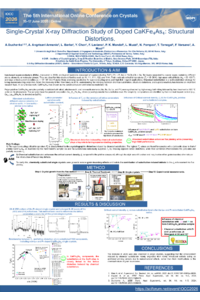
Iron-based superconductors, discovered in 2008, have attracted considerable attention due to their promising superconducting properties and their potential for high-field applications.
They share a FeAs or FeSe structural building blocks and exhibit a wide variety of structural families. Among them, the 1144 phase (AAeFe₄As₄ A=Alkaline and Ae=Alkaline earth metal), discovered in 2016, has attracted particular interest due to its robust superconducting properties. Within this family, CaKFe₄As₄ is considered one of the most promising compounds. The synthesis of these materials in polycrystalline form, relevant for superconducting wire applications, strongly affects their superconducting performance. In particular, intergrain properties, secondary phases, grain-boundary chemistry, and microstructural features such as porosity and density play a crucial role.
Chemical substitutions have been explored to optimize its superconducting properties, with partial replacement of Ca and K by elements with similar ionic radius (Na, La, Pr, Sr, and Ba). Previous studies on polycrystalline samples suggested that doping induces lattice distortions affecting the superconducting critical temperature (Tc), and enhancing the critical current density (Jc), although microstructural effects could not be excluded.
To distinguish intrinsic effects from microstructural contributions, single crystals of pristine and doped CaKFe₄As₄ were grown and investigated by single-crystal X-ray diffraction, from which the corresponding CIF files were obtained. Complementary morpho-structural and superconducting measurements were also performed to correlate the crystal structure with the physical properties.
The combined analysis highlights a clear correlation between structural modifications and superconducting behavior. Furthermore, the structural analysis suggests that defects introduced by doping act as effective pinning centers, explaining the observed enhancement of Jc.
Keywords
Crystal structure
1144 phase
Iron-based superconductors
Lattice distortion
Chemical substitution
Poster
Poster-IOCC2026_Duchenko_12.06.2026.pdf
Mesoporous CeO₂-Supported Ni Catalysts: Tuning Nickel Dispersion for CO₂ Methanation
Monte Carlo simulation of the hysteresis behavior in a mixed-spin graphene bilayer