Event submissions
Published
This submission belongs to the session S5. Materials for Energy Applications of the event The 5th International Online Conference on Crystals
Published date
10 Jun, 2026
Academic Editor
'%3e%3cpath%20d='M12.6657%2010.9104C12.4185%2010.325%2012.0599%209.79327%2011.6097%209.34482C11.1609%208.89508%2010.6293%208.5365%2010.0442%208.28888C10.0389%208.28626%2010.0337%208.28495%2010.0285%208.28233C10.8446%207.69279%2011.3752%206.73249%2011.3752%205.64904C11.3752%203.8542%209.92103%202.39999%208.1262%202.39999C6.33136%202.39999%204.87715%203.8542%204.87715%205.64904C4.87715%206.73249%205.40774%207.69279%206.22393%208.28364C6.21869%208.28626%206.21345%208.28757%206.20821%208.29019C5.62129%208.5378%205.09463%208.89284%204.64265%209.34613C4.1929%209.79493%203.83432%2010.3266%203.58671%2010.9117C3.34345%2011.4845%203.21226%2012.0987%203.20023%2012.7209C3.19988%2012.7349%203.20233%2012.7488%203.20744%2012.7619C3.21255%2012.7749%203.22022%2012.7867%203.22998%2012.7968C3.23975%2012.8068%203.25142%2012.8147%203.26431%2012.8202C3.2772%2012.8256%203.29105%2012.8284%203.30504%2012.8284H4.09109C4.14874%2012.8284%204.19459%2012.7825%204.1959%2012.7262C4.2221%2011.7148%204.62823%2010.7676%205.34617%2010.0497C6.08899%209.30683%207.0755%208.89808%208.1262%208.89808C9.17689%208.89808%2010.1634%209.30683%2010.9062%2010.0497C11.6242%2010.7676%2012.0303%2011.7148%2012.0565%2012.7262C12.0578%2012.7838%2012.1037%2012.8284%2012.1613%2012.8284H12.9474C12.9613%2012.8284%2012.9752%2012.8256%2012.9881%2012.8202C13.001%2012.8147%2013.0126%2012.8068%2013.0224%2012.7968C13.0322%2012.7867%2013.0398%2012.7749%2013.0449%2012.7619C13.0501%2012.7488%2013.0525%2012.7349%2013.0522%2012.7209C13.0391%2012.0947%2012.9094%2011.4855%2012.6657%2010.9104ZM8.1262%207.9024C7.52486%207.9024%206.9589%207.6679%206.53312%207.24211C6.10733%206.81633%205.87283%206.25037%205.87283%205.64904C5.87283%205.0477%206.10733%204.48174%206.53312%204.05596C6.9589%203.63018%207.52486%203.39567%208.1262%203.39567C8.72753%203.39567%209.29349%203.63018%209.71927%204.05596C10.1451%204.48174%2010.3796%205.0477%2010.3796%205.64904C10.3796%206.25037%2010.1451%206.81633%209.71927%207.24211C9.29349%207.6679%208.72753%207.9024%208.1262%207.9024Z'%20fill='%235D1EE1'/%3e%3c/g%3e%3c/svg%3e) Alessandra Toncelli
Alessandra ToncelliCitation
Huma Amber, Loreta Tamašauskaitė-Tamašiūnaitė, Zita Sukackienė, Eugenijus Norkus, Electrolessly Deposited Transition Metal Phosphide Catalysts for Hydrogen Generation from Hydrolysis of Sodium Borohydride, in Proceedings of The 5th International Online Conference on Crystals, 15 June–17 June 2026, MDPI: Basel, Switzerland
Share
Email
Facebook
Twitter
LinkedIn
Electrolessly Deposited Transition Metal Phosphide Catalysts for Hydrogen Generation from Hydrolysis of Sodium Borohydride
'%3e%3cpath%20d='M12.6647%2010.9104C12.4176%2010.325%2012.0589%209.7933%2011.6088%209.34485C11.16%208.89511%2010.6283%208.53653%2010.0432%208.28891C10.038%208.28629%2010.0327%208.28498%2010.0275%208.28236C10.8437%207.69282%2011.3743%206.73252%2011.3743%205.64907C11.3743%203.85423%209.92005%202.40002%208.12522%202.40002C6.33038%202.40002%204.87618%203.85423%204.87618%205.64907C4.87618%206.73252%205.40677%207.69282%206.22296%208.28367C6.21772%208.28629%206.21248%208.2876%206.20724%208.29022C5.62031%208.53783%205.09365%208.89287%204.64167%209.34616C4.19192%209.79496%203.83334%2010.3266%203.58573%2010.9117C3.34247%2011.4846%203.21128%2012.0987%203.19925%2012.721C3.1989%2012.735%203.20135%2012.7489%203.20646%2012.7619C3.21157%2012.7749%203.21924%2012.7868%203.22901%2012.7968C3.23877%2012.8068%203.25045%2012.8148%203.26334%2012.8202C3.27623%2012.8256%203.29007%2012.8284%203.30406%2012.8284H4.09012C4.14776%2012.8284%204.19362%2012.7825%204.19493%2012.7262C4.22113%2011.7148%204.62726%2010.7676%205.34519%2010.0497C6.08802%209.30686%207.07452%208.89811%208.12522%208.89811C9.17592%208.89811%2010.1624%209.30686%2010.9052%2010.0497C11.6232%2010.7676%2012.0293%2011.7148%2012.0555%2012.7262C12.0568%2012.7839%2012.1027%2012.8284%2012.1603%2012.8284H12.9464C12.9604%2012.8284%2012.9742%2012.8256%2012.9871%2012.8202C13%2012.8148%2013.0117%2012.8068%2013.0214%2012.7968C13.0312%2012.7868%2013.0389%2012.7749%2013.044%2012.7619C13.0491%2012.7489%2013.0515%2012.735%2013.0512%2012.721C13.0381%2012.0947%2012.9084%2011.4856%2012.6647%2010.9104ZM8.12522%207.90243C7.52388%207.90243%206.95792%207.66793%206.53214%207.24215C6.10636%206.81636%205.87185%206.2504%205.87185%205.64907C5.87185%205.04773%206.10636%204.48177%206.53214%204.05599C6.95792%203.63021%207.52388%203.3957%208.12522%203.3957C8.72655%203.3957%209.29252%203.63021%209.7183%204.05599C10.1441%204.48177%2010.3786%205.04773%2010.3786%205.64907C10.3786%206.2504%2010.1441%206.81636%209.7183%207.24215C9.29252%207.66793%208.72655%207.90243%208.12522%207.90243Z'%20fill='%235D1EE1'/%3e%3c/g%3e%3c/svg%3e)
Huma Amber 1

Loreta Tamašauskaitė-Tamašiūnaitė 1

Zita Sukackienė 1
Eugenijus Norkus 1
1. Department of Catalysis, Center for Physical Sciences and Technology (FTMC), LT-10257 Vilnius, Lithuania, Lithuania
Abstract
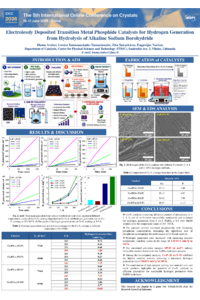
Hydrogen (H2) is regarded as a significant and environmentally sustainable energy carrier due to its high energy efficacy, zero toxicity, and pollution-free combustion, making it a potential long-term substitute for fossil fuels. However, efficient hydrogen storage remains a challenge. Among chemical hydrides, sodium borohydride (NaBH4) is attractive due to its high hydrogen content (10.8 wt%) and environmentally favorable hydrolysis products. Nevertheless, its hydrolysis in water is slow and requires efficient catalysts to enhance hydrogen generation. Herein, cobalt-phosphorus (Co-P) catalysts with varying phosphorus contents were investigated for hydrogen generation via the hydrolysis of alkaline NaBH4 solutions. The catalysts were fabricated on copper substrates through an electroless metal plating technique, with sodium hypophosphite (NaH2PO2) utilized as the reducing agent. The Co-P catalysts with different P amounts of 3, 5, 8, and 11 wt.% were obtained. The morphology, structure, and elemental composition of the prepared catalysts were characterized using a variety of analytical techniques, including scanning electron microscopy (SEM), energy-dispersive X-ray spectroscopy (EDX), inductively coupled plasma optical emission spectroscopy (ICP-OES), X-ray diffraction (XRD), and X-ray photoelectron spectroscopy (XPS).
The hydrogen generation rate was evaluated in a solution containing 5 wt.% NaBH4 and 0.4 wt.% NaOH at temperatures ranging from 313 to 343 K. The results indicate that Co-P catalysts have notable catalytic activity toward the hydrolysis of NaBH4. The hydrogen generation rate exhibited a range from 1 to 10 L min-1 g-1 at 343 K, while the activation energy demonstrated a range from 49 to 85 kJ mol-1, dependent on the phosphorus content. Specifically, the Co-P catalyst containing 11wt.% phosphorus was identified as the most efficient catalyst, exhibiting a hydrogen generation rate of 10.05 L min-1 g-1 at 343K. The excellent catalytic performance and cost-effectiveness of the electroless-deposited Co-P catalysts highlight their potential for efficient hydrogen production via NaBH4 hydrolysis.
Keywords
Co-P catalyst
Electroless deposition
Hydrogen generation
Sodium borohydride hydrolysis
Poster
Poster_Huma_Amber.pdf
Improved Dielectric and Nonlinear Properties of Doped CaCu₃Ti₄O₁₂ Ceramics for High-Efficiency Energy Storage Applications
Plasmonic Poynting vector vortices for uniform coupling to photocatalytic coatings