Event submissions
Published
This submission belongs to the session S6. Crystal Engineering of the event The 5th International Online Conference on Crystals
Published date
10 Jun, 2026
Academic Editor
'%3e%3cpath%20d='M12.6657%2010.9104C12.4185%2010.325%2012.0599%209.79327%2011.6097%209.34482C11.1609%208.89508%2010.6293%208.5365%2010.0442%208.28888C10.0389%208.28626%2010.0337%208.28495%2010.0285%208.28233C10.8446%207.69279%2011.3752%206.73249%2011.3752%205.64904C11.3752%203.8542%209.92103%202.39999%208.1262%202.39999C6.33136%202.39999%204.87715%203.8542%204.87715%205.64904C4.87715%206.73249%205.40774%207.69279%206.22393%208.28364C6.21869%208.28626%206.21345%208.28757%206.20821%208.29019C5.62129%208.5378%205.09463%208.89284%204.64265%209.34613C4.1929%209.79493%203.83432%2010.3266%203.58671%2010.9117C3.34345%2011.4845%203.21226%2012.0987%203.20023%2012.7209C3.19988%2012.7349%203.20233%2012.7488%203.20744%2012.7619C3.21255%2012.7749%203.22022%2012.7867%203.22998%2012.7968C3.23975%2012.8068%203.25142%2012.8147%203.26431%2012.8202C3.2772%2012.8256%203.29105%2012.8284%203.30504%2012.8284H4.09109C4.14874%2012.8284%204.19459%2012.7825%204.1959%2012.7262C4.2221%2011.7148%204.62823%2010.7676%205.34617%2010.0497C6.08899%209.30683%207.0755%208.89808%208.1262%208.89808C9.17689%208.89808%2010.1634%209.30683%2010.9062%2010.0497C11.6242%2010.7676%2012.0303%2011.7148%2012.0565%2012.7262C12.0578%2012.7838%2012.1037%2012.8284%2012.1613%2012.8284H12.9474C12.9613%2012.8284%2012.9752%2012.8256%2012.9881%2012.8202C13.001%2012.8147%2013.0126%2012.8068%2013.0224%2012.7968C13.0322%2012.7867%2013.0398%2012.7749%2013.0449%2012.7619C13.0501%2012.7488%2013.0525%2012.7349%2013.0522%2012.7209C13.0391%2012.0947%2012.9094%2011.4855%2012.6657%2010.9104ZM8.1262%207.9024C7.52486%207.9024%206.9589%207.6679%206.53312%207.24211C6.10733%206.81633%205.87283%206.25037%205.87283%205.64904C5.87283%205.0477%206.10733%204.48174%206.53312%204.05596C6.9589%203.63018%207.52486%203.39567%208.1262%203.39567C8.72753%203.39567%209.29349%203.63018%209.71927%204.05596C10.1451%204.48174%2010.3796%205.0477%2010.3796%205.64904C10.3796%206.25037%2010.1451%206.81633%209.71927%207.24211C9.29349%207.6679%208.72753%207.9024%208.1262%207.9024Z'%20fill='%235D1EE1'/%3e%3c/g%3e%3c/svg%3e) Alessandra Toncelli
Alessandra ToncelliCitation
Antonio del Bosque, María Sánchez-Jiménez, Pablo Fernández-Arias, Diego Vergara, Crystallographic Principles Explored via Immersive and Non-Immersive Virtual Reality Tools, in Proceedings of The 5th International Online Conference on Crystals, 15 June–17 June 2026, MDPI: Basel, Switzerland
Share
Email
Facebook
Twitter
LinkedIn
Crystallographic Principles Explored via Immersive and Non-Immersive Virtual Reality Tools

María Sánchez-Jiménez 1

Antonio del Bosque 1

Pablo Fernández-Arias 1

Diego Vergara 1
1. Technology, Instruction and Design in Engineering and Education Research Group (TiDEE.rg), Catholic University of Avila, C/Canteros s/n, 05005 Avila, Spain, Spain
Abstract
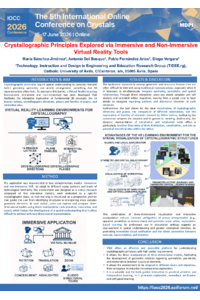
Introduction: The visualization of crystallographic structures is essential for understanding lattice geometry, symmetry, and atomic arrangements. However, traditional two-dimensional depictions often fail to provide the spatial insight required for mastering these concepts. To address this challenge, we developed an immersive and non-immersive Virtual Reality Learning Environment (VRLE) designed to facilitate intuitive exploration of foundational crystallographic principles, including the 14 Bravais lattices, crystallographic directions, planes, plane families, and interstitial sites.
Methods: The application was implemented both as immersive and non-immersive VRLE. The VRLE is structured as a virtual museum consisting of five interactive stations, each dedicated to a specific crystallographic topic. Users can manipulate 3D models through rotation, translation, zooming, selective hiding or highlighting of elements, and guided structural walkthroughs.
Results: The application successfully conveys geometric and structural features that are typically difficult to interpret from traditional representations. Users can examine unit cells and extended lattices, visualize the orientation of crystallographic directions and planes, and explore families of Miller-indexed elements. The dynamic rendering of tetrahedral and octahedral voids provides a clear illustration of their distribution and coordination within the lattice. Preliminary use in educational settings indicates enhanced spatial comprehension and improved conceptual retention.
Conclusions: The immersive and non-immersive VRLE offers an effective and accessible platform for understanding crystallographic principles. Its interactivity, modular structure, and real-time visualization capabilities make it a valuable tool for both guided instruction and independent learning.
Keywords
3D lattice
Crystallography
Bravais
Miller index
Virtual Reality Learning Environment
Education
Poster
IOCC2026. Crystallographic VR and AR.pdf
ESTANPy Toolbox for Assessing and Enhancing Data Information Content: Application to Paracetamol Batch Cooling Crystallization
CFD Design of a NETmix Crystalliser for Struvite Precipitation from Sidestream Digestate