Event submissions
Published
This submission belongs to the session S6. Crystal Engineering of the event The 5th International Online Conference on Crystals
Published date
10 Jun, 2026
Academic Editor
'%3e%3cpath%20d='M12.6657%2010.9104C12.4185%2010.325%2012.0599%209.79327%2011.6097%209.34482C11.1609%208.89508%2010.6293%208.5365%2010.0442%208.28888C10.0389%208.28626%2010.0337%208.28495%2010.0285%208.28233C10.8446%207.69279%2011.3752%206.73249%2011.3752%205.64904C11.3752%203.8542%209.92103%202.39999%208.1262%202.39999C6.33136%202.39999%204.87715%203.8542%204.87715%205.64904C4.87715%206.73249%205.40774%207.69279%206.22393%208.28364C6.21869%208.28626%206.21345%208.28757%206.20821%208.29019C5.62129%208.5378%205.09463%208.89284%204.64265%209.34613C4.1929%209.79493%203.83432%2010.3266%203.58671%2010.9117C3.34345%2011.4845%203.21226%2012.0987%203.20023%2012.7209C3.19988%2012.7349%203.20233%2012.7488%203.20744%2012.7619C3.21255%2012.7749%203.22022%2012.7867%203.22998%2012.7968C3.23975%2012.8068%203.25142%2012.8147%203.26431%2012.8202C3.2772%2012.8256%203.29105%2012.8284%203.30504%2012.8284H4.09109C4.14874%2012.8284%204.19459%2012.7825%204.1959%2012.7262C4.2221%2011.7148%204.62823%2010.7676%205.34617%2010.0497C6.08899%209.30683%207.0755%208.89808%208.1262%208.89808C9.17689%208.89808%2010.1634%209.30683%2010.9062%2010.0497C11.6242%2010.7676%2012.0303%2011.7148%2012.0565%2012.7262C12.0578%2012.7838%2012.1037%2012.8284%2012.1613%2012.8284H12.9474C12.9613%2012.8284%2012.9752%2012.8256%2012.9881%2012.8202C13.001%2012.8147%2013.0126%2012.8068%2013.0224%2012.7968C13.0322%2012.7867%2013.0398%2012.7749%2013.0449%2012.7619C13.0501%2012.7488%2013.0525%2012.7349%2013.0522%2012.7209C13.0391%2012.0947%2012.9094%2011.4855%2012.6657%2010.9104ZM8.1262%207.9024C7.52486%207.9024%206.9589%207.6679%206.53312%207.24211C6.10733%206.81633%205.87283%206.25037%205.87283%205.64904C5.87283%205.0477%206.10733%204.48174%206.53312%204.05596C6.9589%203.63018%207.52486%203.39567%208.1262%203.39567C8.72753%203.39567%209.29349%203.63018%209.71927%204.05596C10.1451%204.48174%2010.3796%205.0477%2010.3796%205.64904C10.3796%206.25037%2010.1451%206.81633%209.71927%207.24211C9.29349%207.6679%208.72753%207.9024%208.1262%207.9024Z'%20fill='%235D1EE1'/%3e%3c/g%3e%3c/svg%3e) Vladimir Chigrinov
Vladimir ChigrinovCitation
Laura J.R. Cullen, Isabel S. Fernandes, Madalena M. Dias, José Carlos B. Lopes, Vítor J.P. Vilar, Ricardo J. Santos, CFD Design of a NETmix Crystalliser for Struvite Precipitation from Sidestream Digestate, in Proceedings of The 5th International Online Conference on Crystals, 15 June–17 June 2026, MDPI: Basel, Switzerland
Share
Email
Facebook
Twitter
LinkedIn
CFD Design of a NETmix Crystalliser for Struvite Precipitation from Sidestream Digestate
'%3e%3cpath%20d='M12.6647%2010.9104C12.4176%2010.325%2012.0589%209.7933%2011.6088%209.34485C11.16%208.89511%2010.6283%208.53653%2010.0432%208.28891C10.038%208.28629%2010.0327%208.28498%2010.0275%208.28236C10.8437%207.69282%2011.3743%206.73252%2011.3743%205.64907C11.3743%203.85423%209.92005%202.40002%208.12522%202.40002C6.33038%202.40002%204.87618%203.85423%204.87618%205.64907C4.87618%206.73252%205.40677%207.69282%206.22296%208.28367C6.21772%208.28629%206.21248%208.2876%206.20724%208.29022C5.62031%208.53783%205.09365%208.89287%204.64167%209.34616C4.19192%209.79496%203.83334%2010.3266%203.58573%2010.9117C3.34247%2011.4846%203.21128%2012.0987%203.19925%2012.721C3.1989%2012.735%203.20135%2012.7489%203.20646%2012.7619C3.21157%2012.7749%203.21924%2012.7868%203.22901%2012.7968C3.23877%2012.8068%203.25045%2012.8148%203.26334%2012.8202C3.27623%2012.8256%203.29007%2012.8284%203.30406%2012.8284H4.09012C4.14776%2012.8284%204.19362%2012.7825%204.19493%2012.7262C4.22113%2011.7148%204.62726%2010.7676%205.34519%2010.0497C6.08802%209.30686%207.07452%208.89811%208.12522%208.89811C9.17592%208.89811%2010.1624%209.30686%2010.9052%2010.0497C11.6232%2010.7676%2012.0293%2011.7148%2012.0555%2012.7262C12.0568%2012.7839%2012.1027%2012.8284%2012.1603%2012.8284H12.9464C12.9604%2012.8284%2012.9742%2012.8256%2012.9871%2012.8202C13%2012.8148%2013.0117%2012.8068%2013.0214%2012.7968C13.0312%2012.7868%2013.0389%2012.7749%2013.044%2012.7619C13.0491%2012.7489%2013.0515%2012.735%2013.0512%2012.721C13.0381%2012.0947%2012.9084%2011.4856%2012.6647%2010.9104ZM8.12522%207.90243C7.52388%207.90243%206.95792%207.66793%206.53214%207.24215C6.10636%206.81636%205.87185%206.2504%205.87185%205.64907C5.87185%205.04773%206.10636%204.48177%206.53214%204.05599C6.95792%203.63021%207.52388%203.3957%208.12522%203.3957C8.72655%203.3957%209.29252%203.63021%209.7183%204.05599C10.1441%204.48177%2010.3786%205.04773%2010.3786%205.64907C10.3786%206.2504%2010.1441%206.81636%209.7183%207.24215C9.29252%207.66793%208.72655%207.90243%208.12522%207.90243Z'%20fill='%235D1EE1'/%3e%3c/g%3e%3c/svg%3e)
Laura J.R. Cullen 1
Isabel S. Fernandes 1

Madalena M. Dias 1
José Carlos B. Lopes 1

Vítor J.P. Vilar 1
Ricardo J. Santos 1
1. LSRE-LCM, ALiCE, Faculty of Engineering, University of Porto, Rua Dr. Roberto Frias, 4200-465 Porto, Portugal, Portugal
Abstract
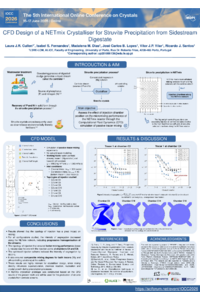
Precipitation is an extensively used unit operation that involves mixing concentrated soluble reactants to form a sparingly soluble product. In wastewater treatment, it has recently been employed to recover nutrients from the liquid fraction obtained after dewatering digested sludge in wastewater treatment plants. Phosphorus (P) and nitrogen (N) are precipitated as struvite crystals upon the addition of a concentrated magnesium solution and subsequently used as slow-release fertilisers.
NETmix is a well-established static mixer and reactor. Owing to its distinct geometry, it surpasses most state-of-the-art technology for mixing and heat transfer and has been successfully used for the production of several crystalline compounds, including hydroxyapatite nanocrystals. This success motivated its application for the production of struvite crystals. This process requires mixing three liquid streams: the effluent stream (P and N source); a stream consisting of a concentrated magnesium (Mg) solution; and one consisting of a pH-controlling solution.
Two concentrated streams (Mg and pH-controlling solutions) are separately injected at low flow rate ratios relative to the main feed flow rate (effluent) directly into selected chambers along the NETmix reactor. This work assesses the effect of injection chamber position on the mixing performance of the reactor through the Computational Fluid Dynamics (CFD) simulation of passive tracer mixing experiments.
The topology of injection was found to have significant impact on mixing. Micromixing performance was quantified using the intensity of segregation. For all configurations studied, the intensity of segregation decreased along the NETmix network, indicating progressive homogenisation of the streams. The optimised injection scheme reduced the intensity of segregation by 99.9 %. It also ensured comparable mixing degrees for both tracers (Mg and pH-controlling solutions) at the outlets.
These results are highly relevant for crystalliser design, since mixing directly influences supersaturation, chemical reaction, nucleation and crystal growth during precipitation processes.
Keywords
NETmix Crystalliser
Struvite
CFD
Injection Chambers
Intensity of Segregation
Poster
IOCC2026Poster_LauraCullen.pdf
Crystallographic Principles Explored via Immersive and Non-Immersive Virtual Reality Tools
Design and Crystal Engineering of a Photonic Crystal Fiber for Optical Pressure Sensing