Event submissions
Published
This submission belongs to the session S6. Crystal Engineering of the event The 5th International Online Conference on Crystals
Published date
10 Jun, 2026
Academic Editor
'%3e%3cpath%20d='M12.6657%2010.9104C12.4185%2010.325%2012.0599%209.79327%2011.6097%209.34482C11.1609%208.89508%2010.6293%208.5365%2010.0442%208.28888C10.0389%208.28626%2010.0337%208.28495%2010.0285%208.28233C10.8446%207.69279%2011.3752%206.73249%2011.3752%205.64904C11.3752%203.8542%209.92103%202.39999%208.1262%202.39999C6.33136%202.39999%204.87715%203.8542%204.87715%205.64904C4.87715%206.73249%205.40774%207.69279%206.22393%208.28364C6.21869%208.28626%206.21345%208.28757%206.20821%208.29019C5.62129%208.5378%205.09463%208.89284%204.64265%209.34613C4.1929%209.79493%203.83432%2010.3266%203.58671%2010.9117C3.34345%2011.4845%203.21226%2012.0987%203.20023%2012.7209C3.19988%2012.7349%203.20233%2012.7488%203.20744%2012.7619C3.21255%2012.7749%203.22022%2012.7867%203.22998%2012.7968C3.23975%2012.8068%203.25142%2012.8147%203.26431%2012.8202C3.2772%2012.8256%203.29105%2012.8284%203.30504%2012.8284H4.09109C4.14874%2012.8284%204.19459%2012.7825%204.1959%2012.7262C4.2221%2011.7148%204.62823%2010.7676%205.34617%2010.0497C6.08899%209.30683%207.0755%208.89808%208.1262%208.89808C9.17689%208.89808%2010.1634%209.30683%2010.9062%2010.0497C11.6242%2010.7676%2012.0303%2011.7148%2012.0565%2012.7262C12.0578%2012.7838%2012.1037%2012.8284%2012.1613%2012.8284H12.9474C12.9613%2012.8284%2012.9752%2012.8256%2012.9881%2012.8202C13.001%2012.8147%2013.0126%2012.8068%2013.0224%2012.7968C13.0322%2012.7867%2013.0398%2012.7749%2013.0449%2012.7619C13.0501%2012.7488%2013.0525%2012.7349%2013.0522%2012.7209C13.0391%2012.0947%2012.9094%2011.4855%2012.6657%2010.9104ZM8.1262%207.9024C7.52486%207.9024%206.9589%207.6679%206.53312%207.24211C6.10733%206.81633%205.87283%206.25037%205.87283%205.64904C5.87283%205.0477%206.10733%204.48174%206.53312%204.05596C6.9589%203.63018%207.52486%203.39567%208.1262%203.39567C8.72753%203.39567%209.29349%203.63018%209.71927%204.05596C10.1451%204.48174%2010.3796%205.0477%2010.3796%205.64904C10.3796%206.25037%2010.1451%206.81633%209.71927%207.24211C9.29349%207.6679%208.72753%207.9024%208.1262%207.9024Z'%20fill='%235D1EE1'/%3e%3c/g%3e%3c/svg%3e) Vladimir Chigrinov
Vladimir ChigrinovCitation
Vandana Kumari Jha, Christophe Duwig, Mechanistic Role of Shear Rate on Transport-Controlled Crystal Growth in Antisolvent Crystallization, in Proceedings of The 5th International Online Conference on Crystals, 15 June–17 June 2026, MDPI: Basel, Switzerland
Share
Email
Facebook
Twitter
LinkedIn
Mechanistic Role of Shear Rate on Transport-Controlled Crystal Growth in Antisolvent Crystallization
'%3e%3cpath%20d='M12.6647%2010.9104C12.4176%2010.325%2012.0589%209.7933%2011.6088%209.34485C11.16%208.89511%2010.6283%208.53653%2010.0432%208.28891C10.038%208.28629%2010.0327%208.28498%2010.0275%208.28236C10.8437%207.69282%2011.3743%206.73252%2011.3743%205.64907C11.3743%203.85423%209.92005%202.40002%208.12522%202.40002C6.33038%202.40002%204.87618%203.85423%204.87618%205.64907C4.87618%206.73252%205.40677%207.69282%206.22296%208.28367C6.21772%208.28629%206.21248%208.2876%206.20724%208.29022C5.62031%208.53783%205.09365%208.89287%204.64167%209.34616C4.19192%209.79496%203.83334%2010.3266%203.58573%2010.9117C3.34247%2011.4846%203.21128%2012.0987%203.19925%2012.721C3.1989%2012.735%203.20135%2012.7489%203.20646%2012.7619C3.21157%2012.7749%203.21924%2012.7868%203.22901%2012.7968C3.23877%2012.8068%203.25045%2012.8148%203.26334%2012.8202C3.27623%2012.8256%203.29007%2012.8284%203.30406%2012.8284H4.09012C4.14776%2012.8284%204.19362%2012.7825%204.19493%2012.7262C4.22113%2011.7148%204.62726%2010.7676%205.34519%2010.0497C6.08802%209.30686%207.07452%208.89811%208.12522%208.89811C9.17592%208.89811%2010.1624%209.30686%2010.9052%2010.0497C11.6232%2010.7676%2012.0293%2011.7148%2012.0555%2012.7262C12.0568%2012.7839%2012.1027%2012.8284%2012.1603%2012.8284H12.9464C12.9604%2012.8284%2012.9742%2012.8256%2012.9871%2012.8202C13%2012.8148%2013.0117%2012.8068%2013.0214%2012.7968C13.0312%2012.7868%2013.0389%2012.7749%2013.044%2012.7619C13.0491%2012.7489%2013.0515%2012.735%2013.0512%2012.721C13.0381%2012.0947%2012.9084%2011.4856%2012.6647%2010.9104ZM8.12522%207.90243C7.52388%207.90243%206.95792%207.66793%206.53214%207.24215C6.10636%206.81636%205.87185%206.2504%205.87185%205.64907C5.87185%205.04773%206.10636%204.48177%206.53214%204.05599C6.95792%203.63021%207.52388%203.3957%208.12522%203.3957C8.72655%203.3957%209.29252%203.63021%209.7183%204.05599C10.1441%204.48177%2010.3786%205.04773%2010.3786%205.64907C10.3786%206.2504%2010.1441%206.81636%209.7183%207.24215C9.29252%207.66793%208.72655%207.90243%208.12522%207.90243Z'%20fill='%235D1EE1'/%3e%3c/g%3e%3c/svg%3e)
Vandana Kumari Jha 1
Christophe Duwig 1
1. Department of Chemical Engineering, KTH Royal Institute of Technology, Stockholm, 10044, Sweden, Sweden
Abstract
Introduction
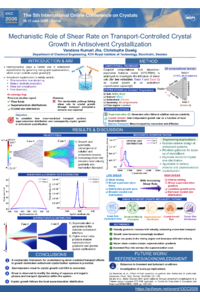
Hydrodynamics plays a central role in antisolvent crystallization by governing mixing and supersaturation generation, which in turn controls crystal growth [1]. While previous studies report the distributions of flow and crystallization fields, the mechanistic role of shear rate in governing growth through transport phenomena remains insufficiently understood.
Methods
A coupled computational fluid dynamics–population balance model (CFD-PBM) is employed to investigate the influence of shear rate on crystal growth under steady-state laminar conditions [2]. A two-dimensional axisymmetric configuration is considered for nickel sulphate hexahydrate (NiSO4.6H2O) crystallization using ethanol as the antisolvent. Supersaturation is generated by the reduction in solubility caused by the addition of an antisolvent to the initially saturated aqueous salt solution at a constant temperature. The size-independent growth rate is applied to the crystal growth.
Results
Shear-induced mixing modifies the spatial distribution of supersaturation and thereby controls growth dynamics. Increasing shear rate enhances convective transport, producing sharper supersaturation gradients and leading to stronger spatial confinement of the growth zone near the mixing interface. In contrast, lower shear conditions result in broader supersaturation fields and more distributed growth regions. The magnitude of the crystal growth rate correlates directly with local supersaturation.
Conclusions
Shear does not intrinsically alter growth kinetics but acts indirectly through transport modulation. This study provides a mechanistic framework for understanding shear-mediated transport effects in growth-dominated antisolvent crystallization systems, connecting hydrodynamic shear to crystal growth and distribution.
References
[1] D.L. Marchisio, M. Soos, J. Sefcik, M. Morbidelli, A.A. Barresi, G. Baldi, Effect of fluid dynamics on particle size distribution in particulate processes, Chem. Eng. Technol. 29 (2006) 191–199. https://doi.org/10.1002/ceat.200500358.
[2] V. Jha, C. Duwig, S. Teimouri, K. Forsberg, Metal recovery from spent batteries through antisolvent crystallization in a T-mixer using a coupled CFD-PBE approach, in: Centre for Evaluation in Education and Science (CEON/CEES), 2025: pp. 407–412. https://doi.org/10.5937/imprc25407k.
Keywords
Antisolvent crystallization
Hydrodynamics
Shear rate
Mixing
Supersaturation
Crystal growth
Poster
IOCC 2026_Poster_Vandana Kumari Jha.pdf
Insights into the supramolecular architecture of xanthene derivatives
Optical properties of non-centrosymmetric Th-based superconductors: a density functional theory study