Event submissions
Published
This submission belongs to the session S6. Crystal Engineering of the event The 5th International Online Conference on Crystals
Published date
10 Jun, 2026
Academic Editor
'%3e%3cpath%20d='M12.6657%2010.9104C12.4185%2010.325%2012.0599%209.79327%2011.6097%209.34482C11.1609%208.89508%2010.6293%208.5365%2010.0442%208.28888C10.0389%208.28626%2010.0337%208.28495%2010.0285%208.28233C10.8446%207.69279%2011.3752%206.73249%2011.3752%205.64904C11.3752%203.8542%209.92103%202.39999%208.1262%202.39999C6.33136%202.39999%204.87715%203.8542%204.87715%205.64904C4.87715%206.73249%205.40774%207.69279%206.22393%208.28364C6.21869%208.28626%206.21345%208.28757%206.20821%208.29019C5.62129%208.5378%205.09463%208.89284%204.64265%209.34613C4.1929%209.79493%203.83432%2010.3266%203.58671%2010.9117C3.34345%2011.4845%203.21226%2012.0987%203.20023%2012.7209C3.19988%2012.7349%203.20233%2012.7488%203.20744%2012.7619C3.21255%2012.7749%203.22022%2012.7867%203.22998%2012.7968C3.23975%2012.8068%203.25142%2012.8147%203.26431%2012.8202C3.2772%2012.8256%203.29105%2012.8284%203.30504%2012.8284H4.09109C4.14874%2012.8284%204.19459%2012.7825%204.1959%2012.7262C4.2221%2011.7148%204.62823%2010.7676%205.34617%2010.0497C6.08899%209.30683%207.0755%208.89808%208.1262%208.89808C9.17689%208.89808%2010.1634%209.30683%2010.9062%2010.0497C11.6242%2010.7676%2012.0303%2011.7148%2012.0565%2012.7262C12.0578%2012.7838%2012.1037%2012.8284%2012.1613%2012.8284H12.9474C12.9613%2012.8284%2012.9752%2012.8256%2012.9881%2012.8202C13.001%2012.8147%2013.0126%2012.8068%2013.0224%2012.7968C13.0322%2012.7867%2013.0398%2012.7749%2013.0449%2012.7619C13.0501%2012.7488%2013.0525%2012.7349%2013.0522%2012.7209C13.0391%2012.0947%2012.9094%2011.4855%2012.6657%2010.9104ZM8.1262%207.9024C7.52486%207.9024%206.9589%207.6679%206.53312%207.24211C6.10733%206.81633%205.87283%206.25037%205.87283%205.64904C5.87283%205.0477%206.10733%204.48174%206.53312%204.05596C6.9589%203.63018%207.52486%203.39567%208.1262%203.39567C8.72753%203.39567%209.29349%203.63018%209.71927%204.05596C10.1451%204.48174%2010.3796%205.0477%2010.3796%205.64904C10.3796%206.25037%2010.1451%206.81633%209.71927%207.24211C9.29349%207.6679%208.72753%207.9024%208.1262%207.9024Z'%20fill='%235D1EE1'/%3e%3c/g%3e%3c/svg%3e) Alessandra Toncelli
Alessandra ToncelliCitation
Kaisar Ahmad Sheikh, Fermin Otalora Muñoz, José A Gavira, Identifying Key Drivers of Nanobody Crystallization using Machine Learning, in Proceedings of The 5th International Online Conference on Crystals, 15 June–17 June 2026, MDPI: Basel, Switzerland
Share
Email
Facebook
Twitter
LinkedIn
Identifying Key Drivers of Nanobody Crystallization using Machine Learning
'%3e%3cpath%20d='M12.6647%2010.9104C12.4176%2010.325%2012.0589%209.7933%2011.6088%209.34485C11.16%208.89511%2010.6283%208.53653%2010.0432%208.28891C10.038%208.28629%2010.0327%208.28498%2010.0275%208.28236C10.8437%207.69282%2011.3743%206.73252%2011.3743%205.64907C11.3743%203.85423%209.92005%202.40002%208.12522%202.40002C6.33038%202.40002%204.87618%203.85423%204.87618%205.64907C4.87618%206.73252%205.40677%207.69282%206.22296%208.28367C6.21772%208.28629%206.21248%208.2876%206.20724%208.29022C5.62031%208.53783%205.09365%208.89287%204.64167%209.34616C4.19192%209.79496%203.83334%2010.3266%203.58573%2010.9117C3.34247%2011.4846%203.21128%2012.0987%203.19925%2012.721C3.1989%2012.735%203.20135%2012.7489%203.20646%2012.7619C3.21157%2012.7749%203.21924%2012.7868%203.22901%2012.7968C3.23877%2012.8068%203.25045%2012.8148%203.26334%2012.8202C3.27623%2012.8256%203.29007%2012.8284%203.30406%2012.8284H4.09012C4.14776%2012.8284%204.19362%2012.7825%204.19493%2012.7262C4.22113%2011.7148%204.62726%2010.7676%205.34519%2010.0497C6.08802%209.30686%207.07452%208.89811%208.12522%208.89811C9.17592%208.89811%2010.1624%209.30686%2010.9052%2010.0497C11.6232%2010.7676%2012.0293%2011.7148%2012.0555%2012.7262C12.0568%2012.7839%2012.1027%2012.8284%2012.1603%2012.8284H12.9464C12.9604%2012.8284%2012.9742%2012.8256%2012.9871%2012.8202C13%2012.8148%2013.0117%2012.8068%2013.0214%2012.7968C13.0312%2012.7868%2013.0389%2012.7749%2013.044%2012.7619C13.0491%2012.7489%2013.0515%2012.735%2013.0512%2012.721C13.0381%2012.0947%2012.9084%2011.4856%2012.6647%2010.9104ZM8.12522%207.90243C7.52388%207.90243%206.95792%207.66793%206.53214%207.24215C6.10636%206.81636%205.87185%206.2504%205.87185%205.64907C5.87185%205.04773%206.10636%204.48177%206.53214%204.05599C6.95792%203.63021%207.52388%203.3957%208.12522%203.3957C8.72655%203.3957%209.29252%203.63021%209.7183%204.05599C10.1441%204.48177%2010.3786%205.04773%2010.3786%205.64907C10.3786%206.2504%2010.1441%206.81636%209.7183%207.24215C9.29252%207.66793%208.72655%207.90243%208.12522%207.90243Z'%20fill='%235D1EE1'/%3e%3c/g%3e%3c/svg%3e)
Kaisar Ahmad Sheikh 1
Fermin Otalora Muñoz 1

José A Gavira 1
1. Andalusian Institute of Earth Sciences (IACT), Spanish National Research Council (CSIC), Granada, 18100, Spain, Spain
Abstract
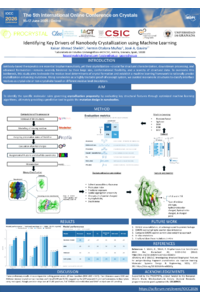
Antibody-based therapeutics represent an important class of biopharmaceuticals [1]. Crystallization of antibodies is essential for structural characterization and holds potential for applications in downstream processing and drug formulation [2]. However, crystallization of antibodies remains challenging due to the large size, conformational flexibility, and complex intermolecular interactions of antibodies [3]. Predicting mutations that influence crystallizability could facilitate rational design of crystallization strategies, yet the limited availability of structural data has restricted the development of robust predictive models. In this study, we combine computational modelling with machine learning to identify descriptors associated with crystallization in nanobodies as a proof-of-concept system, given the scarcity of crystallized full-length monoclonal antibodies. Monomeric nanobody structures were curated and analyzed to identify crystal interface residues, which were classified as crystal-site or non-crystal-site residues. Each residue was represented using a multidimensional set of physicochemical and structural descriptors capturing both intrinsic residue properties and features of the surrounding structural environment. Several machine learning algorithms were evaluated for residue classification, among which XGBoost demonstrated the best predictive performance. Here, we present our preliminary analysis revealing structural characteristics associated with crystallization propensity, providing insights into residue-level determinants of crystal formation. This is one of the first fundamental steps towards a framework aimed at enhancing crystallization of antibodies through mutation-driven crystal contact engineering.
References:
1. Walsh, G., Walsh, E. Biopharmaceutical benchmarks 2022. Nat Biotechnol 40, 1722–1760 (2022). https://doi.org/10.1038/s41587-022-01582-x
2.Zang Y, Kammerer B, Eisenkolb M, Lohr K, Kiefer H (2011) Towards Protein Crystallization as a Process Step in Downstream Processing of Therapeutic Antibodies: Screening and Optimization at Microbatch Scale. PLoS ONE 6(9): e25282. https://doi.org/10.1371/journal.pone.0025282
3.Chattaraj et al (2025c). Investigating structural biophysical features for antigen-binding fragment crystallization via machine learning. Molecular Systems Design & Engineering, 10(5), 377–393. https://doi.org/10.1039/d4me00187g
Acknowledgements
We acknowledge the PROCRYSTAL consortium for supporting this research, funded under Grant Agreement ID: 101169471.
Keywords
prediction
residue
mutations
models
nanaobodies
Poster
Poster-MDPI.pdf
Crystal Engineering of Quinazoline Derivatives: Impact of Chalcogen Substitution and Substituent Bulk on 3D Architecture and Intermolecular Interactions
Simulation of recrystallization in polycrystalline materials