Event submissions
Published
This submission belongs to the session S1. Technology Enhanced Education of the event The 1st International Online Conference on Education Sciences
Published date
10 Jun, 2026
Academic Editor
'%3e%3cpath%20d='M12.6657%2010.9104C12.4185%2010.325%2012.0599%209.79327%2011.6097%209.34482C11.1609%208.89508%2010.6293%208.5365%2010.0442%208.28888C10.0389%208.28626%2010.0337%208.28495%2010.0285%208.28233C10.8446%207.69279%2011.3752%206.73249%2011.3752%205.64904C11.3752%203.8542%209.92103%202.39999%208.1262%202.39999C6.33136%202.39999%204.87715%203.8542%204.87715%205.64904C4.87715%206.73249%205.40774%207.69279%206.22393%208.28364C6.21869%208.28626%206.21345%208.28757%206.20821%208.29019C5.62129%208.5378%205.09463%208.89284%204.64265%209.34613C4.1929%209.79493%203.83432%2010.3266%203.58671%2010.9117C3.34345%2011.4845%203.21226%2012.0987%203.20023%2012.7209C3.19988%2012.7349%203.20233%2012.7488%203.20744%2012.7619C3.21255%2012.7749%203.22022%2012.7867%203.22998%2012.7968C3.23975%2012.8068%203.25142%2012.8147%203.26431%2012.8202C3.2772%2012.8256%203.29105%2012.8284%203.30504%2012.8284H4.09109C4.14874%2012.8284%204.19459%2012.7825%204.1959%2012.7262C4.2221%2011.7148%204.62823%2010.7676%205.34617%2010.0497C6.08899%209.30683%207.0755%208.89808%208.1262%208.89808C9.17689%208.89808%2010.1634%209.30683%2010.9062%2010.0497C11.6242%2010.7676%2012.0303%2011.7148%2012.0565%2012.7262C12.0578%2012.7838%2012.1037%2012.8284%2012.1613%2012.8284H12.9474C12.9613%2012.8284%2012.9752%2012.8256%2012.9881%2012.8202C13.001%2012.8147%2013.0126%2012.8068%2013.0224%2012.7968C13.0322%2012.7867%2013.0398%2012.7749%2013.0449%2012.7619C13.0501%2012.7488%2013.0525%2012.7349%2013.0522%2012.7209C13.0391%2012.0947%2012.9094%2011.4855%2012.6657%2010.9104ZM8.1262%207.9024C7.52486%207.9024%206.9589%207.6679%206.53312%207.24211C6.10733%206.81633%205.87283%206.25037%205.87283%205.64904C5.87283%205.0477%206.10733%204.48174%206.53312%204.05596C6.9589%203.63018%207.52486%203.39567%208.1262%203.39567C8.72753%203.39567%209.29349%203.63018%209.71927%204.05596C10.1451%204.48174%2010.3796%205.0477%2010.3796%205.64904C10.3796%206.25037%2010.1451%206.81633%209.71927%207.24211C9.29349%207.6679%208.72753%207.9024%208.1262%207.9024Z'%20fill='%235D1EE1'/%3e%3c/g%3e%3c/svg%3e) Mike Joy
Mike JoyCitation
Xinxin Jiang, Bridging the Digital Divide: Scaffolding Postgraduate Academic English Proficiency Through AI-Powered Adaptive Learning Platforms, in Proceedings of The 1st International Online Conference on Education Sciences, 15 June–17 June 2026, MDPI: Basel, Switzerland
Share
Email
Facebook
Twitter
LinkedIn
Bridging the Digital Divide: Scaffolding Postgraduate Academic English Proficiency Through AI-Powered Adaptive Learning Platforms

Xinxin Jiang 1
1. Harbin Engineering University, Harbin, China, China
Abstract
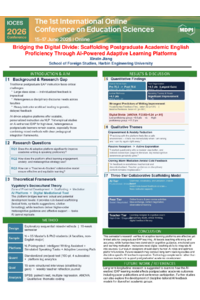
The integration of artificial intelligence (AI) into English for Academic Purposes (EAP) instruction marks a substantial transformation in technology-enhanced education, especially for postgraduate students in need of advanced linguistic and critical thinking abilities. This study investigates the integration of an AI-driven adaptive learning platform within a compulsory postgraduate public English course at Harbin Engineering University, China, aiming to enhance personalized learning experiences and improve educational outcomes. The platform employs natural language processing to offer tailored feedback on academic writing and speaking tasks, focusing on aspects such as argumentation, lexical accuracy, and disciplinary discourse norms. Utilizing a mixed-methods approach that incorporates pre- and post-assessment scores, platform analytics, and semi-structured student interviews, the research assesses the platform's effectiveness in supporting academic English proficiency. Initial results from a semester-long study (N = 85) reveal statistically significant improvements in students' academic writing proficiency (p < .05, Cohen's d = 0.62), particularly in writing coherence and disciplinary vocabulary breadth. Qualitative data indicate that immediate, personalized feedback alleviated speaking anxiety and prompted more frequent attempts at using complex language structures. Nevertheless, students with lower initial proficiency continued to face challenges, highlighting the necessity for additional instructor support. The study suggests that AI-powered tools, when integrated pedagogically, can complement traditional instructional models by providing scalable, personalized support. This may enhance linguistic proficiency while also cultivating metacognitive awareness in academic communication. The paper concludes by presenting a framework for incorporating adaptive technology into EAP curricula, highlighting the indispensable role of teachers in promoting critical digital literacy and ensuring equitable learning experiences.
Keywords
Technology Enhanced Education
English for Academic Purposes (EAP)
Adaptive Learning
Artificial Intelligence (AI)
Postgraduate Education
Scaffolding
Personalized Feedback
Poster
Xinxin Jiang's Poster.pdf
Connected Schools: Spatial Implications, Accessibility, and the Digital Divide in Small Towns and Rural Areas, Buenos Aires
Lichens and Education: Integrating GIS Technology and Montessori Pedagogy for Urban Environmental Awareness