Event submissions
Published
This submission belongs to the session S2. Higher Education of the event The 1st International Online Conference on Education Sciences
Published date
10 Jun, 2026
Academic Editor
'%3e%3cpath%20d='M12.6657%2010.9104C12.4185%2010.325%2012.0599%209.79327%2011.6097%209.34482C11.1609%208.89508%2010.6293%208.5365%2010.0442%208.28888C10.0389%208.28626%2010.0337%208.28495%2010.0285%208.28233C10.8446%207.69279%2011.3752%206.73249%2011.3752%205.64904C11.3752%203.8542%209.92103%202.39999%208.1262%202.39999C6.33136%202.39999%204.87715%203.8542%204.87715%205.64904C4.87715%206.73249%205.40774%207.69279%206.22393%208.28364C6.21869%208.28626%206.21345%208.28757%206.20821%208.29019C5.62129%208.5378%205.09463%208.89284%204.64265%209.34613C4.1929%209.79493%203.83432%2010.3266%203.58671%2010.9117C3.34345%2011.4845%203.21226%2012.0987%203.20023%2012.7209C3.19988%2012.7349%203.20233%2012.7488%203.20744%2012.7619C3.21255%2012.7749%203.22022%2012.7867%203.22998%2012.7968C3.23975%2012.8068%203.25142%2012.8147%203.26431%2012.8202C3.2772%2012.8256%203.29105%2012.8284%203.30504%2012.8284H4.09109C4.14874%2012.8284%204.19459%2012.7825%204.1959%2012.7262C4.2221%2011.7148%204.62823%2010.7676%205.34617%2010.0497C6.08899%209.30683%207.0755%208.89808%208.1262%208.89808C9.17689%208.89808%2010.1634%209.30683%2010.9062%2010.0497C11.6242%2010.7676%2012.0303%2011.7148%2012.0565%2012.7262C12.0578%2012.7838%2012.1037%2012.8284%2012.1613%2012.8284H12.9474C12.9613%2012.8284%2012.9752%2012.8256%2012.9881%2012.8202C13.001%2012.8147%2013.0126%2012.8068%2013.0224%2012.7968C13.0322%2012.7867%2013.0398%2012.7749%2013.0449%2012.7619C13.0501%2012.7488%2013.0525%2012.7349%2013.0522%2012.7209C13.0391%2012.0947%2012.9094%2011.4855%2012.6657%2010.9104ZM8.1262%207.9024C7.52486%207.9024%206.9589%207.6679%206.53312%207.24211C6.10733%206.81633%205.87283%206.25037%205.87283%205.64904C5.87283%205.0477%206.10733%204.48174%206.53312%204.05596C6.9589%203.63018%207.52486%203.39567%208.1262%203.39567C8.72753%203.39567%209.29349%203.63018%209.71927%204.05596C10.1451%204.48174%2010.3796%205.0477%2010.3796%205.64904C10.3796%206.25037%2010.1451%206.81633%209.71927%207.24211C9.29349%207.6679%208.72753%207.9024%208.1262%207.9024Z'%20fill='%235D1EE1'/%3e%3c/g%3e%3c/svg%3e) EMILIO ABAD-SEGURA
EMILIO ABAD-SEGURACitation
M.M. Quazi, Mehak Mohiuddin, A Comparative Analysis of Educational Barriers Between Pakistan and Malaysia, in Proceedings of The 1st International Online Conference on Education Sciences, 15 June–17 June 2026, MDPI: Basel, Switzerland
Share
Email
Facebook
Twitter
LinkedIn
A Comparative Analysis of Educational Barriers Between Pakistan and Malaysia
'%3e%3cpath%20d='M12.6647%2010.9104C12.4176%2010.325%2012.0589%209.7933%2011.6088%209.34485C11.16%208.89511%2010.6283%208.53653%2010.0432%208.28891C10.038%208.28629%2010.0327%208.28498%2010.0275%208.28236C10.8437%207.69282%2011.3743%206.73252%2011.3743%205.64907C11.3743%203.85423%209.92005%202.40002%208.12522%202.40002C6.33038%202.40002%204.87618%203.85423%204.87618%205.64907C4.87618%206.73252%205.40677%207.69282%206.22296%208.28367C6.21772%208.28629%206.21248%208.2876%206.20724%208.29022C5.62031%208.53783%205.09365%208.89287%204.64167%209.34616C4.19192%209.79496%203.83334%2010.3266%203.58573%2010.9117C3.34247%2011.4846%203.21128%2012.0987%203.19925%2012.721C3.1989%2012.735%203.20135%2012.7489%203.20646%2012.7619C3.21157%2012.7749%203.21924%2012.7868%203.22901%2012.7968C3.23877%2012.8068%203.25045%2012.8148%203.26334%2012.8202C3.27623%2012.8256%203.29007%2012.8284%203.30406%2012.8284H4.09012C4.14776%2012.8284%204.19362%2012.7825%204.19493%2012.7262C4.22113%2011.7148%204.62726%2010.7676%205.34519%2010.0497C6.08802%209.30686%207.07452%208.89811%208.12522%208.89811C9.17592%208.89811%2010.1624%209.30686%2010.9052%2010.0497C11.6232%2010.7676%2012.0293%2011.7148%2012.0555%2012.7262C12.0568%2012.7839%2012.1027%2012.8284%2012.1603%2012.8284H12.9464C12.9604%2012.8284%2012.9742%2012.8256%2012.9871%2012.8202C13%2012.8148%2013.0117%2012.8068%2013.0214%2012.7968C13.0312%2012.7868%2013.0389%2012.7749%2013.044%2012.7619C13.0491%2012.7489%2013.0515%2012.735%2013.0512%2012.721C13.0381%2012.0947%2012.9084%2011.4856%2012.6647%2010.9104ZM8.12522%207.90243C7.52388%207.90243%206.95792%207.66793%206.53214%207.24215C6.10636%206.81636%205.87185%206.2504%205.87185%205.64907C5.87185%205.04773%206.10636%204.48177%206.53214%204.05599C6.95792%203.63021%207.52388%203.3957%208.12522%203.3957C8.72655%203.3957%209.29252%203.63021%209.7183%204.05599C10.1441%204.48177%2010.3786%205.04773%2010.3786%205.64907C10.3786%206.2504%2010.1441%206.81636%209.7183%207.24215C9.29252%207.66793%208.72655%207.90243%208.12522%207.90243Z'%20fill='%235D1EE1'/%3e%3c/g%3e%3c/svg%3e)
Mehak Mohiuddin 1
M.M. Quazi 2
1. Faculty of Education, Allama Iqbal Open University, Islamabad 44310, Pakistan, Pakistan
2. Faculty of Mechanical and Automotive Engineering Technology, Universiti Malaysia Pahang Al-Sultan Abdullah, 26600, Pekan, Pahang, Malaysia, Malaysia
Abstract
Introduction:
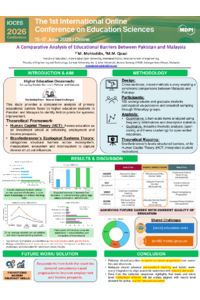
With the evolving landscape of global higher education, it is imperative to analyse and understand specific friction points for systemic improvement. This paper provides comparative analysis of primary educational barriers faced by higher education students in Pakistan and Malaysia. Human Capital Theory (HCT) frames education as an investment that is aimed at providing employment and better income prospects, while Bronfenbrenner's Ecological Systems Theory categorises barriers across microsystem, mesosystem, exosystem, and macrosystem levels to capture structural influences at each level.
Methods:
This study employed a cross-sectional, mixed-methods survey design, selected for enabling synchronic comparison across two national contexts. Participants were recruited through purposive and snowball sampling, distributed via WhatsApp student groups, targeting undergraduate and graduate students in Pakistan and Malaysia. A total of 102 valid responses were collected. Likert-scale items were analysed using frequency distributions and descriptive statistics, while open-ended responses underwent inductive thematic analysis through open-coding and theme clustering. Bronfenbrenner's levels structured barrier categorisation and HCT-informed interpretation of student motivations.
Results:
Unanimously at the mesosystem level, both cohorts identified cost of education and mental health pressure as dominant shared barriers, consistent with HCT's premise that financial strain undermines educational investment returns. Structural barriers diverged at the microsystem and exosystem levels. Pakistani students reported frustration with rote memorisation, rigid structures, and outdated assessments, reflecting deeply rooted examination-based credentialism at the macrosystem level. Malaysian students identified lack of personalisation and curriculum–industry misalignment as primary exosystem-level barriers. Both cohorts preferred project-based learning, reflecting HCT-aligned demands for market-relevant skills, while Malaysian respondents additionally favoured hybrid work–study models reflecting macrosystem-level academic industry expectations.
Conclusion:
Shared financial and psychological burdens reflect HCT's consistent expectations of economic returns from education. Reform in Pakistan should prioritise competency-based progression over exam-focused structures, while Malaysia should advance personalised learning and hybrid work–study integration to align academic outcomes with industry demands.
Keywords
higher education
rote learning
rigid structures
assessment methods
hybrid work-study
practical industry ready
Poster
IOCES poster.pdf
Large Language Models for Generating Interactive Simulations in Anatomy Education
Developmental and Contextual Predictors, and Behavioral Patterns of Off-Task Behavior in UAE Early Childhood English Classrooms