Event submissions
Published
This submission belongs to the session S1. Technology Enhanced Education of the event The 1st International Online Conference on Education Sciences
Published date
10 Jun, 2026
Academic Editor
'%3e%3cpath%20d='M12.6657%2010.9104C12.4185%2010.325%2012.0599%209.79327%2011.6097%209.34482C11.1609%208.89508%2010.6293%208.5365%2010.0442%208.28888C10.0389%208.28626%2010.0337%208.28495%2010.0285%208.28233C10.8446%207.69279%2011.3752%206.73249%2011.3752%205.64904C11.3752%203.8542%209.92103%202.39999%208.1262%202.39999C6.33136%202.39999%204.87715%203.8542%204.87715%205.64904C4.87715%206.73249%205.40774%207.69279%206.22393%208.28364C6.21869%208.28626%206.21345%208.28757%206.20821%208.29019C5.62129%208.5378%205.09463%208.89284%204.64265%209.34613C4.1929%209.79493%203.83432%2010.3266%203.58671%2010.9117C3.34345%2011.4845%203.21226%2012.0987%203.20023%2012.7209C3.19988%2012.7349%203.20233%2012.7488%203.20744%2012.7619C3.21255%2012.7749%203.22022%2012.7867%203.22998%2012.7968C3.23975%2012.8068%203.25142%2012.8147%203.26431%2012.8202C3.2772%2012.8256%203.29105%2012.8284%203.30504%2012.8284H4.09109C4.14874%2012.8284%204.19459%2012.7825%204.1959%2012.7262C4.2221%2011.7148%204.62823%2010.7676%205.34617%2010.0497C6.08899%209.30683%207.0755%208.89808%208.1262%208.89808C9.17689%208.89808%2010.1634%209.30683%2010.9062%2010.0497C11.6242%2010.7676%2012.0303%2011.7148%2012.0565%2012.7262C12.0578%2012.7838%2012.1037%2012.8284%2012.1613%2012.8284H12.9474C12.9613%2012.8284%2012.9752%2012.8256%2012.9881%2012.8202C13.001%2012.8147%2013.0126%2012.8068%2013.0224%2012.7968C13.0322%2012.7867%2013.0398%2012.7749%2013.0449%2012.7619C13.0501%2012.7488%2013.0525%2012.7349%2013.0522%2012.7209C13.0391%2012.0947%2012.9094%2011.4855%2012.6657%2010.9104ZM8.1262%207.9024C7.52486%207.9024%206.9589%207.6679%206.53312%207.24211C6.10733%206.81633%205.87283%206.25037%205.87283%205.64904C5.87283%205.0477%206.10733%204.48174%206.53312%204.05596C6.9589%203.63018%207.52486%203.39567%208.1262%203.39567C8.72753%203.39567%209.29349%203.63018%209.71927%204.05596C10.1451%204.48174%2010.3796%205.0477%2010.3796%205.64904C10.3796%206.25037%2010.1451%206.81633%209.71927%207.24211C9.29349%207.6679%208.72753%207.9024%208.1262%207.9024Z'%20fill='%235D1EE1'/%3e%3c/g%3e%3c/svg%3e) Mike Joy
Mike JoyCitation
Salome Oniani, Ia Mosashvili, Selcuk Toprak, Ready4Disasters: A Scalable 3D Mobile Gamification Framework for Multi-Hazard Emergency Response Training, in Proceedings of The 1st International Online Conference on Education Sciences, 15 June–17 June 2026, MDPI: Basel, Switzerland
Share
Email
Facebook
Twitter
LinkedIn
Ready4Disasters: A Scalable 3D Mobile Gamification Framework for Multi-Hazard Emergency Response Training
'%3e%3cpath%20d='M12.6647%2010.9104C12.4176%2010.325%2012.0589%209.7933%2011.6088%209.34485C11.16%208.89511%2010.6283%208.53653%2010.0432%208.28891C10.038%208.28629%2010.0327%208.28498%2010.0275%208.28236C10.8437%207.69282%2011.3743%206.73252%2011.3743%205.64907C11.3743%203.85423%209.92005%202.40002%208.12522%202.40002C6.33038%202.40002%204.87618%203.85423%204.87618%205.64907C4.87618%206.73252%205.40677%207.69282%206.22296%208.28367C6.21772%208.28629%206.21248%208.2876%206.20724%208.29022C5.62031%208.53783%205.09365%208.89287%204.64167%209.34616C4.19192%209.79496%203.83334%2010.3266%203.58573%2010.9117C3.34247%2011.4846%203.21128%2012.0987%203.19925%2012.721C3.1989%2012.735%203.20135%2012.7489%203.20646%2012.7619C3.21157%2012.7749%203.21924%2012.7868%203.22901%2012.7968C3.23877%2012.8068%203.25045%2012.8148%203.26334%2012.8202C3.27623%2012.8256%203.29007%2012.8284%203.30406%2012.8284H4.09012C4.14776%2012.8284%204.19362%2012.7825%204.19493%2012.7262C4.22113%2011.7148%204.62726%2010.7676%205.34519%2010.0497C6.08802%209.30686%207.07452%208.89811%208.12522%208.89811C9.17592%208.89811%2010.1624%209.30686%2010.9052%2010.0497C11.6232%2010.7676%2012.0293%2011.7148%2012.0555%2012.7262C12.0568%2012.7839%2012.1027%2012.8284%2012.1603%2012.8284H12.9464C12.9604%2012.8284%2012.9742%2012.8256%2012.9871%2012.8202C13%2012.8148%2013.0117%2012.8068%2013.0214%2012.7968C13.0312%2012.7868%2013.0389%2012.7749%2013.044%2012.7619C13.0491%2012.7489%2013.0515%2012.735%2013.0512%2012.721C13.0381%2012.0947%2012.9084%2011.4856%2012.6647%2010.9104ZM8.12522%207.90243C7.52388%207.90243%206.95792%207.66793%206.53214%207.24215C6.10636%206.81636%205.87185%206.2504%205.87185%205.64907C5.87185%205.04773%206.10636%204.48177%206.53214%204.05599C6.95792%203.63021%207.52388%203.3957%208.12522%203.3957C8.72655%203.3957%209.29252%203.63021%209.7183%204.05599C10.1441%204.48177%2010.3786%205.04773%2010.3786%205.64907C10.3786%206.2504%2010.1441%206.81636%209.7183%207.24215C9.29252%207.66793%208.72655%207.90243%208.12522%207.90243Z'%20fill='%235D1EE1'/%3e%3c/g%3e%3c/svg%3e)
Salome Oniani 1
Ia Mosashvili 2
Selcuk Toprak 3
1. Information Technology School, Alte University, Tbilisi, 0177, Georgia, Georgia
2. Computer Science School, Kutaisi International University, Kutaisi, 4600, Georgia, Georgia
3. Department of Civil Engineering, Gebze Technical University, Gebze/KOCAELİ, 41400, Turkey, Turkey (Türkiye)
Abstract
Introduction
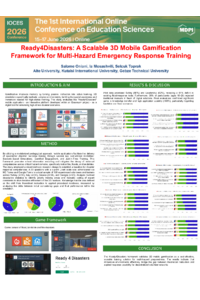
Gamification improves memory by turning passive instruction into active learning. 3D simulations specifically replicate complex environments, building the spatial awareness and immersion needed for high-stakes training. This study evaluates the "Ready4Disasters" mobile application—an interactive platform developed within an Erasmus+ project—as a digital tool for simulating high-stress disaster scenarios.
Methods
By utilizing a modularized pedagogical approach, mobile applications facilitate the delivery of specialized disaster response training through several key instructional modalities: Scenario-Based Simulations, Gamified Engagement, and Just-in-Time Training. This framework promotes robust information encoding and mitigates the decay of technical competencies across critical hazard domains, specifically indoor fire, floods, and landslides.
This study employed a mixed-methods research design to establish a baseline for disaster response competencies. A questionnaire comprising 33 questions with a 5-point Likert scale was administered via MS Forms and Google Forms to a total sample of 159 experienced volunteers and trainers across Turkey (n=51), Italy (n=51), Greece (n=36), and Georgia (n=21). Analysis involved descriptive statistics to identify priority training areas and thematic coding of expert comments to drive iterative refinement of the 3D modules. Knowledge transfer was defined as the shift from theoretical instruction to applied procedural readiness, measured by analyzing the delta between initial competency gaps and final performance within the simulation.
Results
Pilot data prioritized Safety (66%) and Leadership (62%), revealing a 61% deficit in existing flood-response tools. Furthermore, 38% of participants (ages 18–25) rejected traditional manuals in favor of digital solutions. Final evaluations confirmed significant gains in knowledge transfer and high application usability (>80%), particularly regarding landslide and flood scenarios.
Conclusions
The Ready4Disasters framework validates 3D mobile gamification as a cost-effective, scalable training solution for multi-hazard preparedness. The results indicate that immersive environments effectively bridge the gap between theoretical instruction and applied response capabilities for decentralized volunteer networks.
Keywords
m-Education
Digitalization
Mobile games
Gamification
Poster
პოსტერი.pdf
Human-Centred Artificial Intelligence in Education: A Conceptual Model of Trust, Agency and Ethics
Towards sustainable clinical teaching in resource-limited settings: the potential role of an artificial intelligence (AI)-generated visual clinic