Event submissions
Published
This submission belongs to the session S1. Technology Enhanced Education of the event The 1st International Online Conference on Education Sciences
Published date
10 Jun, 2026
Academic Editor
'%3e%3cpath%20d='M12.6657%2010.9104C12.4185%2010.325%2012.0599%209.79327%2011.6097%209.34482C11.1609%208.89508%2010.6293%208.5365%2010.0442%208.28888C10.0389%208.28626%2010.0337%208.28495%2010.0285%208.28233C10.8446%207.69279%2011.3752%206.73249%2011.3752%205.64904C11.3752%203.8542%209.92103%202.39999%208.1262%202.39999C6.33136%202.39999%204.87715%203.8542%204.87715%205.64904C4.87715%206.73249%205.40774%207.69279%206.22393%208.28364C6.21869%208.28626%206.21345%208.28757%206.20821%208.29019C5.62129%208.5378%205.09463%208.89284%204.64265%209.34613C4.1929%209.79493%203.83432%2010.3266%203.58671%2010.9117C3.34345%2011.4845%203.21226%2012.0987%203.20023%2012.7209C3.19988%2012.7349%203.20233%2012.7488%203.20744%2012.7619C3.21255%2012.7749%203.22022%2012.7867%203.22998%2012.7968C3.23975%2012.8068%203.25142%2012.8147%203.26431%2012.8202C3.2772%2012.8256%203.29105%2012.8284%203.30504%2012.8284H4.09109C4.14874%2012.8284%204.19459%2012.7825%204.1959%2012.7262C4.2221%2011.7148%204.62823%2010.7676%205.34617%2010.0497C6.08899%209.30683%207.0755%208.89808%208.1262%208.89808C9.17689%208.89808%2010.1634%209.30683%2010.9062%2010.0497C11.6242%2010.7676%2012.0303%2011.7148%2012.0565%2012.7262C12.0578%2012.7838%2012.1037%2012.8284%2012.1613%2012.8284H12.9474C12.9613%2012.8284%2012.9752%2012.8256%2012.9881%2012.8202C13.001%2012.8147%2013.0126%2012.8068%2013.0224%2012.7968C13.0322%2012.7867%2013.0398%2012.7749%2013.0449%2012.7619C13.0501%2012.7488%2013.0525%2012.7349%2013.0522%2012.7209C13.0391%2012.0947%2012.9094%2011.4855%2012.6657%2010.9104ZM8.1262%207.9024C7.52486%207.9024%206.9589%207.6679%206.53312%207.24211C6.10733%206.81633%205.87283%206.25037%205.87283%205.64904C5.87283%205.0477%206.10733%204.48174%206.53312%204.05596C6.9589%203.63018%207.52486%203.39567%208.1262%203.39567C8.72753%203.39567%209.29349%203.63018%209.71927%204.05596C10.1451%204.48174%2010.3796%205.0477%2010.3796%205.64904C10.3796%206.25037%2010.1451%206.81633%209.71927%207.24211C9.29349%207.6679%208.72753%207.9024%208.1262%207.9024Z'%20fill='%235D1EE1'/%3e%3c/g%3e%3c/svg%3e) Mike Joy
Mike JoyCitation
Antonio David Martin-Barrado, Diego Gomez-Baya, The Relationship Between Positive Youth Development and Attitudes Toward Artificial Intelligence., in Proceedings of The 1st International Online Conference on Education Sciences, 15 June–17 June 2026, MDPI: Basel, Switzerland
Share
Email
Facebook
Twitter
LinkedIn
The Relationship Between Positive Youth Development and Attitudes Toward Artificial Intelligence.

Antonio David Martin-Barrado 1

Diego Gomez-Baya 1
1. Department of Social, Developmental and Educational Psychology, Universidad de Huelva, 21007 Huelva, Spain., Spain
Abstract
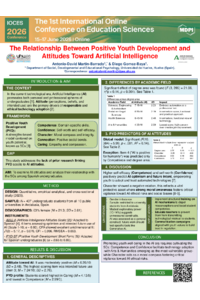
Introduction: Understanding how young people perceive Artificial Intelligence (AI) is crucial for promoting its ethical and responsible adoption. The Positive Youth Development (PYD) framework proposes a strength-based approach centered on the 5Cs, which promote overall well-being. While PYD has proven effective in mitigating various digital risks, its role in shaping AI-related attitudes remains largely unexplored. Therefore, this study analyzed the relationship between these attitudes and the 5Cs of PYD within the university context.
Method: The sample consisted of 407 Spanish undergraduate students (63.1% women; M = 21.93) enrolled in 10 universities in Andalusia (Spain). Participants completed the PYD-SF and AIAS-4 scales during the year 2025.
Results: The findings indicated a weak but significant correlation between both constructs, suggesting that specific PYD dimensions are aligned with a favorable view of AI. Hierarchical regression models found that higher levels of Confidence, Competence, and degree area emerged as significant positive predictors of AI favorability. Conversely, Character showed a negative association. Students in Science, Engineering, and Architecture reported the most favorable attitudes compared to their peers in Arts and Humanities, who obtained the lowest scores. Competence and degree area were found to be significant predictors of the perception of AI as a positive technology for humanity. No significant gender differences were observed.
Discussion: These results suggest that certain strengths, such as self-efficacy (Competence) and self-esteem (Confidence), facilitate technology adoption. However, students with higher moral awareness (Character) appear to maintain a more critical stance regarding ethical risks and social inequalities. Future research should address the limitations of this cross-sectional design and explore specific AI applications. Finally, practical implications underscore the need for governments to increase transparency in AI regulation to foster public trust.
Keywords
Artificial Intelligence
Positive Youth Development
5Cs
attitudes
undergraduate students.
Poster
Poster_AI attitudes and PYD.pdf
ChatGPT as a Tool for Generating Clinical Simulation Cases in Emergency Medicine Education: A Validity-Based Comparative Study
Enhancing Statistical Learning in Primary Education through Scratch: An Educational Intervention Study