Event submissions
Published
This submission belongs to the session S1. Technology Enhanced Education of the event The 1st International Online Conference on Education Sciences
Published date
10 Jun, 2026
Academic Editor
'%3e%3cpath%20d='M12.6657%2010.9104C12.4185%2010.325%2012.0599%209.79327%2011.6097%209.34482C11.1609%208.89508%2010.6293%208.5365%2010.0442%208.28888C10.0389%208.28626%2010.0337%208.28495%2010.0285%208.28233C10.8446%207.69279%2011.3752%206.73249%2011.3752%205.64904C11.3752%203.8542%209.92103%202.39999%208.1262%202.39999C6.33136%202.39999%204.87715%203.8542%204.87715%205.64904C4.87715%206.73249%205.40774%207.69279%206.22393%208.28364C6.21869%208.28626%206.21345%208.28757%206.20821%208.29019C5.62129%208.5378%205.09463%208.89284%204.64265%209.34613C4.1929%209.79493%203.83432%2010.3266%203.58671%2010.9117C3.34345%2011.4845%203.21226%2012.0987%203.20023%2012.7209C3.19988%2012.7349%203.20233%2012.7488%203.20744%2012.7619C3.21255%2012.7749%203.22022%2012.7867%203.22998%2012.7968C3.23975%2012.8068%203.25142%2012.8147%203.26431%2012.8202C3.2772%2012.8256%203.29105%2012.8284%203.30504%2012.8284H4.09109C4.14874%2012.8284%204.19459%2012.7825%204.1959%2012.7262C4.2221%2011.7148%204.62823%2010.7676%205.34617%2010.0497C6.08899%209.30683%207.0755%208.89808%208.1262%208.89808C9.17689%208.89808%2010.1634%209.30683%2010.9062%2010.0497C11.6242%2010.7676%2012.0303%2011.7148%2012.0565%2012.7262C12.0578%2012.7838%2012.1037%2012.8284%2012.1613%2012.8284H12.9474C12.9613%2012.8284%2012.9752%2012.8256%2012.9881%2012.8202C13.001%2012.8147%2013.0126%2012.8068%2013.0224%2012.7968C13.0322%2012.7867%2013.0398%2012.7749%2013.0449%2012.7619C13.0501%2012.7488%2013.0525%2012.7349%2013.0522%2012.7209C13.0391%2012.0947%2012.9094%2011.4855%2012.6657%2010.9104ZM8.1262%207.9024C7.52486%207.9024%206.9589%207.6679%206.53312%207.24211C6.10733%206.81633%205.87283%206.25037%205.87283%205.64904C5.87283%205.0477%206.10733%204.48174%206.53312%204.05596C6.9589%203.63018%207.52486%203.39567%208.1262%203.39567C8.72753%203.39567%209.29349%203.63018%209.71927%204.05596C10.1451%204.48174%2010.3796%205.0477%2010.3796%205.64904C10.3796%206.25037%2010.1451%206.81633%209.71927%207.24211C9.29349%207.6679%208.72753%207.9024%208.1262%207.9024Z'%20fill='%235D1EE1'/%3e%3c/g%3e%3c/svg%3e) Mike Joy
Mike JoyCitation
Marina Pérez-Tomás, Perceived impact of social networks on the cognitive functions of university students, in Proceedings of The 1st International Online Conference on Education Sciences, 15 June–17 June 2026, MDPI: Basel, Switzerland
Share
Email
Facebook
Twitter
LinkedIn
Perceived impact of social networks on the cognitive functions of university students

Marina Pérez-Tomás 1
1. Department of Education Sciences, University of Zaragoza, Zaragoza, 50009, Spain, Spain
Abstract
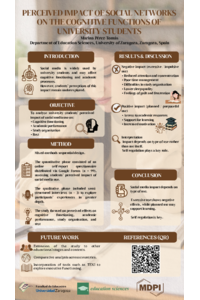
The increasing presence of social media in students’ everyday lives has generated growing interest in its perceived influence on learning processes and cognitive functioning within educational contexts. This research forms part of an ongoing doctoral project that builds on previous work conducted with university students and is currently being expanded to different educational stages and national contexts.
The initial phase of the research explored university students’ perceptions of the impact of social media use on cognitive functioning, academic performance, study organisation, and rest. This phase employed an online self-report questionnaire distributed via Google Forms, complemented by qualitative data collected through semi-structured interviews. Drawing on the findings and methodological foundations of this earlier work, the doctoral project now adopts a broader and comparative perspective.
At present, two complementary research plans are being developed. The first continues data collection with university students in Spain, allowing for the replication and extension of previous results. The second extends the study to secondary education contexts in England, incorporating both the original questionnaire and the Teenage Executive Functioning Inventory (TEXI) to explore perceived cognitive and learning-related processes across educational stages.
The overall research design follows a non-experimental, mixed-methods approach and focuses on students’ perceptions rather than objective performance measures. By examining how learners at different educational levels perceive the role of social media in relation to their learning and everyday cognitive functioning, this study contributes to current discussions in technology-enhanced education. The research aims to inform educational practice and future research by highlighting the importance of self-regulation, digital awareness, and students’ perspectives in contemporary learning environments.
Keywords
social networks
cognitive functions
self-regulation
academic performance
higher education
Poster
MarinaPerezTomas_IOCES2026_Poster.pdf
Enhancing Statistical Learning in Primary Education through Scratch: An Educational Intervention Study
Privacy Policies of the Top 100 Educational Apps: A Transparency and Ethics Analysis