Event submissions
Published
This submission belongs to the session S1. Technology Enhanced Education of the event The 1st International Online Conference on Education Sciences
Published date
10 Jun, 2026
Academic Editor
'%3e%3cpath%20d='M12.6657%2010.9104C12.4185%2010.325%2012.0599%209.79327%2011.6097%209.34482C11.1609%208.89508%2010.6293%208.5365%2010.0442%208.28888C10.0389%208.28626%2010.0337%208.28495%2010.0285%208.28233C10.8446%207.69279%2011.3752%206.73249%2011.3752%205.64904C11.3752%203.8542%209.92103%202.39999%208.1262%202.39999C6.33136%202.39999%204.87715%203.8542%204.87715%205.64904C4.87715%206.73249%205.40774%207.69279%206.22393%208.28364C6.21869%208.28626%206.21345%208.28757%206.20821%208.29019C5.62129%208.5378%205.09463%208.89284%204.64265%209.34613C4.1929%209.79493%203.83432%2010.3266%203.58671%2010.9117C3.34345%2011.4845%203.21226%2012.0987%203.20023%2012.7209C3.19988%2012.7349%203.20233%2012.7488%203.20744%2012.7619C3.21255%2012.7749%203.22022%2012.7867%203.22998%2012.7968C3.23975%2012.8068%203.25142%2012.8147%203.26431%2012.8202C3.2772%2012.8256%203.29105%2012.8284%203.30504%2012.8284H4.09109C4.14874%2012.8284%204.19459%2012.7825%204.1959%2012.7262C4.2221%2011.7148%204.62823%2010.7676%205.34617%2010.0497C6.08899%209.30683%207.0755%208.89808%208.1262%208.89808C9.17689%208.89808%2010.1634%209.30683%2010.9062%2010.0497C11.6242%2010.7676%2012.0303%2011.7148%2012.0565%2012.7262C12.0578%2012.7838%2012.1037%2012.8284%2012.1613%2012.8284H12.9474C12.9613%2012.8284%2012.9752%2012.8256%2012.9881%2012.8202C13.001%2012.8147%2013.0126%2012.8068%2013.0224%2012.7968C13.0322%2012.7867%2013.0398%2012.7749%2013.0449%2012.7619C13.0501%2012.7488%2013.0525%2012.7349%2013.0522%2012.7209C13.0391%2012.0947%2012.9094%2011.4855%2012.6657%2010.9104ZM8.1262%207.9024C7.52486%207.9024%206.9589%207.6679%206.53312%207.24211C6.10733%206.81633%205.87283%206.25037%205.87283%205.64904C5.87283%205.0477%206.10733%204.48174%206.53312%204.05596C6.9589%203.63018%207.52486%203.39567%208.1262%203.39567C8.72753%203.39567%209.29349%203.63018%209.71927%204.05596C10.1451%204.48174%2010.3796%205.0477%2010.3796%205.64904C10.3796%206.25037%2010.1451%206.81633%209.71927%207.24211C9.29349%207.6679%208.72753%207.9024%208.1262%207.9024Z'%20fill='%235D1EE1'/%3e%3c/g%3e%3c/svg%3e) Mike Joy
Mike JoyCitation
Eva Diaz, Salvador Ordóñez, Evaluating the impact of gamification in Chemical Engineering education and its relevance to society and employers, in Proceedings of The 1st International Online Conference on Education Sciences, 15 June–17 June 2026, MDPI: Basel, Switzerland
Share
Email
Facebook
Twitter
LinkedIn
Evaluating the impact of gamification in Chemical Engineering education and its relevance to society and employers

Eva Diaz 1

Salvador Ordóñez 1
1. Department of Chemical and Environmental Engineering, University of Oviedo, Oviedo, Spain, Spain
Abstract
Introduction
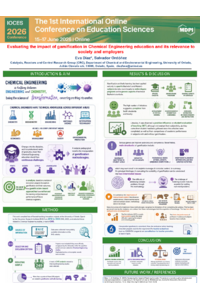
Chemical engineering is halfway between engineering and chemistry, converting one thing into another. For this, chemical engineers need technical knowledge across different areas such as chemistry, biochemistry, engineering, materials science and information technology, as well as complementary areas such as economics, management, safety and environmental protection.
Changes in the discipline and the professional needs of graduates mean that chemical engineering education should face continuous challenges. A notable pedagogical trend is the incorporation of gamification methodologies.
The aim of this work is to analyse, based on a revision of innovation projects focused on gamification and their outcomes, how gamification-based approaches have enhanced the learning and professional performance of future chemical engineers.
Methods
A comprehensive analysis was conducted of innovation projects involving the use of gamification in Bachelor's and Master's courses of Chemical Engineering at a Spanish university over the past 15 years. These projects were examined in relation to data on academic success and employer evaluations.
Results
The analysis of numerous projects revealed that gamification in chemical engineering had a positive assessment from both students and teachers, remarking the development of critical thinking, reinforcement of student self-confidence, and increased interaction between students and instructors.
However, a trend towards higher scores in the Students’ Evaluation of Teaching (SET) was observed, constituting one of the outcomes of this study. This trend, according to the literature, could have a significant subjective component. By contrast, from employer assessment data, no significant improvement was detected in student maturation, which is an attribute regarded as highly relevant by employers.
Conclusions
Gamification is associated with positive perceptions but demonstrates limited measurable impact on key quality indicators. Current evidence does not suggest that employer priorities were met through these methodologies. However, notable strengths were identified, by integration with other tools such as virtual reality, creating learning environments that more closely resemble the real world.
Keywords
Chemical Engineering
learning evaluation
gamification
Poster
poster 163062.pdf
Creating an AI-ready school smart diagnostics.
Promoting Sustainable Use of LLM Through Mindful Prompting and Gamification