Event submissions
Published
This submission belongs to the session S2. Higher Education of the event The 1st International Online Conference on Education Sciences
Published date
10 Jun, 2026
Academic Editor
'%3e%3cpath%20d='M12.6657%2010.9104C12.4185%2010.325%2012.0599%209.79327%2011.6097%209.34482C11.1609%208.89508%2010.6293%208.5365%2010.0442%208.28888C10.0389%208.28626%2010.0337%208.28495%2010.0285%208.28233C10.8446%207.69279%2011.3752%206.73249%2011.3752%205.64904C11.3752%203.8542%209.92103%202.39999%208.1262%202.39999C6.33136%202.39999%204.87715%203.8542%204.87715%205.64904C4.87715%206.73249%205.40774%207.69279%206.22393%208.28364C6.21869%208.28626%206.21345%208.28757%206.20821%208.29019C5.62129%208.5378%205.09463%208.89284%204.64265%209.34613C4.1929%209.79493%203.83432%2010.3266%203.58671%2010.9117C3.34345%2011.4845%203.21226%2012.0987%203.20023%2012.7209C3.19988%2012.7349%203.20233%2012.7488%203.20744%2012.7619C3.21255%2012.7749%203.22022%2012.7867%203.22998%2012.7968C3.23975%2012.8068%203.25142%2012.8147%203.26431%2012.8202C3.2772%2012.8256%203.29105%2012.8284%203.30504%2012.8284H4.09109C4.14874%2012.8284%204.19459%2012.7825%204.1959%2012.7262C4.2221%2011.7148%204.62823%2010.7676%205.34617%2010.0497C6.08899%209.30683%207.0755%208.89808%208.1262%208.89808C9.17689%208.89808%2010.1634%209.30683%2010.9062%2010.0497C11.6242%2010.7676%2012.0303%2011.7148%2012.0565%2012.7262C12.0578%2012.7838%2012.1037%2012.8284%2012.1613%2012.8284H12.9474C12.9613%2012.8284%2012.9752%2012.8256%2012.9881%2012.8202C13.001%2012.8147%2013.0126%2012.8068%2013.0224%2012.7968C13.0322%2012.7867%2013.0398%2012.7749%2013.0449%2012.7619C13.0501%2012.7488%2013.0525%2012.7349%2013.0522%2012.7209C13.0391%2012.0947%2012.9094%2011.4855%2012.6657%2010.9104ZM8.1262%207.9024C7.52486%207.9024%206.9589%207.6679%206.53312%207.24211C6.10733%206.81633%205.87283%206.25037%205.87283%205.64904C5.87283%205.0477%206.10733%204.48174%206.53312%204.05596C6.9589%203.63018%207.52486%203.39567%208.1262%203.39567C8.72753%203.39567%209.29349%203.63018%209.71927%204.05596C10.1451%204.48174%2010.3796%205.0477%2010.3796%205.64904C10.3796%206.25037%2010.1451%206.81633%209.71927%207.24211C9.29349%207.6679%208.72753%207.9024%208.1262%207.9024Z'%20fill='%235D1EE1'/%3e%3c/g%3e%3c/svg%3e) EMILIO ABAD-SEGURA
EMILIO ABAD-SEGURACitation
Mervat Fayez Alnaji, Farida Mohammad Aboud, Asmaa Ahmed Dunia, Omar Mohammad Abboud, The role of AI-assisted tools in Turkish language acquisition among Syrian multilingual pharmacy students in Northern Cyprus, in Proceedings of The 1st International Online Conference on Education Sciences, 15 June–17 June 2026, MDPI: Basel, Switzerland
Share
Email
Facebook
Twitter
LinkedIn
The role of AI-assisted tools in Turkish language acquisition among Syrian multilingual pharmacy students in Northern Cyprus
'%3e%3cpath%20d='M12.6647%2010.9104C12.4176%2010.325%2012.0589%209.7933%2011.6088%209.34485C11.16%208.89511%2010.6283%208.53653%2010.0432%208.28891C10.038%208.28629%2010.0327%208.28498%2010.0275%208.28236C10.8437%207.69282%2011.3743%206.73252%2011.3743%205.64907C11.3743%203.85423%209.92005%202.40002%208.12522%202.40002C6.33038%202.40002%204.87618%203.85423%204.87618%205.64907C4.87618%206.73252%205.40677%207.69282%206.22296%208.28367C6.21772%208.28629%206.21248%208.2876%206.20724%208.29022C5.62031%208.53783%205.09365%208.89287%204.64167%209.34616C4.19192%209.79496%203.83334%2010.3266%203.58573%2010.9117C3.34247%2011.4846%203.21128%2012.0987%203.19925%2012.721C3.1989%2012.735%203.20135%2012.7489%203.20646%2012.7619C3.21157%2012.7749%203.21924%2012.7868%203.22901%2012.7968C3.23877%2012.8068%203.25045%2012.8148%203.26334%2012.8202C3.27623%2012.8256%203.29007%2012.8284%203.30406%2012.8284H4.09012C4.14776%2012.8284%204.19362%2012.7825%204.19493%2012.7262C4.22113%2011.7148%204.62726%2010.7676%205.34519%2010.0497C6.08802%209.30686%207.07452%208.89811%208.12522%208.89811C9.17592%208.89811%2010.1624%209.30686%2010.9052%2010.0497C11.6232%2010.7676%2012.0293%2011.7148%2012.0555%2012.7262C12.0568%2012.7839%2012.1027%2012.8284%2012.1603%2012.8284H12.9464C12.9604%2012.8284%2012.9742%2012.8256%2012.9871%2012.8202C13%2012.8148%2013.0117%2012.8068%2013.0214%2012.7968C13.0312%2012.7868%2013.0389%2012.7749%2013.044%2012.7619C13.0491%2012.7489%2013.0515%2012.735%2013.0512%2012.721C13.0381%2012.0947%2012.9084%2011.4856%2012.6647%2010.9104ZM8.12522%207.90243C7.52388%207.90243%206.95792%207.66793%206.53214%207.24215C6.10636%206.81636%205.87185%206.2504%205.87185%205.64907C5.87185%205.04773%206.10636%204.48177%206.53214%204.05599C6.95792%203.63021%207.52388%203.3957%208.12522%203.3957C8.72655%203.3957%209.29252%203.63021%209.7183%204.05599C10.1441%204.48177%2010.3786%205.04773%2010.3786%205.64907C10.3786%206.2504%2010.1441%206.81636%209.7183%207.24215C9.29252%207.66793%208.72655%207.90243%208.12522%207.90243Z'%20fill='%235D1EE1'/%3e%3c/g%3e%3c/svg%3e)
Farida Mohammad Aboud 1
Asmaa Ahmed Dunia 2
Mervat Fayez Alnaji 3

Omar Mohammad Abboud 4
1. Department of English Language Teaching, Ada Kent University, Famagusta, 99628, Northern Cyprus, Cyprus
2. Department of CD Gender Studies, Eastern Mediterranean University, Famagusta, 99628, Northern Cyprus, Cyprus
3. Department of Information and communication Technologies in Education, Eastern Mediterranean University, Famagusta, 99628, Northern Cyprus, Cyprus
4. Department of Pharmacy, Cyprus International University, Nicosia, 99628, Northern Cyprus, Cyprus
Abstract
Introduction
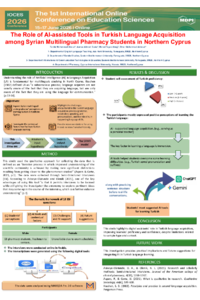
Understanding the role of Artificial Intelligence (AI) in language acquisition is fundamental for multilinguals studying in Northern Cyprus. The current study examines Syrian students’ perceptions of learning Turkish, the effects of AI and contextual exposure, the challenges encountered in the acquisition process (grammar, vocabulary, speaking, and pronunciation), AI support for language skills, and their recommendations for using AI to learn Turkish efficiently. Thus, this investigation drew on Krashen’s input hypothesis, Swain’s output hypothesis, and the SAMR model.
Methods
This study used semi-structured interviews as a qualitative approach to collect data. The developed questions were organized into four main themes: perceptions, AI and contextual factors, challenges and AI support, and future suggestions. Due to exam schedules, female participants could not be reached; therefore, thirteen male pharmacy students, ranging from freshmen to seniors, were interviewed online in Arabic. The transcriptions were generated using digital tools (TurboScribe, Google Docs, and Copilot), and the original Arabic transcripts were manually reviewed to ensure translation validity and reliability. The data were analyzed using qualitative content analysis with MAXQDA Pro 2.0 software, applying the deductive coding approach based on the pre-set categories.
Results
The participants generally expressed positive perceptions of learning Turkish. AI supported language acquisition (e.g., serving as a personal teacher), while immersion remained the key factor in language learning. Although the students addressed several challenges pertaining to language acquisition (e.g., Turkish vowel pronunciation and suffixes), AI tools assisted them in overcoming some of these issues. ChatGPT and Gemini were the most suggested AI tools among the participants, along with practicing sentence structure before real-life conversations.
Conclusion
This study highlights the role of digital assistants in Turkish language acquisition, particularly in improving learners’ proficiency and confidence, despite limitations related to sample type and context. It also provides practical implications and future suggestions for integrating AI into Turkish language learning.
Keywords
AI
language acquistion
multilingual
qualitative method
higher education
Poster
Poster.pdf
Engaged much? An applied perspective of classroom practices used to engage students at the university level in England
Use of university directed studies and undergraduate summer student research programs to create enhanced antibiograms and improve antimicrobial stewardship