Event submissions
Published
This submission belongs to the session S2. Higher Education of the event The 1st International Online Conference on Education Sciences
Published date
10 Jun, 2026
Academic Editor
'%3e%3cpath%20d='M12.6657%2010.9104C12.4185%2010.325%2012.0599%209.79327%2011.6097%209.34482C11.1609%208.89508%2010.6293%208.5365%2010.0442%208.28888C10.0389%208.28626%2010.0337%208.28495%2010.0285%208.28233C10.8446%207.69279%2011.3752%206.73249%2011.3752%205.64904C11.3752%203.8542%209.92103%202.39999%208.1262%202.39999C6.33136%202.39999%204.87715%203.8542%204.87715%205.64904C4.87715%206.73249%205.40774%207.69279%206.22393%208.28364C6.21869%208.28626%206.21345%208.28757%206.20821%208.29019C5.62129%208.5378%205.09463%208.89284%204.64265%209.34613C4.1929%209.79493%203.83432%2010.3266%203.58671%2010.9117C3.34345%2011.4845%203.21226%2012.0987%203.20023%2012.7209C3.19988%2012.7349%203.20233%2012.7488%203.20744%2012.7619C3.21255%2012.7749%203.22022%2012.7867%203.22998%2012.7968C3.23975%2012.8068%203.25142%2012.8147%203.26431%2012.8202C3.2772%2012.8256%203.29105%2012.8284%203.30504%2012.8284H4.09109C4.14874%2012.8284%204.19459%2012.7825%204.1959%2012.7262C4.2221%2011.7148%204.62823%2010.7676%205.34617%2010.0497C6.08899%209.30683%207.0755%208.89808%208.1262%208.89808C9.17689%208.89808%2010.1634%209.30683%2010.9062%2010.0497C11.6242%2010.7676%2012.0303%2011.7148%2012.0565%2012.7262C12.0578%2012.7838%2012.1037%2012.8284%2012.1613%2012.8284H12.9474C12.9613%2012.8284%2012.9752%2012.8256%2012.9881%2012.8202C13.001%2012.8147%2013.0126%2012.8068%2013.0224%2012.7968C13.0322%2012.7867%2013.0398%2012.7749%2013.0449%2012.7619C13.0501%2012.7488%2013.0525%2012.7349%2013.0522%2012.7209C13.0391%2012.0947%2012.9094%2011.4855%2012.6657%2010.9104ZM8.1262%207.9024C7.52486%207.9024%206.9589%207.6679%206.53312%207.24211C6.10733%206.81633%205.87283%206.25037%205.87283%205.64904C5.87283%205.0477%206.10733%204.48174%206.53312%204.05596C6.9589%203.63018%207.52486%203.39567%208.1262%203.39567C8.72753%203.39567%209.29349%203.63018%209.71927%204.05596C10.1451%204.48174%2010.3796%205.0477%2010.3796%205.64904C10.3796%206.25037%2010.1451%206.81633%209.71927%207.24211C9.29349%207.6679%208.72753%207.9024%208.1262%207.9024Z'%20fill='%235D1EE1'/%3e%3c/g%3e%3c/svg%3e) EMILIO ABAD-SEGURA
EMILIO ABAD-SEGURACitation
Arasay Padrón Alvarez, Odiel Estrada Molina, Integrated Inclusive Model with AI for Challenges (MIIA-R): Validation through Participatory Action Research in a Virtual University Environment, in Proceedings of The 1st International Online Conference on Education Sciences, 15 June–17 June 2026, MDPI: Basel, Switzerland
Share
Email
Facebook
Twitter
LinkedIn
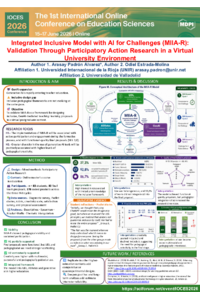
Integrated Inclusive Model with AI for Challenges (MIIA-R): Validation through Participatory Action Research in a Virtual University Environment
'%3e%3cpath%20d='M12.6647%2010.9104C12.4176%2010.325%2012.0589%209.7933%2011.6088%209.34485C11.16%208.89511%2010.6283%208.53653%2010.0432%208.28891C10.038%208.28629%2010.0327%208.28498%2010.0275%208.28236C10.8437%207.69282%2011.3743%206.73252%2011.3743%205.64907C11.3743%203.85423%209.92005%202.40002%208.12522%202.40002C6.33038%202.40002%204.87618%203.85423%204.87618%205.64907C4.87618%206.73252%205.40677%207.69282%206.22296%208.28367C6.21772%208.28629%206.21248%208.2876%206.20724%208.29022C5.62031%208.53783%205.09365%208.89287%204.64167%209.34616C4.19192%209.79496%203.83334%2010.3266%203.58573%2010.9117C3.34247%2011.4846%203.21128%2012.0987%203.19925%2012.721C3.1989%2012.735%203.20135%2012.7489%203.20646%2012.7619C3.21157%2012.7749%203.21924%2012.7868%203.22901%2012.7968C3.23877%2012.8068%203.25045%2012.8148%203.26334%2012.8202C3.27623%2012.8256%203.29007%2012.8284%203.30406%2012.8284H4.09012C4.14776%2012.8284%204.19362%2012.7825%204.19493%2012.7262C4.22113%2011.7148%204.62726%2010.7676%205.34519%2010.0497C6.08802%209.30686%207.07452%208.89811%208.12522%208.89811C9.17592%208.89811%2010.1624%209.30686%2010.9052%2010.0497C11.6232%2010.7676%2012.0293%2011.7148%2012.0555%2012.7262C12.0568%2012.7839%2012.1027%2012.8284%2012.1603%2012.8284H12.9464C12.9604%2012.8284%2012.9742%2012.8256%2012.9871%2012.8202C13%2012.8148%2013.0117%2012.8068%2013.0214%2012.7968C13.0312%2012.7868%2013.0389%2012.7749%2013.044%2012.7619C13.0491%2012.7489%2013.0515%2012.735%2013.0512%2012.721C13.0381%2012.0947%2012.9084%2011.4856%2012.6647%2010.9104ZM8.12522%207.90243C7.52388%207.90243%206.95792%207.66793%206.53214%207.24215C6.10636%206.81636%205.87185%206.2504%205.87185%205.64907C5.87185%205.04773%206.10636%204.48177%206.53214%204.05599C6.95792%203.63021%207.52388%203.3957%208.12522%203.3957C8.72655%203.3957%209.29252%203.63021%209.7183%204.05599C10.1441%204.48177%2010.3786%205.04773%2010.3786%205.64907C10.3786%206.2504%2010.1441%206.81636%209.7183%207.24215C9.29252%207.66793%208.72655%207.90243%208.12522%207.90243Z'%20fill='%235D1EE1'/%3e%3c/g%3e%3c/svg%3e)
Arasay Padrón Alvarez 1,2

Odiel Estrada Molina 3
1. Department of Education, Faculty of Education, Universidad Internacional de La Rioja (UNIR), Logroño, Spain, Spain
2. Faculty of Education, Universidad Internacional de Valencia (VIU), Valencia, Spain
3. Department of Pedagogy, Faculty of Education and Social Work, University of Valladolid, Valladolid, Spain, Spain
Abstract
Introduction:
The rapid incorporation of generative AI into teacher education has outpaced the development of inclusive pedagogical frameworks. This study aims to validate the Integrated Inclusive Model with AI for Challenges (MIIA-R), which combines Universal Design for Learning, challenge-based learning focused on authentic professional problems, and Participatory Action Research to guide accessible instructional design in a virtual postgraduate context.
Methods:
A mixed-methods Participatory Action Research design was implemented across three iterative cycles with 83 master’s students, analysing 80 challenge proposals. Data were collected through an analytic rubric, a creativity scale, reflective group journals, and a satisfaction survey to examine proposal quality, pedagogical uses of AI, and patterns of creativity.
Results:
Overall proposal quality exceeded the functional threshold (M = 3.29/5), confirming the model’s applicability. However, a gap emerged between feasibility (M = 4.18) and pedagogical use of AI (M = 2.39), suggesting that technical adoption does not guarantee inclusive integration. Creativity followed an inverted U-shaped trajectory: it increased during guided design but declined at the public challenge fair, where evaluative pressure acted as a pedagogical selection mechanism between instrumental uses of AI and more reflective applications. In the final cycle, diversity of AI tools correlated significantly with creativity (ρ = 0.527; p < 0.001), supporting the view that natural-language tools function as conditional catalysts rather than automatic drivers of innovation.
Conclusions:
The MIIA-R model offers a reproducible framework that extends previous approaches by integrating AI, UDL, and challenge-based learning into a reflective and ethically grounded design process. Its main contribution is to demonstrate that inclusive pedagogical creativity depends less on the number of tools used than on prior pedagogical scaffolding and critical reflection, reinforcing its relevance for teacher education in virtual environments.
Keywords
Universal Design for Learning
challenge-based learning
generative artificial intelligence
participatory action research
teacher education
inclusive education
Poster
0Poster Arasay 28 MAYO 2026.pdf
Evaluating the Effectiveness of Institutional End-of-Semester Surveys: Perspectives of Postgraduate Computing Students
Reconfiguring Academic Labor in Evaluative Universities: Organizational Designs and the Distribution of Institutional Pressure