Event submissions
Published
This submission belongs to the session S2. Higher Education of the event The 1st International Online Conference on Education Sciences
Published date
10 Jun, 2026
Academic Editor
'%3e%3cpath%20d='M12.6657%2010.9104C12.4185%2010.325%2012.0599%209.79327%2011.6097%209.34482C11.1609%208.89508%2010.6293%208.5365%2010.0442%208.28888C10.0389%208.28626%2010.0337%208.28495%2010.0285%208.28233C10.8446%207.69279%2011.3752%206.73249%2011.3752%205.64904C11.3752%203.8542%209.92103%202.39999%208.1262%202.39999C6.33136%202.39999%204.87715%203.8542%204.87715%205.64904C4.87715%206.73249%205.40774%207.69279%206.22393%208.28364C6.21869%208.28626%206.21345%208.28757%206.20821%208.29019C5.62129%208.5378%205.09463%208.89284%204.64265%209.34613C4.1929%209.79493%203.83432%2010.3266%203.58671%2010.9117C3.34345%2011.4845%203.21226%2012.0987%203.20023%2012.7209C3.19988%2012.7349%203.20233%2012.7488%203.20744%2012.7619C3.21255%2012.7749%203.22022%2012.7867%203.22998%2012.7968C3.23975%2012.8068%203.25142%2012.8147%203.26431%2012.8202C3.2772%2012.8256%203.29105%2012.8284%203.30504%2012.8284H4.09109C4.14874%2012.8284%204.19459%2012.7825%204.1959%2012.7262C4.2221%2011.7148%204.62823%2010.7676%205.34617%2010.0497C6.08899%209.30683%207.0755%208.89808%208.1262%208.89808C9.17689%208.89808%2010.1634%209.30683%2010.9062%2010.0497C11.6242%2010.7676%2012.0303%2011.7148%2012.0565%2012.7262C12.0578%2012.7838%2012.1037%2012.8284%2012.1613%2012.8284H12.9474C12.9613%2012.8284%2012.9752%2012.8256%2012.9881%2012.8202C13.001%2012.8147%2013.0126%2012.8068%2013.0224%2012.7968C13.0322%2012.7867%2013.0398%2012.7749%2013.0449%2012.7619C13.0501%2012.7488%2013.0525%2012.7349%2013.0522%2012.7209C13.0391%2012.0947%2012.9094%2011.4855%2012.6657%2010.9104ZM8.1262%207.9024C7.52486%207.9024%206.9589%207.6679%206.53312%207.24211C6.10733%206.81633%205.87283%206.25037%205.87283%205.64904C5.87283%205.0477%206.10733%204.48174%206.53312%204.05596C6.9589%203.63018%207.52486%203.39567%208.1262%203.39567C8.72753%203.39567%209.29349%203.63018%209.71927%204.05596C10.1451%204.48174%2010.3796%205.0477%2010.3796%205.64904C10.3796%206.25037%2010.1451%206.81633%209.71927%207.24211C9.29349%207.6679%208.72753%207.9024%208.1262%207.9024Z'%20fill='%235D1EE1'/%3e%3c/g%3e%3c/svg%3e) EMILIO ABAD-SEGURA
EMILIO ABAD-SEGURACitation
Nancy Guzman-Raya, Emilio Sánchez-Santa-Bárbara, Ariadna Crisantema Martínez-Hernández, Raquel Lara-Moreno, Reconfiguring Academic Labor in Evaluative Universities: Organizational Designs and the Distribution of Institutional Pressure, in Proceedings of The 1st International Online Conference on Education Sciences, 15 June–17 June 2026, MDPI: Basel, Switzerland
Share
Email
Facebook
Twitter
LinkedIn
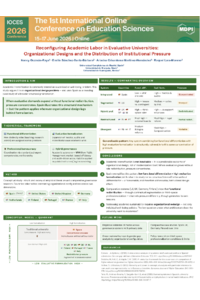
Reconfiguring Academic Labor in Evaluative Universities: Organizational Designs and the Distribution of Institutional Pressure

Nancy Guzman-Raya 1
'%3e%3cpath%20d='M12.6647%2010.9104C12.4176%2010.325%2012.0589%209.7933%2011.6088%209.34485C11.16%208.89511%2010.6283%208.53653%2010.0432%208.28891C10.038%208.28629%2010.0327%208.28498%2010.0275%208.28236C10.8437%207.69282%2011.3743%206.73252%2011.3743%205.64907C11.3743%203.85423%209.92005%202.40002%208.12522%202.40002C6.33038%202.40002%204.87618%203.85423%204.87618%205.64907C4.87618%206.73252%205.40677%207.69282%206.22296%208.28367C6.21772%208.28629%206.21248%208.2876%206.20724%208.29022C5.62031%208.53783%205.09365%208.89287%204.64167%209.34616C4.19192%209.79496%203.83334%2010.3266%203.58573%2010.9117C3.34247%2011.4846%203.21128%2012.0987%203.19925%2012.721C3.1989%2012.735%203.20135%2012.7489%203.20646%2012.7619C3.21157%2012.7749%203.21924%2012.7868%203.22901%2012.7968C3.23877%2012.8068%203.25045%2012.8148%203.26334%2012.8202C3.27623%2012.8256%203.29007%2012.8284%203.30406%2012.8284H4.09012C4.14776%2012.8284%204.19362%2012.7825%204.19493%2012.7262C4.22113%2011.7148%204.62726%2010.7676%205.34519%2010.0497C6.08802%209.30686%207.07452%208.89811%208.12522%208.89811C9.17592%208.89811%2010.1624%209.30686%2010.9052%2010.0497C11.6232%2010.7676%2012.0293%2011.7148%2012.0555%2012.7262C12.0568%2012.7839%2012.1027%2012.8284%2012.1603%2012.8284H12.9464C12.9604%2012.8284%2012.9742%2012.8256%2012.9871%2012.8202C13%2012.8148%2013.0117%2012.8068%2013.0214%2012.7968C13.0312%2012.7868%2013.0389%2012.7749%2013.044%2012.7619C13.0491%2012.7489%2013.0515%2012.735%2013.0512%2012.721C13.0381%2012.0947%2012.9084%2011.4856%2012.6647%2010.9104ZM8.12522%207.90243C7.52388%207.90243%206.95792%207.66793%206.53214%207.24215C6.10636%206.81636%205.87185%206.2504%205.87185%205.64907C5.87185%205.04773%206.10636%204.48177%206.53214%204.05599C6.95792%203.63021%207.52388%203.3957%208.12522%203.3957C8.72655%203.3957%209.29252%203.63021%209.7183%204.05599C10.1441%204.48177%2010.3786%205.04773%2010.3786%205.64907C10.3786%206.2504%2010.1441%206.81636%209.7183%207.24215C9.29252%207.66793%208.72655%207.90243%208.12522%207.90243Z'%20fill='%235D1EE1'/%3e%3c/g%3e%3c/svg%3e)
Ariadna Crisantema Martínez-Hernández 2
Raquel Lara-Moreno 3
Emilio Sánchez-Santa-Bárbara 4
1. Department of Organization and Business, Faculty of Economics and Business Sciences, Complutense University of Madrid, 28223 Madrid, Spain, Spain
2. Department of Organizational Studies, Division of Economic and Administrative Sciences, University of Guanajuato, Guanajuato 36250, Mexico, Mexico
3. Health Psychology/Behavioral Medicine Research Group (CTS-267), School of Psychology, University of Granada, Cartuja Campus, s/n, 18071 Granada, Spain, Spain
4. Department of Social Psychology, Faculty of Labor Relations and Human Resources, University of Granada, 18071 Granada, Spain, Spain
Abstract
Introduction:
Debates on academic work have largely focused on workload and individual well-being, overlooking the institutional architecture shaping task distribution. This study examines whether academic intensification in Spain reflects increased workload or an integrated organizational model under growing evaluative formalization. Drawing on sociological and organizational perspectives on professional bureaucracies and hybrid governance, the study reframes intensification as a structural phenomenon.
Methods:
This is a conceptual study based on a structured review of existing empirical literature on academic work in Spain (including time-use and workload studies) and comparative research on higher education governance. Countries (Spain, the United States, and selected European systems) were selected to represent contrasting organizational configurations of academic work. The analysis focuses on two dimensions: functional differentiation and evaluative formalization.
Results:
Spain combines low functional differentiation with high evaluative formalization, concentrating multiple roles within one position. This configuration accumulates institutional pressure and has been associated with emotional exhaustion and reduced well-being. In contrast, the U.S. redistributes pressure through contractual segmentation, while European systems rely on professionalized support roles.
Conclusions:
Academic intensification is shaped by organizational design. Where evaluation expands without redistribution, pressure concentrates, increasing burnout risk and challenging academic sustainability.
Conflict of Interest: The authors declare no conflicts of interest.
Keywords
academic work
higher education governance
labor intensification
organizational differentiation
university evaluation systems
comparative higher education
Poster
poster 5.pdf
Integrated Inclusive Model with AI for Challenges (MIIA-R): Validation through Participatory Action Research in a Virtual University Environment
Genre Naivety and the Essay Type Assessment: A Genre Analysis of Writing Challenges Among Undergraduate Law Students