Event submissions
Published
This submission belongs to the session S3. Curriculum and Instruction of the event The 1st International Online Conference on Education Sciences
Published date
10 Jun, 2026
Academic Editor
'%3e%3cpath%20d='M12.6657%2010.9104C12.4185%2010.325%2012.0599%209.79327%2011.6097%209.34482C11.1609%208.89508%2010.6293%208.5365%2010.0442%208.28888C10.0389%208.28626%2010.0337%208.28495%2010.0285%208.28233C10.8446%207.69279%2011.3752%206.73249%2011.3752%205.64904C11.3752%203.8542%209.92103%202.39999%208.1262%202.39999C6.33136%202.39999%204.87715%203.8542%204.87715%205.64904C4.87715%206.73249%205.40774%207.69279%206.22393%208.28364C6.21869%208.28626%206.21345%208.28757%206.20821%208.29019C5.62129%208.5378%205.09463%208.89284%204.64265%209.34613C4.1929%209.79493%203.83432%2010.3266%203.58671%2010.9117C3.34345%2011.4845%203.21226%2012.0987%203.20023%2012.7209C3.19988%2012.7349%203.20233%2012.7488%203.20744%2012.7619C3.21255%2012.7749%203.22022%2012.7867%203.22998%2012.7968C3.23975%2012.8068%203.25142%2012.8147%203.26431%2012.8202C3.2772%2012.8256%203.29105%2012.8284%203.30504%2012.8284H4.09109C4.14874%2012.8284%204.19459%2012.7825%204.1959%2012.7262C4.2221%2011.7148%204.62823%2010.7676%205.34617%2010.0497C6.08899%209.30683%207.0755%208.89808%208.1262%208.89808C9.17689%208.89808%2010.1634%209.30683%2010.9062%2010.0497C11.6242%2010.7676%2012.0303%2011.7148%2012.0565%2012.7262C12.0578%2012.7838%2012.1037%2012.8284%2012.1613%2012.8284H12.9474C12.9613%2012.8284%2012.9752%2012.8256%2012.9881%2012.8202C13.001%2012.8147%2013.0126%2012.8068%2013.0224%2012.7968C13.0322%2012.7867%2013.0398%2012.7749%2013.0449%2012.7619C13.0501%2012.7488%2013.0525%2012.7349%2013.0522%2012.7209C13.0391%2012.0947%2012.9094%2011.4855%2012.6657%2010.9104ZM8.1262%207.9024C7.52486%207.9024%206.9589%207.6679%206.53312%207.24211C6.10733%206.81633%205.87283%206.25037%205.87283%205.64904C5.87283%205.0477%206.10733%204.48174%206.53312%204.05596C6.9589%203.63018%207.52486%203.39567%208.1262%203.39567C8.72753%203.39567%209.29349%203.63018%209.71927%204.05596C10.1451%204.48174%2010.3796%205.0477%2010.3796%205.64904C10.3796%206.25037%2010.1451%206.81633%209.71927%207.24211C9.29349%207.6679%208.72753%207.9024%208.1262%207.9024Z'%20fill='%235D1EE1'/%3e%3c/g%3e%3c/svg%3e) Honggang Liu
Honggang LiuCitation
Covadonga Huidobro, Elena Arboleya-García, Antonio Torralba-Burrial, Victoria Fernández-Fernández, Maria Celenza, Laura Miralles, Yaisel Juan Borrell, Promoting sharks and ray literacy through an interactive outreach experience, in Proceedings of The 1st International Online Conference on Education Sciences, 15 June–17 June 2026, MDPI: Basel, Switzerland
Share
Email
Facebook
Twitter
LinkedIn
Promoting sharks and ray literacy through an interactive outreach experience
'%3e%3cpath%20d='M12.6647%2010.9104C12.4176%2010.325%2012.0589%209.7933%2011.6088%209.34485C11.16%208.89511%2010.6283%208.53653%2010.0432%208.28891C10.038%208.28629%2010.0327%208.28498%2010.0275%208.28236C10.8437%207.69282%2011.3743%206.73252%2011.3743%205.64907C11.3743%203.85423%209.92005%202.40002%208.12522%202.40002C6.33038%202.40002%204.87618%203.85423%204.87618%205.64907C4.87618%206.73252%205.40677%207.69282%206.22296%208.28367C6.21772%208.28629%206.21248%208.2876%206.20724%208.29022C5.62031%208.53783%205.09365%208.89287%204.64167%209.34616C4.19192%209.79496%203.83334%2010.3266%203.58573%2010.9117C3.34247%2011.4846%203.21128%2012.0987%203.19925%2012.721C3.1989%2012.735%203.20135%2012.7489%203.20646%2012.7619C3.21157%2012.7749%203.21924%2012.7868%203.22901%2012.7968C3.23877%2012.8068%203.25045%2012.8148%203.26334%2012.8202C3.27623%2012.8256%203.29007%2012.8284%203.30406%2012.8284H4.09012C4.14776%2012.8284%204.19362%2012.7825%204.19493%2012.7262C4.22113%2011.7148%204.62726%2010.7676%205.34519%2010.0497C6.08802%209.30686%207.07452%208.89811%208.12522%208.89811C9.17592%208.89811%2010.1624%209.30686%2010.9052%2010.0497C11.6232%2010.7676%2012.0293%2011.7148%2012.0555%2012.7262C12.0568%2012.7839%2012.1027%2012.8284%2012.1603%2012.8284H12.9464C12.9604%2012.8284%2012.9742%2012.8256%2012.9871%2012.8202C13%2012.8148%2013.0117%2012.8068%2013.0214%2012.7968C13.0312%2012.7868%2013.0389%2012.7749%2013.044%2012.7619C13.0491%2012.7489%2013.0515%2012.735%2013.0512%2012.721C13.0381%2012.0947%2012.9084%2011.4856%2012.6647%2010.9104ZM8.12522%207.90243C7.52388%207.90243%206.95792%207.66793%206.53214%207.24215C6.10636%206.81636%205.87185%206.2504%205.87185%205.64907C5.87185%205.04773%206.10636%204.48177%206.53214%204.05599C6.95792%203.63021%207.52388%203.3957%208.12522%203.3957C8.72655%203.3957%209.29252%203.63021%209.7183%204.05599C10.1441%204.48177%2010.3786%205.04773%2010.3786%205.64907C10.3786%206.2504%2010.1441%206.81636%209.7183%207.24215C9.29252%207.66793%208.72655%207.90243%208.12522%207.90243Z'%20fill='%235D1EE1'/%3e%3c/g%3e%3c/svg%3e)
Elena Arboleya-García 1
Covadonga Huidobro 1

Antonio Torralba-Burrial 1,2
Victoria Fernández-Fernández 3
Maria Celenza 4

Laura Miralles 4

Yaisel Juan Borrell 4
1. Department of Education Sciences, Didactics of Experimental Sciences, University of Oviedo. 33005 Oviedo, Spain, Spain
2. Instituto de Recursos Naturales y Ordenación del Territorio (Indurot), University of Oviedo. 33600 Mieres, Spain
3. Department of Education Sciences, University of Oviedo. 33005 Oviedo, Spain, Spain
4. Department of Functional Biology, Genetics, University of Oviedo, Oviedo 33007, Spain, Spain
Abstract
An environmental education intervention was implemented during the European Researchers’ Night in a coastal region with an important fisheries sector to improve public understanding of sharks and rays through hands-on activities. The instructional sequence combined games, biological samples (including egg cases), and guided discussions. Participants (N=51; mean age = 9.93 ± 5.97; 54.90% female), who were mainly primary school students (78.43%), completed pre- and post-questionnaires to assess prior knowledge and learning outcomes. The questionnaire included 4 demographic and 10 questions combining drawings (eggs and adults), Likert-scale, and open-ended responses addressing elasmobranch biology, ecology, and threats. Data were analyzed using descriptive statistics and pre-post comparisons to identify changes in knowledge, perceptions, and attitudes. Initial drawings showed that most participants could accurately depict adult sharks and rays, but representations of eggs were often inaccurate, consistent with limited prior exposure. After the intervention, drawings of egg cases became notably more precise. Most respondents identified sharks and rays as fish, but fewer recognized them as vertebrates, particularly rays. Species knowledge was scarce and strongly biased towards well-known shark species, whereas awareness of ray diversity was limited even after the intervention. Perceived threats to sharks and rays were already high at pre-test, especially pollution, habitat destruction, and overfishing, and generally values increased after post-intervention. Participants justified protection mainly in terms of biodiversity and ecosystem roles. Pro-environmental intentions shifted from a general focus on pollution toward more specific actions such as avoiding overfishing and habitat destruction. Attitudes toward citizen science showed substantial gains, with strong post-test increases in willingness to report sightings, search for egg cases, disseminate conservation information, and enroll in educational projects like The.Shark-Ray.Map. Overall, results indicate that short, interactive outreach activities integrating real biological samples and participatory science can effectively enhance marine literacy and foster engagement with conservation actions among younger audiences.
Keywords
Ocean literacy
hands-on learning
informal education
science outreach
Poster
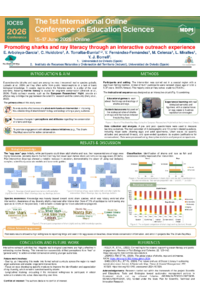
IOCES-Poster-Sciforum-173226.pdf
Empowering students through One Health parasitology: An intensive hands-on summer course on emerging parasites at the University of Alcalá, Spain
Educational Digital Twins for Sustainability Competences in Engineering and Architecture: Integrating Level(s) and the New European Bauhaus through a Spain–Chile SWOT–CAME Analysis and the ERI Readiness Index