Event submissions
Published
This submission belongs to the session S2. Higher Education of the event The 1st International Online Conference on Education Sciences
Published date
10 Jun, 2026
Academic Editor
'%3e%3cpath%20d='M12.6657%2010.9104C12.4185%2010.325%2012.0599%209.79327%2011.6097%209.34482C11.1609%208.89508%2010.6293%208.5365%2010.0442%208.28888C10.0389%208.28626%2010.0337%208.28495%2010.0285%208.28233C10.8446%207.69279%2011.3752%206.73249%2011.3752%205.64904C11.3752%203.8542%209.92103%202.39999%208.1262%202.39999C6.33136%202.39999%204.87715%203.8542%204.87715%205.64904C4.87715%206.73249%205.40774%207.69279%206.22393%208.28364C6.21869%208.28626%206.21345%208.28757%206.20821%208.29019C5.62129%208.5378%205.09463%208.89284%204.64265%209.34613C4.1929%209.79493%203.83432%2010.3266%203.58671%2010.9117C3.34345%2011.4845%203.21226%2012.0987%203.20023%2012.7209C3.19988%2012.7349%203.20233%2012.7488%203.20744%2012.7619C3.21255%2012.7749%203.22022%2012.7867%203.22998%2012.7968C3.23975%2012.8068%203.25142%2012.8147%203.26431%2012.8202C3.2772%2012.8256%203.29105%2012.8284%203.30504%2012.8284H4.09109C4.14874%2012.8284%204.19459%2012.7825%204.1959%2012.7262C4.2221%2011.7148%204.62823%2010.7676%205.34617%2010.0497C6.08899%209.30683%207.0755%208.89808%208.1262%208.89808C9.17689%208.89808%2010.1634%209.30683%2010.9062%2010.0497C11.6242%2010.7676%2012.0303%2011.7148%2012.0565%2012.7262C12.0578%2012.7838%2012.1037%2012.8284%2012.1613%2012.8284H12.9474C12.9613%2012.8284%2012.9752%2012.8256%2012.9881%2012.8202C13.001%2012.8147%2013.0126%2012.8068%2013.0224%2012.7968C13.0322%2012.7867%2013.0398%2012.7749%2013.0449%2012.7619C13.0501%2012.7488%2013.0525%2012.7349%2013.0522%2012.7209C13.0391%2012.0947%2012.9094%2011.4855%2012.6657%2010.9104ZM8.1262%207.9024C7.52486%207.9024%206.9589%207.6679%206.53312%207.24211C6.10733%206.81633%205.87283%206.25037%205.87283%205.64904C5.87283%205.0477%206.10733%204.48174%206.53312%204.05596C6.9589%203.63018%207.52486%203.39567%208.1262%203.39567C8.72753%203.39567%209.29349%203.63018%209.71927%204.05596C10.1451%204.48174%2010.3796%205.0477%2010.3796%205.64904C10.3796%206.25037%2010.1451%206.81633%209.71927%207.24211C9.29349%207.6679%208.72753%207.9024%208.1262%207.9024Z'%20fill='%235D1EE1'/%3e%3c/g%3e%3c/svg%3e) Doris L. Watson
Doris L. WatsonCitation
Montserrat Iglesias, Cristina Tarazona, Virtual Language Exchange as Internationalization at Home: From Initial Expectations to Perceived Outcomes, in Proceedings of The 1st International Online Conference on Education Sciences, 15 June–17 June 2026, MDPI: Basel, Switzerland
Share
Email
Facebook
Twitter
LinkedIn
Virtual Language Exchange as Internationalization at Home: From Initial Expectations to Perceived Outcomes
'%3e%3cpath%20d='M12.6647%2010.9104C12.4176%2010.325%2012.0589%209.7933%2011.6088%209.34485C11.16%208.89511%2010.6283%208.53653%2010.0432%208.28891C10.038%208.28629%2010.0327%208.28498%2010.0275%208.28236C10.8437%207.69282%2011.3743%206.73252%2011.3743%205.64907C11.3743%203.85423%209.92005%202.40002%208.12522%202.40002C6.33038%202.40002%204.87618%203.85423%204.87618%205.64907C4.87618%206.73252%205.40677%207.69282%206.22296%208.28367C6.21772%208.28629%206.21248%208.2876%206.20724%208.29022C5.62031%208.53783%205.09365%208.89287%204.64167%209.34616C4.19192%209.79496%203.83334%2010.3266%203.58573%2010.9117C3.34247%2011.4846%203.21128%2012.0987%203.19925%2012.721C3.1989%2012.735%203.20135%2012.7489%203.20646%2012.7619C3.21157%2012.7749%203.21924%2012.7868%203.22901%2012.7968C3.23877%2012.8068%203.25045%2012.8148%203.26334%2012.8202C3.27623%2012.8256%203.29007%2012.8284%203.30406%2012.8284H4.09012C4.14776%2012.8284%204.19362%2012.7825%204.19493%2012.7262C4.22113%2011.7148%204.62726%2010.7676%205.34519%2010.0497C6.08802%209.30686%207.07452%208.89811%208.12522%208.89811C9.17592%208.89811%2010.1624%209.30686%2010.9052%2010.0497C11.6232%2010.7676%2012.0293%2011.7148%2012.0555%2012.7262C12.0568%2012.7839%2012.1027%2012.8284%2012.1603%2012.8284H12.9464C12.9604%2012.8284%2012.9742%2012.8256%2012.9871%2012.8202C13%2012.8148%2013.0117%2012.8068%2013.0214%2012.7968C13.0312%2012.7868%2013.0389%2012.7749%2013.044%2012.7619C13.0491%2012.7489%2013.0515%2012.735%2013.0512%2012.721C13.0381%2012.0947%2012.9084%2011.4856%2012.6647%2010.9104ZM8.12522%207.90243C7.52388%207.90243%206.95792%207.66793%206.53214%207.24215C6.10636%206.81636%205.87185%206.2504%205.87185%205.64907C5.87185%205.04773%206.10636%204.48177%206.53214%204.05599C6.95792%203.63021%207.52388%203.3957%208.12522%203.3957C8.72655%203.3957%209.29252%203.63021%209.7183%204.05599C10.1441%204.48177%2010.3786%205.04773%2010.3786%205.64907C10.3786%206.2504%2010.1441%206.81636%209.7183%207.24215C9.29252%207.66793%208.72655%207.90243%208.12522%207.90243Z'%20fill='%235D1EE1'/%3e%3c/g%3e%3c/svg%3e)
Montserrat Iglesias 1
Cristina Tarazona 2
1. CETT Barcelona School of Tourism, Hospitality and Gastronomy, University of Barcelona, 08035, Barcelona, Spain, Spain
2. Oxford College of Emory University, Oxford, GA 30054, USA, USA
Abstract
This quantitative study investigates students’ perceptions of a virtual language exchange implemented between two higher education institutions. By examining two successive cohorts, the research aimed to identify shared patterns, institutional differences, and changes over the duration of the exchange.
Data were collected through two opinion questionnaires administered at the beginning and at the end of the exchange in each academic period. Quantitative analyses included descriptive statistics, independent-samples t-tests, chi-square tests, and Pearson correlation analyses. The results were examined globally, by institution, and longitudinally to capture overall trends and contextual variation.
Across both successive cohorts, students entered the exchange with strong initial motivation, particularly a desire for intercultural openness, alongside comparatively low self-confidence in the target language. By the end of the exchange, participants reported high satisfaction with their exchange partners, positive evaluations of the interactional framework, and increased self-confidence, involvement, and cross-cultural awareness. Institutional differences emerged in specific areas, such as perceived language level, satisfaction, and cultural learning, but these did not substantially alter the overall pattern of findings. Correlation analyses revealed strong and significant relationships among key variables, indicating that linguistic development, learner engagement, self-confidence, and intercultural knowledge were closely interconnected and mutually reinforcing.
The findings suggest that virtual language exchanges supported by clear guidelines and a structured pedagogical design can enhance undergraduate learners’ language skills and cultural growth. The study contributes to existing research by demonstrating the consistency of these outcomes across cohorts and institutional contexts, and by highlighting the dynamic links between affective, linguistic, and cultural dimensions. These results support the integration of virtual language exchanges as a sustainable and effective component of internationalization at home in higher education since they offer students opportunities for authentic interaction and sensitivity to cultural diversity without physical mobility. Therefore, they can promote multilingualism and intercultural understanding, the keystone of democratic societies.
Keywords
communicative competence
intercultural competence
linguistic development
telecollaboration
undergraduate language learners
Poster
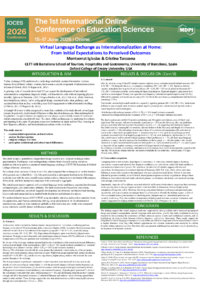
Poster Iglesias_Tarazona.pdf
Strengthening professional preparedness through interdisciplinary CBRN education at the University of Alcalá, Spain
Exploring Experienced Teachers’ Awareness of Culturally Relevant Pedagogy Through a Personable Culturally Situated Mathematical Modeling Task