Event submissions
Published
This submission belongs to the session S2. Higher Education of the event The 1st International Online Conference on Education Sciences
Published date
10 Jun, 2026
Academic Editor
'%3e%3cpath%20d='M12.6657%2010.9104C12.4185%2010.325%2012.0599%209.79327%2011.6097%209.34482C11.1609%208.89508%2010.6293%208.5365%2010.0442%208.28888C10.0389%208.28626%2010.0337%208.28495%2010.0285%208.28233C10.8446%207.69279%2011.3752%206.73249%2011.3752%205.64904C11.3752%203.8542%209.92103%202.39999%208.1262%202.39999C6.33136%202.39999%204.87715%203.8542%204.87715%205.64904C4.87715%206.73249%205.40774%207.69279%206.22393%208.28364C6.21869%208.28626%206.21345%208.28757%206.20821%208.29019C5.62129%208.5378%205.09463%208.89284%204.64265%209.34613C4.1929%209.79493%203.83432%2010.3266%203.58671%2010.9117C3.34345%2011.4845%203.21226%2012.0987%203.20023%2012.7209C3.19988%2012.7349%203.20233%2012.7488%203.20744%2012.7619C3.21255%2012.7749%203.22022%2012.7867%203.22998%2012.7968C3.23975%2012.8068%203.25142%2012.8147%203.26431%2012.8202C3.2772%2012.8256%203.29105%2012.8284%203.30504%2012.8284H4.09109C4.14874%2012.8284%204.19459%2012.7825%204.1959%2012.7262C4.2221%2011.7148%204.62823%2010.7676%205.34617%2010.0497C6.08899%209.30683%207.0755%208.89808%208.1262%208.89808C9.17689%208.89808%2010.1634%209.30683%2010.9062%2010.0497C11.6242%2010.7676%2012.0303%2011.7148%2012.0565%2012.7262C12.0578%2012.7838%2012.1037%2012.8284%2012.1613%2012.8284H12.9474C12.9613%2012.8284%2012.9752%2012.8256%2012.9881%2012.8202C13.001%2012.8147%2013.0126%2012.8068%2013.0224%2012.7968C13.0322%2012.7867%2013.0398%2012.7749%2013.0449%2012.7619C13.0501%2012.7488%2013.0525%2012.7349%2013.0522%2012.7209C13.0391%2012.0947%2012.9094%2011.4855%2012.6657%2010.9104ZM8.1262%207.9024C7.52486%207.9024%206.9589%207.6679%206.53312%207.24211C6.10733%206.81633%205.87283%206.25037%205.87283%205.64904C5.87283%205.0477%206.10733%204.48174%206.53312%204.05596C6.9589%203.63018%207.52486%203.39567%208.1262%203.39567C8.72753%203.39567%209.29349%203.63018%209.71927%204.05596C10.1451%204.48174%2010.3796%205.0477%2010.3796%205.64904C10.3796%206.25037%2010.1451%206.81633%209.71927%207.24211C9.29349%207.6679%208.72753%207.9024%208.1262%207.9024Z'%20fill='%235D1EE1'/%3e%3c/g%3e%3c/svg%3e) Doris L. Watson
Doris L. WatsonCitation
Antonio del Bosque, Pablo Fernández-Arias, Diego Vergara, Álvaro Antón-Sancho, Exploring the Role of Information and Communication Technologies in Higher Education, in Proceedings of The 1st International Online Conference on Education Sciences, 15 June–17 June 2026, MDPI: Basel, Switzerland
Share
Email
Facebook
Twitter
LinkedIn
Exploring the Role of Information and Communication Technologies in Higher Education

Pablo Fernández-Arias 1

Diego Vergara 1

Álvaro Antón-Sancho 1

Antonio del Bosque 1
1. Technology, Instruction and Design in Engineering and Education Research Group (TiDEE.rg), Catholic University of Ávila, C/Canteros, s/n, 05005 Ávila, Spain, Spain
Abstract
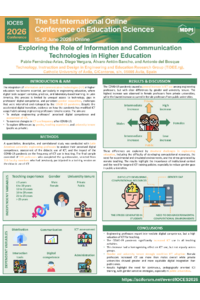
Introduction: Information and Communication Technologies (ICTs) have become essential components of teaching and learning processes in higher education. Their adoption has been accelerated by global digitalization trends, yet disparities remain in terms of institutional support, training, and user experience. This study examines how students and professors in Latin American universities perceive the impact of ICT on educational quality, learning, and professional development.
Methods: A cross-sectional survey was conducted with a sample of 1,050 participants, including both students and teachers from various countries in Latin America. The instrument, validated through expert review and reliability testing, comprised multiple dimensions such as usability, accessibility, pedagogical contribution, and professional relevance. Descriptive analyses were complemented with inferential tests (t-tests and ANOVA) to explore differences by gender, age, institutional ownership, and academic role.
Results: The findings revealed that both students and faculty value ICT as an essential facilitator of communication, information access, and academic innovation. Nevertheless, important differences emerged: professors in private universities expressed greater satisfaction with ICT integration, while those in public institutions reported more barriers related to infrastructure and training. Gender and age differences were also evident, with younger participants showing higher confidence in adopting ICT tools. Despite these challenges, both groups recognized ICT as indispensable for improving higher education outcomes.
Conclusions: ICT adoption in Latin American universities is perceived as a driver of quality and modernization, yet its potential is hindered by inequalities in institutional support and digital competence. Expanding training opportunities and reducing infrastructural gaps are crucial steps to promote inclusive and effective ICT integration across the region’s higher education systems.
Keywords
Information and Communication Technologies
Innovation
Higher education
Digital competence
Poster
2026. IOCES. ICT Higher Education.pdf
Designed for Understanding: Learning Progressions for Global Citizenship
Conceptual Reconstruction and Implementation Pathways of Educational Happiness from a Cross-Cultural Perspective: A Comparative Analysis of China and Latvia