Event submissions
Published
This submission belongs to the session S4. Special and Inclusive Education of the event The 1st International Online Conference on Education Sciences
Published date
10 Jun, 2026
Academic Editor
'%3e%3cpath%20d='M12.6657%2010.9104C12.4185%2010.325%2012.0599%209.79327%2011.6097%209.34482C11.1609%208.89508%2010.6293%208.5365%2010.0442%208.28888C10.0389%208.28626%2010.0337%208.28495%2010.0285%208.28233C10.8446%207.69279%2011.3752%206.73249%2011.3752%205.64904C11.3752%203.8542%209.92103%202.39999%208.1262%202.39999C6.33136%202.39999%204.87715%203.8542%204.87715%205.64904C4.87715%206.73249%205.40774%207.69279%206.22393%208.28364C6.21869%208.28626%206.21345%208.28757%206.20821%208.29019C5.62129%208.5378%205.09463%208.89284%204.64265%209.34613C4.1929%209.79493%203.83432%2010.3266%203.58671%2010.9117C3.34345%2011.4845%203.21226%2012.0987%203.20023%2012.7209C3.19988%2012.7349%203.20233%2012.7488%203.20744%2012.7619C3.21255%2012.7749%203.22022%2012.7867%203.22998%2012.7968C3.23975%2012.8068%203.25142%2012.8147%203.26431%2012.8202C3.2772%2012.8256%203.29105%2012.8284%203.30504%2012.8284H4.09109C4.14874%2012.8284%204.19459%2012.7825%204.1959%2012.7262C4.2221%2011.7148%204.62823%2010.7676%205.34617%2010.0497C6.08899%209.30683%207.0755%208.89808%208.1262%208.89808C9.17689%208.89808%2010.1634%209.30683%2010.9062%2010.0497C11.6242%2010.7676%2012.0303%2011.7148%2012.0565%2012.7262C12.0578%2012.7838%2012.1037%2012.8284%2012.1613%2012.8284H12.9474C12.9613%2012.8284%2012.9752%2012.8256%2012.9881%2012.8202C13.001%2012.8147%2013.0126%2012.8068%2013.0224%2012.7968C13.0322%2012.7867%2013.0398%2012.7749%2013.0449%2012.7619C13.0501%2012.7488%2013.0525%2012.7349%2013.0522%2012.7209C13.0391%2012.0947%2012.9094%2011.4855%2012.6657%2010.9104ZM8.1262%207.9024C7.52486%207.9024%206.9589%207.6679%206.53312%207.24211C6.10733%206.81633%205.87283%206.25037%205.87283%205.64904C5.87283%205.0477%206.10733%204.48174%206.53312%204.05596C6.9589%203.63018%207.52486%203.39567%208.1262%203.39567C8.72753%203.39567%209.29349%203.63018%209.71927%204.05596C10.1451%204.48174%2010.3796%205.0477%2010.3796%205.64904C10.3796%206.25037%2010.1451%206.81633%209.71927%207.24211C9.29349%207.6679%208.72753%207.9024%208.1262%207.9024Z'%20fill='%235D1EE1'/%3e%3c/g%3e%3c/svg%3e) Garry Hornby
Garry HornbyCitation
PURNA JANA, Kriti Ranjan Sahu, Teaching Multidimensional Poverty for Inclusive Classrooms: Evidence from Marginalized Regions of India, in Proceedings of The 1st International Online Conference on Education Sciences, 15 June–17 June 2026, MDPI: Basel, Switzerland
Share
Email
Facebook
Twitter
LinkedIn
Teaching Multidimensional Poverty for Inclusive Classrooms: Evidence from Marginalized Regions of India
'%3e%3cpath%20d='M12.6647%2010.9104C12.4176%2010.325%2012.0589%209.7933%2011.6088%209.34485C11.16%208.89511%2010.6283%208.53653%2010.0432%208.28891C10.038%208.28629%2010.0327%208.28498%2010.0275%208.28236C10.8437%207.69282%2011.3743%206.73252%2011.3743%205.64907C11.3743%203.85423%209.92005%202.40002%208.12522%202.40002C6.33038%202.40002%204.87618%203.85423%204.87618%205.64907C4.87618%206.73252%205.40677%207.69282%206.22296%208.28367C6.21772%208.28629%206.21248%208.2876%206.20724%208.29022C5.62031%208.53783%205.09365%208.89287%204.64167%209.34616C4.19192%209.79496%203.83334%2010.3266%203.58573%2010.9117C3.34247%2011.4846%203.21128%2012.0987%203.19925%2012.721C3.1989%2012.735%203.20135%2012.7489%203.20646%2012.7619C3.21157%2012.7749%203.21924%2012.7868%203.22901%2012.7968C3.23877%2012.8068%203.25045%2012.8148%203.26334%2012.8202C3.27623%2012.8256%203.29007%2012.8284%203.30406%2012.8284H4.09012C4.14776%2012.8284%204.19362%2012.7825%204.19493%2012.7262C4.22113%2011.7148%204.62726%2010.7676%205.34519%2010.0497C6.08802%209.30686%207.07452%208.89811%208.12522%208.89811C9.17592%208.89811%2010.1624%209.30686%2010.9052%2010.0497C11.6232%2010.7676%2012.0293%2011.7148%2012.0555%2012.7262C12.0568%2012.7839%2012.1027%2012.8284%2012.1603%2012.8284H12.9464C12.9604%2012.8284%2012.9742%2012.8256%2012.9871%2012.8202C13%2012.8148%2013.0117%2012.8068%2013.0214%2012.7968C13.0312%2012.7868%2013.0389%2012.7749%2013.044%2012.7619C13.0491%2012.7489%2013.0515%2012.735%2013.0512%2012.721C13.0381%2012.0947%2012.9084%2011.4856%2012.6647%2010.9104ZM8.12522%207.90243C7.52388%207.90243%206.95792%207.66793%206.53214%207.24215C6.10636%206.81636%205.87185%206.2504%205.87185%205.64907C5.87185%205.04773%206.10636%204.48177%206.53214%204.05599C6.95792%203.63021%207.52388%203.3957%208.12522%203.3957C8.72655%203.3957%209.29252%203.63021%209.7183%204.05599C10.1441%204.48177%2010.3786%205.04773%2010.3786%205.64907C10.3786%206.2504%2010.1441%206.81636%209.7183%207.24215C9.29252%207.66793%208.72655%207.90243%208.12522%207.90243Z'%20fill='%235D1EE1'/%3e%3c/g%3e%3c/svg%3e)
PURNA JANA 1
Kriti Ranjan Sahu 2
1. Department of Economics, Bhatter College, Dantan(Autonomous), Dantan, Paschim Medinipur, West Bengal, 721426, India, India
2. Department of Physics, Bhatter College, Dantan(Autonomous), Dantan, Paschim Medinipur, West Bengal, 721426, India, India
Abstract
Introduction:
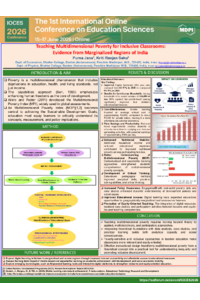
Multidimensional Poverty (MDP) extends beyond income to encompass deprivations in education, health, living standards, social inclusion, and empowerment. Despite its significance for equitable development, MDP remains inadequately addressed in higher and teacher education, particularly within inclusive classroom contexts [1]. This study focuses on marginalized districts of West Bengal, such as Jhargram (2023–2024), where over 60% of households in communities like the Sabar earn below ₹3,000 per month, reflecting persistent socio-economic and educational challenges. The study also examines digital inclusion, specifically government-supported smartphone access, as a tool to reduce educational barriers and enhance learning outcomes [2,3].
Methods:
A mixed-method approach was employed, combining secondary analysis of Higher Secondary (HS) examination results (2018–2025) with a primary survey of 500 households. The study assessed the impact of mobile-based learning, cost-effectiveness compared to private tuition, and time-use patterns. Various online platforms, including NDLI, SWAYAM, and NPTEL, were used, alongside experimental demonstrations and supporting materials shared through WhatsApp, Telegram, or direct guidance from class teachers. Curriculum mapping identified gaps in higher and teacher education, informing strategies using MPI-based data, localized case studies, participatory activities, and digital tools.
Results and Discussion:
Findings show a notable improvement in educational outcomes, with Higher Secondary (HS) pass rates projected to increase from 83.75% in 2018 to 90.79% in 2025. Among households earning ≤ ₹36,000 annually, 54% reported that mobile learning significantly benefited their children. Mobile access (~₹2,400/year) was more cost-effective than private tuition (~₹6,000/year) and reduced travel time, allowing students to devote more time to studying or income-generating activities (~₹350/day) and improving nutritional stability. Contextualized, experiential, and data-driven pedagogies enhanced understanding of MDP, critical thinking, and policy awareness, while digital tools improved access for geographically marginalized learners and fostered equity-oriented teaching competencies.
Conclusions:
Integrating MDP into experiential and digitally supported pedagogy enhances inclusive education in marginalized regions. Mobile-based learning improves academic outcomes, reduces costs, and optimizes time for study and income-generating activities. Contextualized, data-driven approaches strengthen critical thinking, policy awareness, and equity-oriented teaching competencies, while digital tools expand access and engagement for geographically and socio-economically disadvantaged learners.
References:
[1] United Nations Development Programme (2023). Human Development Report 2023/2024.
[2] Garzón, J., Burgos, D., & Tlili, A. (2025). Mobile learning and student achievement: A meta-analysis. Educational Technology Research and Development.
[3] Alam, G. M., & Forhad, M. A. R. (2023). Smartphone access and education disparity. Sustainability.
Keywords
Multidimensional Poverty
Inclusive Education
Teacher Education
Digital Inclusion
Experiential Learning
MPI.
Poster
Jana & Sahu_IOCES 2026.pdf
Task-Based Language Teaching and EFL Oral Skills: A Pre–Post Study at Djelfa University
Gamified mobile learning to strengthen malaria diagnostic competence: a case study from Sierra Leone