Event submissions
Published
This submission belongs to the session S4. Special and Inclusive Education of the event The 1st International Online Conference on Education Sciences
Published date
10 Jun, 2026
Academic Editor
'%3e%3cpath%20d='M12.6657%2010.9104C12.4185%2010.325%2012.0599%209.79327%2011.6097%209.34482C11.1609%208.89508%2010.6293%208.5365%2010.0442%208.28888C10.0389%208.28626%2010.0337%208.28495%2010.0285%208.28233C10.8446%207.69279%2011.3752%206.73249%2011.3752%205.64904C11.3752%203.8542%209.92103%202.39999%208.1262%202.39999C6.33136%202.39999%204.87715%203.8542%204.87715%205.64904C4.87715%206.73249%205.40774%207.69279%206.22393%208.28364C6.21869%208.28626%206.21345%208.28757%206.20821%208.29019C5.62129%208.5378%205.09463%208.89284%204.64265%209.34613C4.1929%209.79493%203.83432%2010.3266%203.58671%2010.9117C3.34345%2011.4845%203.21226%2012.0987%203.20023%2012.7209C3.19988%2012.7349%203.20233%2012.7488%203.20744%2012.7619C3.21255%2012.7749%203.22022%2012.7867%203.22998%2012.7968C3.23975%2012.8068%203.25142%2012.8147%203.26431%2012.8202C3.2772%2012.8256%203.29105%2012.8284%203.30504%2012.8284H4.09109C4.14874%2012.8284%204.19459%2012.7825%204.1959%2012.7262C4.2221%2011.7148%204.62823%2010.7676%205.34617%2010.0497C6.08899%209.30683%207.0755%208.89808%208.1262%208.89808C9.17689%208.89808%2010.1634%209.30683%2010.9062%2010.0497C11.6242%2010.7676%2012.0303%2011.7148%2012.0565%2012.7262C12.0578%2012.7838%2012.1037%2012.8284%2012.1613%2012.8284H12.9474C12.9613%2012.8284%2012.9752%2012.8256%2012.9881%2012.8202C13.001%2012.8147%2013.0126%2012.8068%2013.0224%2012.7968C13.0322%2012.7867%2013.0398%2012.7749%2013.0449%2012.7619C13.0501%2012.7488%2013.0525%2012.7349%2013.0522%2012.7209C13.0391%2012.0947%2012.9094%2011.4855%2012.6657%2010.9104ZM8.1262%207.9024C7.52486%207.9024%206.9589%207.6679%206.53312%207.24211C6.10733%206.81633%205.87283%206.25037%205.87283%205.64904C5.87283%205.0477%206.10733%204.48174%206.53312%204.05596C6.9589%203.63018%207.52486%203.39567%208.1262%203.39567C8.72753%203.39567%209.29349%203.63018%209.71927%204.05596C10.1451%204.48174%2010.3796%205.0477%2010.3796%205.64904C10.3796%206.25037%2010.1451%206.81633%209.71927%207.24211C9.29349%207.6679%208.72753%207.9024%208.1262%207.9024Z'%20fill='%235D1EE1'/%3e%3c/g%3e%3c/svg%3e) Garry Hornby
Garry HornbyCitation
José Manuel Pulido, ArInLi Erasmus+ Project: Open, Accessibility‑First AI Literacy for Inclusive Secondary Education, in Proceedings of The 1st International Online Conference on Education Sciences, 15 June–17 June 2026, MDPI: Basel, Switzerland
Share
Email
Facebook
Twitter
LinkedIn
ArInLi Erasmus+ Project: Open, Accessibility‑First AI Literacy for Inclusive Secondary Education
'%3e%3cpath%20d='M12.6647%2010.9104C12.4176%2010.325%2012.0589%209.7933%2011.6088%209.34485C11.16%208.89511%2010.6283%208.53653%2010.0432%208.28891C10.038%208.28629%2010.0327%208.28498%2010.0275%208.28236C10.8437%207.69282%2011.3743%206.73252%2011.3743%205.64907C11.3743%203.85423%209.92005%202.40002%208.12522%202.40002C6.33038%202.40002%204.87618%203.85423%204.87618%205.64907C4.87618%206.73252%205.40677%207.69282%206.22296%208.28367C6.21772%208.28629%206.21248%208.2876%206.20724%208.29022C5.62031%208.53783%205.09365%208.89287%204.64167%209.34616C4.19192%209.79496%203.83334%2010.3266%203.58573%2010.9117C3.34247%2011.4846%203.21128%2012.0987%203.19925%2012.721C3.1989%2012.735%203.20135%2012.7489%203.20646%2012.7619C3.21157%2012.7749%203.21924%2012.7868%203.22901%2012.7968C3.23877%2012.8068%203.25045%2012.8148%203.26334%2012.8202C3.27623%2012.8256%203.29007%2012.8284%203.30406%2012.8284H4.09012C4.14776%2012.8284%204.19362%2012.7825%204.19493%2012.7262C4.22113%2011.7148%204.62726%2010.7676%205.34519%2010.0497C6.08802%209.30686%207.07452%208.89811%208.12522%208.89811C9.17592%208.89811%2010.1624%209.30686%2010.9052%2010.0497C11.6232%2010.7676%2012.0293%2011.7148%2012.0555%2012.7262C12.0568%2012.7839%2012.1027%2012.8284%2012.1603%2012.8284H12.9464C12.9604%2012.8284%2012.9742%2012.8256%2012.9871%2012.8202C13%2012.8148%2013.0117%2012.8068%2013.0214%2012.7968C13.0312%2012.7868%2013.0389%2012.7749%2013.044%2012.7619C13.0491%2012.7489%2013.0515%2012.735%2013.0512%2012.721C13.0381%2012.0947%2012.9084%2011.4856%2012.6647%2010.9104ZM8.12522%207.90243C7.52388%207.90243%206.95792%207.66793%206.53214%207.24215C6.10636%206.81636%205.87185%206.2504%205.87185%205.64907C5.87185%205.04773%206.10636%204.48177%206.53214%204.05599C6.95792%203.63021%207.52388%203.3957%208.12522%203.3957C8.72655%203.3957%209.29252%203.63021%209.7183%204.05599C10.1441%204.48177%2010.3786%205.04773%2010.3786%205.64907C10.3786%206.2504%2010.1441%206.81636%209.7183%207.24215C9.29252%207.66793%208.72655%207.90243%208.12522%207.90243Z'%20fill='%235D1EE1'/%3e%3c/g%3e%3c/svg%3e)
José Manuel Pulido 1
1. Faculty of Humanities and Social Sciences, Universidad Isabel I de Castilla, Burgos, 09003, Spain., Spain
Abstract
Introduction:
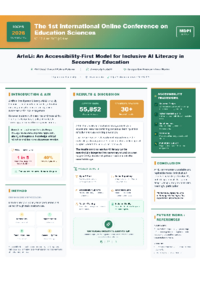
Artificial Intelligence Literacy (AI‑L) has rapidly become an emerging educational priority in secondary schooling, demanding conceptual understanding, ethical awareness, and accessible pedagogical guidance. However, students with disabilities and those at risk of digital exclusion face disproportionate barriers in engaging meaningfully with AI‑enhanced learning environments. ArInLi, an Erasmus+ KA210 collaboration among four European schools from Spain, Türkiye, Italy and Germany, addresses these challenges by developing two open outputs: a public website and a freely available e‑book designed to integrate foundational knowledge of AI with ethically grounded, classroom‑ready resources through an accessibility‑first approach.
Methods.
Using a design‑based, practice‑oriented methodology, ArInLi iteratively develops and curates instructional sequences and teacher guidance. The e‑book offers structured chapters on core concepts (AI, Machine Learning, Deep Learning), AI in education and data ethics, followed by catalogues of AI tools for teaching and learning. The website disseminates these materials and incorporates a four‑session “AI Copilot” classroom guide, alongside curated accessibility‑focused toolsets (e.g., screen readers, text‑to‑speech, captioning, simplified text) with practical recommendations for students with disabilities and learners experiencing digital vulnerability.
Results.
Project outputs include: an openly licensed e‑book consolidating conceptual, ethical, and pedagogical elements; a dynamic online repository with tutorials and teacher‑ready sequences; and curated accessibility supports that normalize the use of assistive technologies in everyday learning. As of 14 January 2026, the website has accumulated 55,852 visits from 30 countries, reflecting substantial international interest and supporting early adoption across partner contexts.
Conclusions.
ArInLi demonstrates a replicable and scalable model for inclusive AI‑L in secondary education by coupling conceptual depth and ethics with accessible, classroom‑ready resources. The framework lowers participation barriers for learners with disabilities and those at risk of digital exclusion. Future iterations will expand language coverage, refine teacher guidance and extend dissemination across wider educational networks.
Keywords
Artificial Intelligence Literacy
Inclusive Education
Digital Accessibility
Assistive Technologies
Digital Vulnerability
Poster
Poster PhD. Jose Manuel Pulido .pdf
Learning Scenarios as Boundary Objects: A Multi-Country Study on Integrating Data Science, STEAM, and Social Justice in Teacher Education
Enhancing Creative Thinking through Coding: Evidence from an Experimental Study in Primary and Secondary Education