Event submissions
Published
This submission belongs to the session S4. Special and Inclusive Education of the event The 1st International Online Conference on Education Sciences
Published date
10 Jun, 2026
Academic Editor
'%3e%3cpath%20d='M12.6657%2010.9104C12.4185%2010.325%2012.0599%209.79327%2011.6097%209.34482C11.1609%208.89508%2010.6293%208.5365%2010.0442%208.28888C10.0389%208.28626%2010.0337%208.28495%2010.0285%208.28233C10.8446%207.69279%2011.3752%206.73249%2011.3752%205.64904C11.3752%203.8542%209.92103%202.39999%208.1262%202.39999C6.33136%202.39999%204.87715%203.8542%204.87715%205.64904C4.87715%206.73249%205.40774%207.69279%206.22393%208.28364C6.21869%208.28626%206.21345%208.28757%206.20821%208.29019C5.62129%208.5378%205.09463%208.89284%204.64265%209.34613C4.1929%209.79493%203.83432%2010.3266%203.58671%2010.9117C3.34345%2011.4845%203.21226%2012.0987%203.20023%2012.7209C3.19988%2012.7349%203.20233%2012.7488%203.20744%2012.7619C3.21255%2012.7749%203.22022%2012.7867%203.22998%2012.7968C3.23975%2012.8068%203.25142%2012.8147%203.26431%2012.8202C3.2772%2012.8256%203.29105%2012.8284%203.30504%2012.8284H4.09109C4.14874%2012.8284%204.19459%2012.7825%204.1959%2012.7262C4.2221%2011.7148%204.62823%2010.7676%205.34617%2010.0497C6.08899%209.30683%207.0755%208.89808%208.1262%208.89808C9.17689%208.89808%2010.1634%209.30683%2010.9062%2010.0497C11.6242%2010.7676%2012.0303%2011.7148%2012.0565%2012.7262C12.0578%2012.7838%2012.1037%2012.8284%2012.1613%2012.8284H12.9474C12.9613%2012.8284%2012.9752%2012.8256%2012.9881%2012.8202C13.001%2012.8147%2013.0126%2012.8068%2013.0224%2012.7968C13.0322%2012.7867%2013.0398%2012.7749%2013.0449%2012.7619C13.0501%2012.7488%2013.0525%2012.7349%2013.0522%2012.7209C13.0391%2012.0947%2012.9094%2011.4855%2012.6657%2010.9104ZM8.1262%207.9024C7.52486%207.9024%206.9589%207.6679%206.53312%207.24211C6.10733%206.81633%205.87283%206.25037%205.87283%205.64904C5.87283%205.0477%206.10733%204.48174%206.53312%204.05596C6.9589%203.63018%207.52486%203.39567%208.1262%203.39567C8.72753%203.39567%209.29349%203.63018%209.71927%204.05596C10.1451%204.48174%2010.3796%205.0477%2010.3796%205.64904C10.3796%206.25037%2010.1451%206.81633%209.71927%207.24211C9.29349%207.6679%208.72753%207.9024%208.1262%207.9024Z'%20fill='%235D1EE1'/%3e%3c/g%3e%3c/svg%3e) Garry Hornby
Garry HornbyCitation
Meriem El Boukhrissi, Hind Brigui, Applying Universal Design for Learning in Reading Comprehension Instruction: Practical Insights for EFL Teachers, in Proceedings of The 1st International Online Conference on Education Sciences, 15 June–17 June 2026, MDPI: Basel, Switzerland
Share
Email
Facebook
Twitter
LinkedIn
Applying Universal Design for Learning in Reading Comprehension Instruction: Practical Insights for EFL Teachers
'%3e%3cpath%20d='M12.6647%2010.9104C12.4176%2010.325%2012.0589%209.7933%2011.6088%209.34485C11.16%208.89511%2010.6283%208.53653%2010.0432%208.28891C10.038%208.28629%2010.0327%208.28498%2010.0275%208.28236C10.8437%207.69282%2011.3743%206.73252%2011.3743%205.64907C11.3743%203.85423%209.92005%202.40002%208.12522%202.40002C6.33038%202.40002%204.87618%203.85423%204.87618%205.64907C4.87618%206.73252%205.40677%207.69282%206.22296%208.28367C6.21772%208.28629%206.21248%208.2876%206.20724%208.29022C5.62031%208.53783%205.09365%208.89287%204.64167%209.34616C4.19192%209.79496%203.83334%2010.3266%203.58573%2010.9117C3.34247%2011.4846%203.21128%2012.0987%203.19925%2012.721C3.1989%2012.735%203.20135%2012.7489%203.20646%2012.7619C3.21157%2012.7749%203.21924%2012.7868%203.22901%2012.7968C3.23877%2012.8068%203.25045%2012.8148%203.26334%2012.8202C3.27623%2012.8256%203.29007%2012.8284%203.30406%2012.8284H4.09012C4.14776%2012.8284%204.19362%2012.7825%204.19493%2012.7262C4.22113%2011.7148%204.62726%2010.7676%205.34519%2010.0497C6.08802%209.30686%207.07452%208.89811%208.12522%208.89811C9.17592%208.89811%2010.1624%209.30686%2010.9052%2010.0497C11.6232%2010.7676%2012.0293%2011.7148%2012.0555%2012.7262C12.0568%2012.7839%2012.1027%2012.8284%2012.1603%2012.8284H12.9464C12.9604%2012.8284%2012.9742%2012.8256%2012.9871%2012.8202C13%2012.8148%2013.0117%2012.8068%2013.0214%2012.7968C13.0312%2012.7868%2013.0389%2012.7749%2013.044%2012.7619C13.0491%2012.7489%2013.0515%2012.735%2013.0512%2012.721C13.0381%2012.0947%2012.9084%2011.4856%2012.6647%2010.9104ZM8.12522%207.90243C7.52388%207.90243%206.95792%207.66793%206.53214%207.24215C6.10636%206.81636%205.87185%206.2504%205.87185%205.64907C5.87185%205.04773%206.10636%204.48177%206.53214%204.05599C6.95792%203.63021%207.52388%203.3957%208.12522%203.3957C8.72655%203.3957%209.29252%203.63021%209.7183%204.05599C10.1441%204.48177%2010.3786%205.04773%2010.3786%205.64907C10.3786%206.2504%2010.1441%206.81636%209.7183%207.24215C9.29252%207.66793%208.72655%207.90243%208.12522%207.90243Z'%20fill='%235D1EE1'/%3e%3c/g%3e%3c/svg%3e)
Meriem El Boukhrissi 1
Hind Brigui 1
1. Faculty of Languages, Letters and Arts, Ibn Tofail University Kenitra, Morocco, Morocco
Abstract
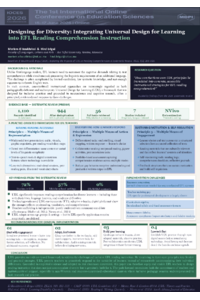
Reading comprehension remains one of the most complex areas of language use (Snow, 2021) in English as a Foreign Language (EFL) classrooms, especially in contexts characterized by distinct learner profiles and varying levels of linguistic proficiency. Universal Design for Learning (UDL), an inclusive educational framework rooted in cognitive neuroscience, presents a promising approach to confronting these challenges by promoting flexibility in teaching and assessment, and presents evidence-based interventions to address the needs of struggling learners. This paper aims to impart EFL teachers with practical strategies that can aid them in integrating UDL principles into reading comprehension instruction. Drawing on existing research and practical classroom insights, this paper reports on a systematic review of the literature that examined the effectiveness of integrating UDL principles in reading comprehension instruction. The review, guided by the research question “How does the application of UDL principles enhance reading comprehension outcomes for diverse EFL learners?”, examined studies conducted between 2013 and 2023 following PRISMA guidelines. This paper underlines how the three core UDL principles—multiple means of representation, multiple means of action and expression, and multiple means of engagement—can be utilized to make reading instruction more attainable, engaging, and inclusive. Practical examples encompass the use of multimodal texts, differentiated comprehension activities, collaborative reading tasks, and technology-enhanced scaffolds to support distinct learners. The paper also discusses common difficulties that teachers may face, such as scarce resources and training needs, and presents recommendations for gradual implementation in resource-restrained contexts. Drawing on these findings, the paper presents evidence-informed strategies for teachers seeking to design inclusive reading lessons. By linking research findings to practical classroom applications, this study contributes to the growing body of evidence supporting UDL as a research-grounded approach to inclusive EFL instruction.
Keywords
Universal Design for Learning
reading comprehension
EFL
inclusive pedagogy
teacher practice
literature review.
Poster
UDLEFLConferencePoster.pdf
Integrating Research and Pedagogy: A Case Study on the Impact of Project-Based Learning on Student Publication Success in Agricultural Engineering
EFFECTS OF GUIDED DISCOVERY APPROACH ON SENIOR SECONDARY TWO STUDENTS’ PERFORMANCE IN VOLUMETRIC ANALYSIS IN GOMBE, GOMBE STATE