Event submissions
Published
This submission belongs to the session S6. Teacher Education of the event The 1st International Online Conference on Education Sciences
Published date
10 Jun, 2026
Academic Editor
'%3e%3cpath%20d='M12.6657%2010.9104C12.4185%2010.325%2012.0599%209.79327%2011.6097%209.34482C11.1609%208.89508%2010.6293%208.5365%2010.0442%208.28888C10.0389%208.28626%2010.0337%208.28495%2010.0285%208.28233C10.8446%207.69279%2011.3752%206.73249%2011.3752%205.64904C11.3752%203.8542%209.92103%202.39999%208.1262%202.39999C6.33136%202.39999%204.87715%203.8542%204.87715%205.64904C4.87715%206.73249%205.40774%207.69279%206.22393%208.28364C6.21869%208.28626%206.21345%208.28757%206.20821%208.29019C5.62129%208.5378%205.09463%208.89284%204.64265%209.34613C4.1929%209.79493%203.83432%2010.3266%203.58671%2010.9117C3.34345%2011.4845%203.21226%2012.0987%203.20023%2012.7209C3.19988%2012.7349%203.20233%2012.7488%203.20744%2012.7619C3.21255%2012.7749%203.22022%2012.7867%203.22998%2012.7968C3.23975%2012.8068%203.25142%2012.8147%203.26431%2012.8202C3.2772%2012.8256%203.29105%2012.8284%203.30504%2012.8284H4.09109C4.14874%2012.8284%204.19459%2012.7825%204.1959%2012.7262C4.2221%2011.7148%204.62823%2010.7676%205.34617%2010.0497C6.08899%209.30683%207.0755%208.89808%208.1262%208.89808C9.17689%208.89808%2010.1634%209.30683%2010.9062%2010.0497C11.6242%2010.7676%2012.0303%2011.7148%2012.0565%2012.7262C12.0578%2012.7838%2012.1037%2012.8284%2012.1613%2012.8284H12.9474C12.9613%2012.8284%2012.9752%2012.8256%2012.9881%2012.8202C13.001%2012.8147%2013.0126%2012.8068%2013.0224%2012.7968C13.0322%2012.7867%2013.0398%2012.7749%2013.0449%2012.7619C13.0501%2012.7488%2013.0525%2012.7349%2013.0522%2012.7209C13.0391%2012.0947%2012.9094%2011.4855%2012.6657%2010.9104ZM8.1262%207.9024C7.52486%207.9024%206.9589%207.6679%206.53312%207.24211C6.10733%206.81633%205.87283%206.25037%205.87283%205.64904C5.87283%205.0477%206.10733%204.48174%206.53312%204.05596C6.9589%203.63018%207.52486%203.39567%208.1262%203.39567C8.72753%203.39567%209.29349%203.63018%209.71927%204.05596C10.1451%204.48174%2010.3796%205.0477%2010.3796%205.64904C10.3796%206.25037%2010.1451%206.81633%209.71927%207.24211C9.29349%207.6679%208.72753%207.9024%208.1262%207.9024Z'%20fill='%235D1EE1'/%3e%3c/g%3e%3c/svg%3e) Federico Corni
Federico CorniCitation
Papiya Upadhyay, Fostering Holistic Education through Experiential Learning: A Phenomenological Study, in Proceedings of The 1st International Online Conference on Education Sciences, 15 June–17 June 2026, MDPI: Basel, Switzerland
Share
Email
Facebook
Twitter
LinkedIn
Fostering Holistic Education through Experiential Learning: A Phenomenological Study

Papiya Upadhyay 1
1. School of Education (SoE)
Netaji Subhas Open University (NSOU)
1st floor, K2, Bidhannagar Fire Station, Sector-V, Salt Lake City, Kolkata - 700 091, West Bengal, India, India
Abstract
Experiential learning can usher in a powerful blend of techniques that can transform the way we learn holistically. Experiential learning makes learning more engaging and relevant with projects, simulations, community-based activities, virtual trips, online teaching–learning activities, etc., coupled with access to information and tools. This qualitative study unlocks the potential of experiential learning towards enhancing holistic education by exploring how students and teachers perceive, interpret, and experience holistic education in their unique ways. Drawing upon the theories of transformative learning and skills acquisition, the research explores the perceptions, lived experiences, and interpretations of teachers (sample size, 25) and undergraduate students (sample size, 100) of the social science discipline (comprising subjects like Sociology, Political Science, and Education). The study context includes five randomly selected Higher Educational Institutions (HEIs) of Kolkata, the capital city of the state of West Bengal in India, that practice and advocate for experience-based learning approaches. Data collection methods include in-depth interviews, focus group discussions, and document analysis of student work samples. The study follows ethical considerations from its planning to execution through informed consents and voluntary participation of the teachers and students. Data analysis includes transcription of interviews and focus group discussions verbatim, and coding by identifying themes and patterns using coding techniques. Interpretation involves careful analysis of the interview transcripts to identify key themes, patterns, and structures in the participants' descriptions of their experiences. The analysis of the coded data (qualitative) encourages one to develop insights and draw conclusions, thereby realizing and understanding how experiential learning contributes to the development of cognitive, social–emotional, and personal–ethical dimensions of holistic education. The present study intends to inform educators and institutional leaders about the potential of experiential learning to foster critical thinking skills, problem solving skills, analytical skills, decision-making skills, team building, and collaborative skills to thrive in a dynamic society.
Keywords
Holistic education
experiential learning
undergraduate students
teachers
21st century skills
Poster
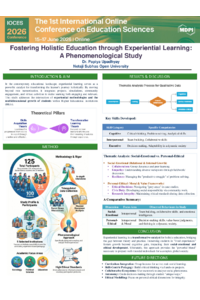
Poster_Dr. Papiya Upadhyay_IOCES 2026.pdf
Transforming Initial Wonder into Structured Understanding: Experiential Science Demonstrations to Foster STEM Pathways
Piagetian Learning Centres and Foundational Numeracy Development in Grade Two Classrooms in the UAE