Event submissions
Published
This submission belongs to the session S6. Teacher Education of the event The 1st International Online Conference on Education Sciences
Published date
10 Jun, 2026
Academic Editor
'%3e%3cpath%20d='M12.6657%2010.9104C12.4185%2010.325%2012.0599%209.79327%2011.6097%209.34482C11.1609%208.89508%2010.6293%208.5365%2010.0442%208.28888C10.0389%208.28626%2010.0337%208.28495%2010.0285%208.28233C10.8446%207.69279%2011.3752%206.73249%2011.3752%205.64904C11.3752%203.8542%209.92103%202.39999%208.1262%202.39999C6.33136%202.39999%204.87715%203.8542%204.87715%205.64904C4.87715%206.73249%205.40774%207.69279%206.22393%208.28364C6.21869%208.28626%206.21345%208.28757%206.20821%208.29019C5.62129%208.5378%205.09463%208.89284%204.64265%209.34613C4.1929%209.79493%203.83432%2010.3266%203.58671%2010.9117C3.34345%2011.4845%203.21226%2012.0987%203.20023%2012.7209C3.19988%2012.7349%203.20233%2012.7488%203.20744%2012.7619C3.21255%2012.7749%203.22022%2012.7867%203.22998%2012.7968C3.23975%2012.8068%203.25142%2012.8147%203.26431%2012.8202C3.2772%2012.8256%203.29105%2012.8284%203.30504%2012.8284H4.09109C4.14874%2012.8284%204.19459%2012.7825%204.1959%2012.7262C4.2221%2011.7148%204.62823%2010.7676%205.34617%2010.0497C6.08899%209.30683%207.0755%208.89808%208.1262%208.89808C9.17689%208.89808%2010.1634%209.30683%2010.9062%2010.0497C11.6242%2010.7676%2012.0303%2011.7148%2012.0565%2012.7262C12.0578%2012.7838%2012.1037%2012.8284%2012.1613%2012.8284H12.9474C12.9613%2012.8284%2012.9752%2012.8256%2012.9881%2012.8202C13.001%2012.8147%2013.0126%2012.8068%2013.0224%2012.7968C13.0322%2012.7867%2013.0398%2012.7749%2013.0449%2012.7619C13.0501%2012.7488%2013.0525%2012.7349%2013.0522%2012.7209C13.0391%2012.0947%2012.9094%2011.4855%2012.6657%2010.9104ZM8.1262%207.9024C7.52486%207.9024%206.9589%207.6679%206.53312%207.24211C6.10733%206.81633%205.87283%206.25037%205.87283%205.64904C5.87283%205.0477%206.10733%204.48174%206.53312%204.05596C6.9589%203.63018%207.52486%203.39567%208.1262%203.39567C8.72753%203.39567%209.29349%203.63018%209.71927%204.05596C10.1451%204.48174%2010.3796%205.0477%2010.3796%205.64904C10.3796%206.25037%2010.1451%206.81633%209.71927%207.24211C9.29349%207.6679%208.72753%207.9024%208.1262%207.9024Z'%20fill='%235D1EE1'/%3e%3c/g%3e%3c/svg%3e) Daniel Muijs
Daniel MuijsCitation
Víctor Hernández-Beltrán, José M. Gamonales, Mário C. Espada, INFLUENCE OF THE COACH'S SELF-DEFINED PROFILE AND MODE OF ACTION IN SCHOOL-AGE FOOTBALL TRAINING, in Proceedings of The 1st International Online Conference on Education Sciences, 15 June–17 June 2026, MDPI: Basel, Switzerland
Share
Email
Facebook
Twitter
LinkedIn
INFLUENCE OF THE COACH'S SELF-DEFINED PROFILE AND MODE OF ACTION IN SCHOOL-AGE FOOTBALL TRAINING
'%3e%3cpath%20d='M12.6647%2010.9104C12.4176%2010.325%2012.0589%209.7933%2011.6088%209.34485C11.16%208.89511%2010.6283%208.53653%2010.0432%208.28891C10.038%208.28629%2010.0327%208.28498%2010.0275%208.28236C10.8437%207.69282%2011.3743%206.73252%2011.3743%205.64907C11.3743%203.85423%209.92005%202.40002%208.12522%202.40002C6.33038%202.40002%204.87618%203.85423%204.87618%205.64907C4.87618%206.73252%205.40677%207.69282%206.22296%208.28367C6.21772%208.28629%206.21248%208.2876%206.20724%208.29022C5.62031%208.53783%205.09365%208.89287%204.64167%209.34616C4.19192%209.79496%203.83334%2010.3266%203.58573%2010.9117C3.34247%2011.4846%203.21128%2012.0987%203.19925%2012.721C3.1989%2012.735%203.20135%2012.7489%203.20646%2012.7619C3.21157%2012.7749%203.21924%2012.7868%203.22901%2012.7968C3.23877%2012.8068%203.25045%2012.8148%203.26334%2012.8202C3.27623%2012.8256%203.29007%2012.8284%203.30406%2012.8284H4.09012C4.14776%2012.8284%204.19362%2012.7825%204.19493%2012.7262C4.22113%2011.7148%204.62726%2010.7676%205.34519%2010.0497C6.08802%209.30686%207.07452%208.89811%208.12522%208.89811C9.17592%208.89811%2010.1624%209.30686%2010.9052%2010.0497C11.6232%2010.7676%2012.0293%2011.7148%2012.0555%2012.7262C12.0568%2012.7839%2012.1027%2012.8284%2012.1603%2012.8284H12.9464C12.9604%2012.8284%2012.9742%2012.8256%2012.9871%2012.8202C13%2012.8148%2013.0117%2012.8068%2013.0214%2012.7968C13.0312%2012.7868%2013.0389%2012.7749%2013.044%2012.7619C13.0491%2012.7489%2013.0515%2012.735%2013.0512%2012.721C13.0381%2012.0947%2012.9084%2011.4856%2012.6647%2010.9104ZM8.12522%207.90243C7.52388%207.90243%206.95792%207.66793%206.53214%207.24215C6.10636%206.81636%205.87185%206.2504%205.87185%205.64907C5.87185%205.04773%206.10636%204.48177%206.53214%204.05599C6.95792%203.63021%207.52388%203.3957%208.12522%203.3957C8.72655%203.3957%209.29252%203.63021%209.7183%204.05599C10.1441%204.48177%2010.3786%205.04773%2010.3786%205.64907C10.3786%206.2504%2010.1441%206.81636%209.7183%207.24215C9.29252%207.66793%208.72655%207.90243%208.12522%207.90243Z'%20fill='%235D1EE1'/%3e%3c/g%3e%3c/svg%3e)
Víctor Hernández-Beltrán 1

José M. Gamonales 1

Mário C. Espada 2,3
1. University of Extremadura, Badajoz, 06006, Spain, Spain
2. Escola Superior de Educação, Instituto Politécnico de Setúbal, Setúbal, 2914-504, Portugal, Portugal
3. SPRINT Sport Physical Activity and Health Research & Innovation Center, Instituto Politécnico de Setúbal, Setúbal, 2914-504, Portugal
Abstract
School-age football represents a key tool for the comprehensive development of young people, as it combines physical, technical, tactical, and psychosocial aspects. However, various studies show that coaches tend to use traditional methodologies that limit meaningful, contextualised, and player-centred learning. In this regard, it is emphasized that realistic tasks should be designed, with opposition and a playful approach, to foster decision-making, group cohesion, and participant motivation. Likewise, it is important to delve deeper into research that analyzes coaches from different categories within the same sports club, in order to better understand the methodological and pedagogical coherence of the training process. Therefore, this study aimed to analyze the self-defined profile and mode of action of four school-age football coaches from the same sports club. A quantitative and descriptive approach was adopted to determine the coaches’ self-defined profile, (i) Coach Orientation Questionnaire; (ii) Coach Knowledge and Skills Questionnaire; (iii) Coach Decision Questionnaire; and (iv) Coach Planning Style Questionnaire, and the Integral System for Training Task Analysis (SIATE, acronym in Spanish) to analyze 169 tasks. For this purpose, descriptive statistical analyses and studies of associations between the examined variables were performed. The results indicate that the coaches mainly identify with traditional and technological profiles, display predominantly democratic leadership styles, and use flexible planning. Likewise, the tasks designed are mainly based on real game situations, with numerical equality, high player participation, and an integration of technical–tactical components. In conclusion, it is recommended to reinforce ongoing coach training, promoting a balance among practical experience, academic foundation, and pedagogical leadership to optimise the comprehensive development of school-age football.
Keywords
COACH'S SELF-DEFINED PROFILE/FOOTBALL/SIATE
Poster
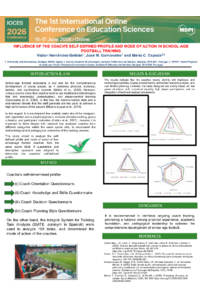
Poster_INFLUENCE OF THE COACH'S SELF-DEFINED PROFILE AND MODE OF ACTION IN SCHOOL-AGE FOOTBALL TRAINING.pdf
Synthetic Cognition for STEM Education: A Novel Framework for Simulating STEM Learners and Discovering Misconceptions
Sociological Factors Explaining Math Anxiety in Spanish Primary School Students